Thank you for visiting SNEWPapers!
Sign up free
The Semi Weekly Messenger
Wilmington, New Hanover County, North Carolina
What is this article about?
Senator Rayner of Maryland speaks at the Democratic Club's Jefferson Day dinner in New York on April 13, defending Democratic principles against accusations of party coalescence and states' rights extremism, opposing government ownership of railroads while advocating obedience to existing laws.
Clipping
OCR Quality
Full Text
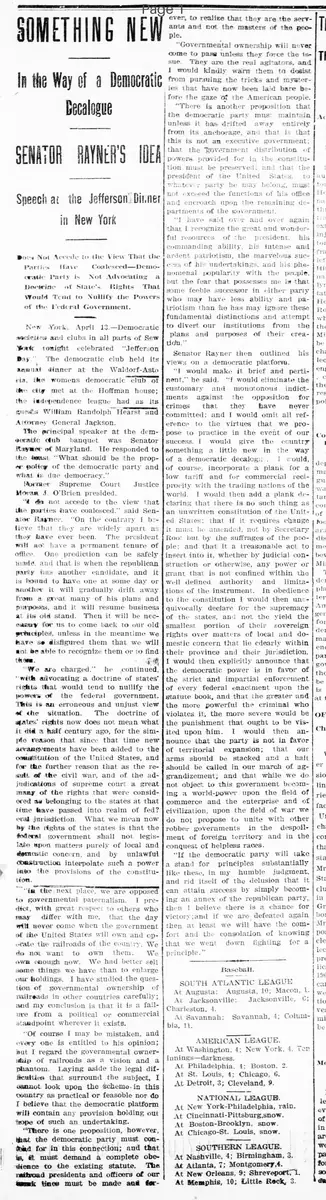
In the Way of a Democratic
Decalogue
SENATOR RAYNER'S
Speech at the Jefferson Dinner
in New York
I Do Not Accede to the View That the
Parties Have
Coalesced—Democratic
Party is
Not Advocating a
Doctrine of State's
Rights
That
Would Tend to Nullify the Powers
of the Federal Government.
New York, April 13.—Democratic
societies and clubs in all parts of New
York tonight celebrated "Jefferson
Day." The democratic club held its
annual dinner at the Waldorf-Astoria,
the women's democratic club of
the city met at the Hoffman house;
the independence league had as its
guests William Randolph Hearst and
Attorney General Jackson.
The principal speaker at the democratic club banquet was Senator
Rayner of Maryland. He responded to
the toast "What should be the proper
policy of the democratic party and
what is due democracy."
Former Supreme Court Justice
Moran J. O'Brien presided.
"I do not accede to the view that
the parties have coalesced," said Senator
Rayner. "On the contrary I believe that they are widely apart as
they have ever been. The president
will not have a permanent tenure of
office. One prediction can be safely
made, and that is when the republican
party has another candidate, and it
is bound to have one at some day or
another it will gradually drift away
from a great many of his plans and
purposes, and it will resume business
at its old stand. Then it will be necessary for us to come back to our old
principles, unless in the meantime we
have so disfigured them that we will
not be able to recognize them or to find
them.
"We are charged," he continued
"with advocating a doctrine of states'
rights that would tend to nullify the
powers of the federal government.
This is an erroneous and unjust view
of the situation. The doctrine of
states' rights now does not mean what
it did a half century ago, for the simple reason that since that time new
amendments have been added to the
constitution of the United States, and
for the further reason that as the result of the civil war, and of the adjudications of supreme court a great
many of the rights that were considered as belonging to the states at that
time have passed into realm of federal
jurisdiction. What we mean now
by the rights of the states is that the federal government shall not legislate upon matters purely of local and
domestic concern, and by unlawful
construction interpolate such a power
into the provisions of the constitution.
"In the next place, we are opposed
to governmental paternalism. I predict, with great respect to others who
may
differ with me, that the day
will never come when the government
of the United States will own and operate the railroads of the country. We
do not want to own them. We
own enough now. We had better sell
some things we have than to enlarge
our holdings. I have studied the question of governmental ownership of
railroads in other countries carefully;
and my conclusion is that it is a failure from a political or commercial
standpoint wherever it exists.
"Of course I may be mistaken, and
every one is entitled to his opinion;
but I regard the governmental ownership of railroads as a vision and a
phantom. Leaving aside the legal difficulties that surround the subject, I
cannot look upon the scheme in this
country as practical or feasible nor do
I believe that the democratic platform
will contain any provision holding out
hope of such an undertaking.
"There is one proposition, however,
that the democratic party must contend for in this connection; and that
is, it must demand a complete obedience to the existing statute. The
railroad presidents and officers of our
bank lines must be made and forced
What sub-type of article is it?
What themes does it cover?
What keywords are associated?
What entities or persons were involved?
Where did it happen?
Story Details
Key Persons
Location
New York
Event Date
April 13
Story Details
At the Jefferson Day dinner, Senator Rayner defends Democratic policies, rejecting party coalescence claims, clarifying modern states' rights doctrine post-Civil War and amendments, opposing federal ownership of railroads as impractical, and insisting on enforcement of existing laws against railroad and bank officers.