Thank you for visiting SNEWPapers!
Sign up free
Alexandria Daily Gazette, Commercial & Political
Alexandria, Virginia
What is this article about?
In the U.S. Senate on November 30, Mr. Pickering continues his speech opposing the embargo, highlighting New England's historical resistance, past U.S. successes under Washington against British and French aggressions, and criticizing the current administration's ineffective negotiations and the unexplained imposition of the embargo that halted prosperous commerce.
Clipping
OCR Quality
Full Text
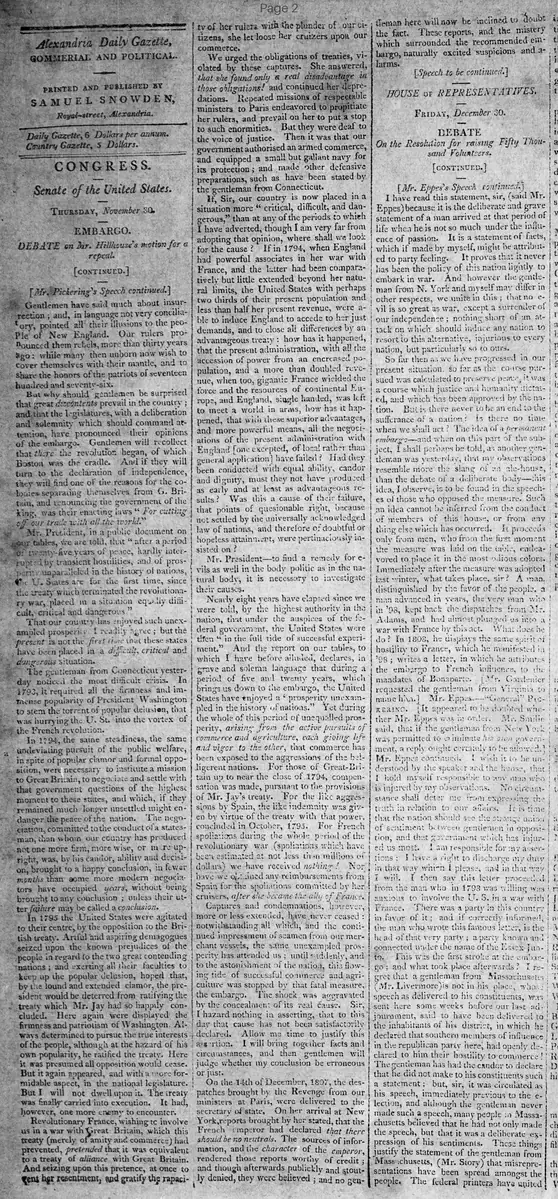
Senate of the United States.
Thursday, November 30
EMBARGO.
DEBATE on Mr. Hillhouse's motion for a repeal.
[CONTINUED.]
Mr. Pickering's Speech continued.
Gentlemen have said much about insurrection; and, in language not very conciliatory, pointed all their allusions to the people of New England. Our rulers pronounced them rebels, more than thirty years ago: while many then unborn now wish to cover themselves with their mantle, and to share the honors of the patriots of seventeen hundred and seventy-six.
But why should gentlemen be surprised that great discontents prevail in the country; and that the legislatures, with a deliberation and solemnity which should command attention, have pronounced their opinions of the embargo. Gentlemen will recollect that there the revolution began, of which Boston was the cradle. And if they will turn to the declaration of independence, they will find one of the reasons for the colonies separating themselves from G. Britain, and renouncing the government of the king, was their enacting laws "For cutting off our trade with all the world?"
Mr. President, in a public document on our tables, we are told, that "after a period of twenty-five years of peace, hardly interrupted by transient hostilities, and of prosperity unparalleled in the history of nations, the U. States are for the first time, since the treaty which terminated the revolutionary war, placed in a situation equally difficult, critical and dangerous."
That our country has enjoyed such unexampled prosperity, I readily agree; but the present is not the first time that these states have been placed in a difficult, critical and dangerous situation.
The gentleman from Connecticut yesterday noticed the most difficult crisis. In 1793, it required all the firmness and immense popularity of President Washington to stem the torrent of popular delusion, that was hurrying the U. St. into the vortex of the French revolution.
In 1794, the same steadiness, the same undeviating pursuit of the public welfare, in spite of popular clamor and formal opposition, were necessary to institute a mission to Great Britain, to negotiate and settle with that government questions of the highest moment to these states, and which, if they remained much longer unsettled might endanger the peace of the nation. The negotiation, committed to the conduct of a statesman, than whom our country has produced not one more firm, more wise, or more upright, was, by his candor, ability and decision, brought to a happy conclusion, in fewer months than some more modern negotiators have occupied years, without being brought to any conclusion; unless their utter failure may be called a conclusion.
In 1795 the United States were agitated to their centre, by the opposition to the British treaty. Artful and aspiring demagogues seized upon the known prejudices of the people in regard to the two great contending nations; and exerting all their faculties to keep up the popular delusion, hoped that by the loud and extended clamor, the president would be deterred from ratifying the treaty which Mr. Jay had so happily concluded. "Here again were displayed the firmness and patriotism of Washington. Always determined to pursue the true interests of the people, although at the hazard of his own popularity, he ratified the treaty. Here it was presumed all opposition would cease. But it again appeared, and with a more formidable aspect, in the national legislature. But I will not dwell upon it. The treaty was finally carried into execution. It had, however, one more enemy to encounter.
Revolutionary France, wishing to involve us in a war with Great Britain, which this treaty (merely of amity and commerce) had prevented, pretended that it was equivalent to a treaty of alliance with Great Britain. And seizing upon this pretence, at once to vent her resentment, and gratify the rapacity of her rulers with the plunder of our citizens, she let loose her cruizers upon our commerce.
We urged the obligations of treaties, violated by these captures. She answered, that she found only a real disadvantage in those obligations. and continued her depredations. Repeated missions of respectable ministers to Paris endeavored to propitiate her rulers, and prevail on her to put a stop to such enormities. , But they were deaf to the voice of justice. Then it was that our government authorised an armed commerce, and equipped a small but gallant navy for its protection; and made other defensive preparations, such as have been stated by the gentleman from Connecticut.
If, Sir, our country is now placed in a situation more "critical, difficult, and dangerous," than at any of the periods to which I have adverted, though I am very far from adopting that opinion, where shall we look for the cause ? If in 1794, when England had powerful associates in her war with France, and the latter had been comparatively but little extended beyond her natural limits, the United States with perhaps two thirds of their present population and less than half her present revenue, were able to induce England to accede to her just demands, and to close all differences by an advantageous treaty : how has it happened, that the present administration, with all the accession of power from an encreased population, and a more than doubled revenue, when too, gigantic France wielded the force and the resources of continental Europe, and England, single handed, was left to meet a world in arms, how has it happened, that with these superior advantages, and more powerful means, all the negotiations of the present administration with England [one excepted, of local rather than general application] have failed? Had they been conducted with equal ability, candor and dignity, must they not have produced as early and at least as advantageous results? Was this a cause of their failure, that points of questionable right, because not settled by the universally acknowledged law of nations, and therefore of doubtful or hopeless attainment, were pertinaciously insisted on?
Mr. President--to find a remedy for evils as well in the body politic as in the natural body, it is necessary to investigate their causes.
Nearly eight years have elapsed since we were told, by the highest authority in the nation, that under the auspices of the federal government, the United States were then "in the full tide of successful experiment." And the report on our tables, to which I have before alluded, declares, in grave and solemn language that during a period of five and twenty years, which brings us down to the embargo, the United States have enjoyed a "prosperity unexampled in the history of nations." Yet during the whole of this period of unequalled prosperity, arising from the active pursuits of commerce and agriculture, each giving life and vigor to the other, that commerce has been exposed to the aggressions of the belligerent nations. For those of Great-Britain up to near the close of 1794, compensation was made, pursuant to the provisions of Mr. Jay's treaty. For the like aggressions by Spain, the like indemnity was given by virtue of the treaty with that power. concluded in October, 1795. For French spoliations during the whole period of the revolutionary war (spoliations which have been estimated at not less than millions of dollars) we have received nothing! Nor have we obtained any reimbursements from Spain for the spoliations committed by her cruisers, after she became the ally of France. Captures and condemnations, however, more or less extended, have never ceased : notwithstanding all which, and the continued impressment of seamen from our merchant vessels, the same unexampled prosperity has attended us ; until suddenly, and to the astonishment of the nation, this flowing tide of successful commerce and agriculture was stopped by that fatal measure, the embargo. The shock was aggravated by the concealment of its real cause. Sir. I hazard nothing in asserting. that to this day that cause has not been satisfactorily declared. Allow me time to justify this assertion. I will bring together facts and circumstances, and then gentlemen will judge whether my conclusion be erroneous or just.
On the 14th of December, 1807, the despatches brought by the Revenge from our ministers at Paris, were delivered to the secretary of state, On her arrival at New York,reports brought by her stated, that the French emperor had declared that there should be no neutrals. The sources of information, and the character of the emperor, rendered those reports worthy of credit ; and though afterwards publickly and stoutly denied, they were believed ; and no gentleman here will now be inclined to doubt the fact. These reports, and the mystery which surrounded the recommended embargo, naturally excited suspicions and alarms.
[Speech to be continued.]
What sub-type of article is it?
What keywords are associated?
What entities or persons were involved?
Where did it happen?
Domestic News Details
Primary Location
United States Senate
Event Date
Thursday, November 30
Key Persons
Event Details
Continuation of Mr. Pickering's speech in the Senate debate on Mr. Hillhouse's motion for repeal of the embargo. He discusses historical discontents in New England, references the Declaration of Independence, reviews past crises under Washington including negotiations with Britain and France, criticizes the current administration's failed negotiations, and questions the causes of the embargo without clear explanation.