Thank you for visiting SNEWPapers!
Sign up free
Editorial
November 7, 1805
Alexandria Daily Advertiser
Alexandria, Virginia
What is this article about?
This editorial strongly condemns profane swearing as a vice, sharing anecdotes of figures like Mr. Howe, Mr. Boyle, and Col. Gardiner who opposed it, and argues it is inexcusable, irrational, vulgar, and profane, calling for reverence toward God.
Merged-components note: These two components form a single continuous editorial piece against profane swearing; merging due to sequential reading order and identical topic.
Clipping
OCR Quality
85%
Good
Full Text
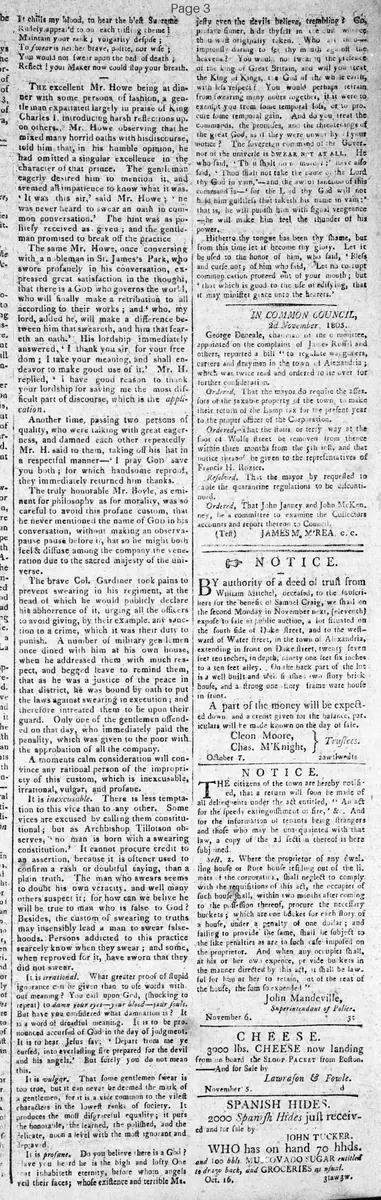
It chills my blood, to hear the base Supreme ; Rudely appear'd to on each trifling theme !
Maintain your rank ; vulgarity despise ; To swear is neither brave, polite, nor wise ; You would not swear upon the bed of death ; Reflect ! your Maker now could stop your breath.
The excellent Mr. Howe being at dinner with some persons of fashion, a gentleman expatiated largely in praise of King Charles I, introducing harsh reflections upon others. Mr. Howe observing that he mixed many horrid oaths with his discourse, told him that, in his humble opinion, he had omitted a singular excellence in the character of that prince. The gentleman eagerly desired him to mention it, and seemed all impatience to know what it was. It was this sir,' said Mr. Howe ; 'he was never heard to swear an oath in common conversation.' The hint was as politely received as given; and the gentleman promised to break off the practice
The same Mr. Howe, once conversing with a nobleman in St. James's Park, who swore profanely in his conversation, expressed great satisfaction in the thought that there is a God who governs the world, who will finally make a retribution to all according to their works ; and who. my lord. added he. will make a difference between him that sweareth, and him that feareth an oath. His lordship immediately answered, 'I thank you sir. for your freedom : I take your meaning. and shall endeavor to make good use of it.' Mr. H. replied, ' I have good reason to thank your lordship for saving me the most difficult part of discourse, which is the application.
Another time, passing two persons of quality, who were talking with great eagerness, and damned each other repeatedly Mr. H. said to them. taking off his hat in a respectful manner-' I pray God save you both; for which handsome reproof, they immediately returned him thanks.
The truly honorable Mr. Boyle, as eminent for philosophy as for morality, was so careful to avoid this profane custom, that he never mentioned the name of God in his conversation, without making an observation pause before it, that so he might both feel & diffuse among the company the veneration due to the sacred majesty of the universe.
The brave Col. Gardiner took pains to prevent swearing in his regiment, at the head of which be would publicly declare his abhorrence of it, urging all the officers to avoid giving, by their example, any sanction to a crime, which it was their duty to punish. A number of military gentlemen once dined with him at his own house, when he addressed them with much respect, and begged leave to remind them, that as he was a justice of the peace in that district, he was bound by oath to put the laws against swearing in execution; and therefore intreated them to be upon their guard. Only one of the gentlemen offended on that day, who immediately paid the penality, which was given to the poor with the approbation of all the company.
A moments calm consideration will convince any rational person of the impropriety of this custom, which is inexcusable, irrational, vulgar, and profane.
It is inexcusable. There is less temptation to this vice than to any other. Some vices are excused by calling them constitutional; but as Archbishop Tillotson observes, ' no man is born with a swearing constitution.' It cannot procure credit to an assertion, because it is oftener used to confirm a rash or doubtful saying, than a plain truth. The man who swears seems to doubt his own veracity. and well may others suspect it; for how can we believe he will be true to man who is false to God ?
Besides, the custom of swearing to truths may insensibly lead a man to swear falsehoods. Persons addicted to this practice scarcely know when they swear; and some, when reproved for it, have sworn that they did not swear.
It is irrational. What greater proof of stupid ignorance can be given than to use words without meaning? You call upon God, (shocking to repeat) to damn your eyes--your blood-your souls. But have you considered what damnation is? It is a word of dreadful meaning. It is to be pronounced accursed of God in the day of judgment. It is to hear. Jesus say; Depart from me ye cursed, into everlasting fire prepared for the devil and his angels.' : But surely you do not mean this.
It is vulgar. That some gentlemen swear is too true, but it can never be deemed the mark of a gentlemen, for it is a vice common to the vilest characters in the lowest rank of society. It produces the most disgraceful equality; it puts the honorable, the learned. the polished, and the delicate. upon a level with the most ignorant and depraved.
It is profane. Do you believe there is a God ? Have you heard he is the high and lofty One that inhabiteth eternity, before whom angels veil their faces; whose existence and terrible Majesty even the devils believe. trembling & Go. profane user, hide thyself in the dust whence thou wast originally taken. Who art thou O impiously-daring to set thy mouth against the heavens?- You would not swear in the presence of the king of Great Britain, and will you treat the King of Kings, the God of the whole earth, with less respect? You would perhaps refrain from swearing many hours together, if it were to exempt you from some temporal loss, or to procure some temporal gain. And do you treat the Commands, the promises. and the threatenings of the great God, as if they were unworthy of your notice ? The sovereign command of the Governor of the universe is SWEAR NOT AT ALL. He who said, : Thou shalt do no murder :' have also said. ' Thou shalt not take the name of the Lord thy God in vain, --and the awful sanction of this command is' for the Lord thy God will not hold him guiltless that taketh his name in vain: that is, he will punish him with high vengeance -he will. make him feel the thunder of his power..
Hitherto thy tongue has been thy Shame, but from this time let it become thy glory. Let it be used to the honor of him, who said. ' Bless and curse not; of him who said, Let no corrupt communication proceed out of your mouth; but 'that which is good to the use or edifying, that it may minister grace unto the hearers.'
Maintain your rank ; vulgarity despise ; To swear is neither brave, polite, nor wise ; You would not swear upon the bed of death ; Reflect ! your Maker now could stop your breath.
The excellent Mr. Howe being at dinner with some persons of fashion, a gentleman expatiated largely in praise of King Charles I, introducing harsh reflections upon others. Mr. Howe observing that he mixed many horrid oaths with his discourse, told him that, in his humble opinion, he had omitted a singular excellence in the character of that prince. The gentleman eagerly desired him to mention it, and seemed all impatience to know what it was. It was this sir,' said Mr. Howe ; 'he was never heard to swear an oath in common conversation.' The hint was as politely received as given; and the gentleman promised to break off the practice
The same Mr. Howe, once conversing with a nobleman in St. James's Park, who swore profanely in his conversation, expressed great satisfaction in the thought that there is a God who governs the world, who will finally make a retribution to all according to their works ; and who. my lord. added he. will make a difference between him that sweareth, and him that feareth an oath. His lordship immediately answered, 'I thank you sir. for your freedom : I take your meaning. and shall endeavor to make good use of it.' Mr. H. replied, ' I have good reason to thank your lordship for saving me the most difficult part of discourse, which is the application.
Another time, passing two persons of quality, who were talking with great eagerness, and damned each other repeatedly Mr. H. said to them. taking off his hat in a respectful manner-' I pray God save you both; for which handsome reproof, they immediately returned him thanks.
The truly honorable Mr. Boyle, as eminent for philosophy as for morality, was so careful to avoid this profane custom, that he never mentioned the name of God in his conversation, without making an observation pause before it, that so he might both feel & diffuse among the company the veneration due to the sacred majesty of the universe.
The brave Col. Gardiner took pains to prevent swearing in his regiment, at the head of which be would publicly declare his abhorrence of it, urging all the officers to avoid giving, by their example, any sanction to a crime, which it was their duty to punish. A number of military gentlemen once dined with him at his own house, when he addressed them with much respect, and begged leave to remind them, that as he was a justice of the peace in that district, he was bound by oath to put the laws against swearing in execution; and therefore intreated them to be upon their guard. Only one of the gentlemen offended on that day, who immediately paid the penality, which was given to the poor with the approbation of all the company.
A moments calm consideration will convince any rational person of the impropriety of this custom, which is inexcusable, irrational, vulgar, and profane.
It is inexcusable. There is less temptation to this vice than to any other. Some vices are excused by calling them constitutional; but as Archbishop Tillotson observes, ' no man is born with a swearing constitution.' It cannot procure credit to an assertion, because it is oftener used to confirm a rash or doubtful saying, than a plain truth. The man who swears seems to doubt his own veracity. and well may others suspect it; for how can we believe he will be true to man who is false to God ?
Besides, the custom of swearing to truths may insensibly lead a man to swear falsehoods. Persons addicted to this practice scarcely know when they swear; and some, when reproved for it, have sworn that they did not swear.
It is irrational. What greater proof of stupid ignorance can be given than to use words without meaning? You call upon God, (shocking to repeat) to damn your eyes--your blood-your souls. But have you considered what damnation is? It is a word of dreadful meaning. It is to be pronounced accursed of God in the day of judgment. It is to hear. Jesus say; Depart from me ye cursed, into everlasting fire prepared for the devil and his angels.' : But surely you do not mean this.
It is vulgar. That some gentlemen swear is too true, but it can never be deemed the mark of a gentlemen, for it is a vice common to the vilest characters in the lowest rank of society. It produces the most disgraceful equality; it puts the honorable, the learned. the polished, and the delicate. upon a level with the most ignorant and depraved.
It is profane. Do you believe there is a God ? Have you heard he is the high and lofty One that inhabiteth eternity, before whom angels veil their faces; whose existence and terrible Majesty even the devils believe. trembling & Go. profane user, hide thyself in the dust whence thou wast originally taken. Who art thou O impiously-daring to set thy mouth against the heavens?- You would not swear in the presence of the king of Great Britain, and will you treat the King of Kings, the God of the whole earth, with less respect? You would perhaps refrain from swearing many hours together, if it were to exempt you from some temporal loss, or to procure some temporal gain. And do you treat the Commands, the promises. and the threatenings of the great God, as if they were unworthy of your notice ? The sovereign command of the Governor of the universe is SWEAR NOT AT ALL. He who said, : Thou shalt do no murder :' have also said. ' Thou shalt not take the name of the Lord thy God in vain, --and the awful sanction of this command is' for the Lord thy God will not hold him guiltless that taketh his name in vain: that is, he will punish him with high vengeance -he will. make him feel the thunder of his power..
Hitherto thy tongue has been thy Shame, but from this time let it become thy glory. Let it be used to the honor of him, who said. ' Bless and curse not; of him who said, Let no corrupt communication proceed out of your mouth; but 'that which is good to the use or edifying, that it may minister grace unto the hearers.'
What sub-type of article is it?
Moral Or Religious
What keywords are associated?
Swearing
Profanity
Morality
Vice
Religion
Oaths
What entities or persons were involved?
Mr. Howe
King Charles I
Mr. Boyle
Col. Gardiner
Archbishop Tillotson
Editorial Details
Primary Topic
Condemnation Of Profane Swearing
Stance / Tone
Moral Exhortation Against Swearing
Key Figures
Mr. Howe
King Charles I
Mr. Boyle
Col. Gardiner
Archbishop Tillotson
Key Arguments
Swearing Is Inexcusable As It Lacks Temptation And Undermines Veracity
It Is Irrational To Use Meaningless Words Invoking Damnation
Swearing Is Vulgar, Equating Gentlemen With The Lowest Classes
It Is Profane To Misuse God's Name, Violating Divine Commands