Thank you for visiting SNEWPapers!
Sign up free
The New Hampshire Gazette
Portsmouth, Rockingham County, New Hampshire
What is this article about?
Richard Lawrence attempted to assassinate President Jackson at the U.S. Capitol in Washington during the funeral of Hon. Warren R. Davis on January 30, 1835. Both pistols misfired, Lawrence was seized and examined in court, deemed sane, and released on $1000 bail. Political rhetoric is speculated as influence. Experiments confirmed pistols functional. Commentary links to prior Whig vandalism of Jackson figurehead in Charleston.
Clipping
OCR Quality
Full Text
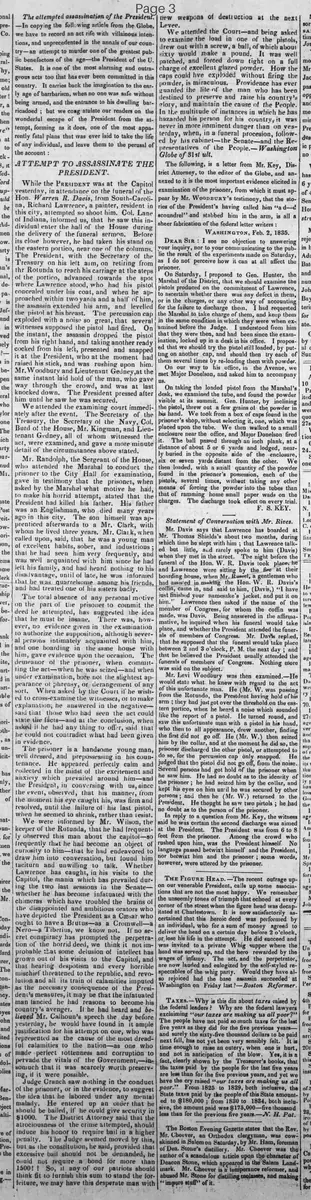
-In copying the following article from the Globe, we have to record an act ripe with villainous intentions, and unprecedented in the annals of our country-an attempt to murder one of the greatest public benefactors of the age-the President of the U. States. It is one of the most alarming and outrageous acts too that has ever been committed in this country. It carries back the imagination to the early age of barbarism, when no one was safe without being armed, and the entrance to his dwelling barricadoed; but we congratulate our readers on the wonderful escape of the President from the attempt, forming as it does, one of the most apparently fatal plans that was ever laid to take the life of any individual, and leave them to the perusal of the account :
ATTEMPT TO ASSASSINATE THE PRESIDENT.
While the President was at the Capitol yesterday, in attendance on the funeral of the Hon. Warren R. Davis, from South-Carolina, Richard Lawrence, a painter, resident in this city, attempted to shoot him. Col. Lane of Indiana, informed us, that he saw this individual enter the hall of the House during the delivery of the funeral sermon. Before its close however, he had taken his stand on the eastern portico, near one of the columns. The President, with the Secretary of the Treasury on his left arm, on retiring from the Rotunda to reach his carriage at the steps of the portico, advanced towards the spot where Lawrence stood, who had his pistol concealed under his coat, and when he approached within two yards and a half of him, the assassin extended his arm, and levelled the pistol at his breast. The percussion cap exploded with a noise so great, that several witnesses supposed the pistol had fired. On the instant, the assassin dropped the pistol from his right hand, and taking another ready cocked from his left, presented and snapped it at the President, who at the moment had raised his stick, and was rushing upon him. Mr. Woodbury and Lieutenant Gedney, at the same instant laid hold of the man, who gave way through the crowd, and was at last knocked down. The President pressed after him until he saw he was secured.
We attended the examining court immediately after the event. The Secretary of the Treasury, the Secretary of the Navy, Col. Burd of the House, Mr. Kingman, and Lieutenant Gedney, all of whom witnessed the act, were examined, and gave a more minute detail of the circumstances above stated.
Mr. Randolph, the Sergeant of the House, who attended the Marshal to conduct the prisoner to the City Hall for examination, gave in testimony that the prisoner, when asked by the Marshal what motive he had, to make his horrid attempt, stated that the President had killed his father. His father was an Englishman, who died many years ago in this city. The son himself was apprenticed afterwards to a Mr. Clark, with whom he lived three years. Mr. Clark, when called upon, said, that he was a young man of excellent habits, sober, and industrious; that he had seen him very frequently, and was well acquainted with him since he had left his family, and had heard nothing to his disadvantage, until of late, he was informed that he was quarrelsome among his friends, and had treated one of his sisters badly.
The total absence of any personal motive on the part of the prisoner to commit the deed he attempted, has suggested the idea that he must be insane. There was, however, no evidence given in the examination to authorize the supposition, although several persons intimately acquainted with him, and one boarding in the same house with him, gave evidence upon the occasion. The demeanor of the prisoner, when committing the act-when he was seized-and when under examination, bore not the slightest appearance of phrensy, or derangement of any sort. When asked by the Court if he wished to cross-examine the witnesses, or to make explanation; he answered in the negative-said that those who had seen the act could state the facts-and at the conclusion, when asked if he had any thing to offer, said that he could not contradict what had been given in evidence.
The prisoner is a handsome young man, well dressed, and prepossessing in his countenance. He appeared perfectly calm and collected in the midst of the excitement and anxiety which prevailed around him-and the President, in conversing with us, since the event, observed, that his manner, from the moment his eye caught his, was firm and resolved, until the failure of his last pistol, when he seemed to shrink, rather than resist.
We were informed by Mr. Wilson, the keeper of the Rotunda, that he had frequently observed this man about the capitol-so frequently that he had become an object of curiosity to him-that he had endeavored to draw him into conversation, but found him taciturn and unwilling to talk. Whether Lawrence has caught, in his visits to the Capitol, the mania which has prevailed during the two last sessions in the Senate—whether he has become infatuated with the chimeras which have troubled the brains of the disappointed and ambitious orators who have depicted the President as a Caesar who ought to have a Brutus-as a Cromwell-a Nero-a Tiberius, we know not. If no secret conspiracy has prompted the perpetration of the horrid deed, we think it not improbable that some delusion of intellect has grown out of his visits to the Capitol, and that hearing despotism and every horrible mischief threatened to the republic, and revolution and all its train of calamities imputed as the necessary consequence of the President's measures, it may be that the infatuated man fancied he had reasons to become his country's avenger. If he had heard and believed Mr. Calhoun's speech the day before yesterday, he would have found in it ample justification for his attempt on one, who was represented as the cause of the most dreadful calamities to the nation-as one who made "perfect rottenness and corruption to pervade the vitals of the Government,"-inasmuch that it was scarcely worth preserving, if it were possible.
Judge Cranch saw nothing in the conduct of the prisoner, or in the evidence, to suggest the idea that he labored under any mental malady. He entered up an order that he should be bailed, if he could give security in $1000. The District Attorney said that the atrociousness of the crime attempted, should induce his honor to require bail in a higher penalty. The Judge seemed moved by this, but as the constitution, he said, provided that excessive bail should not be demanded, he could not require a bond for more than $1000!! So, if any of our patriots should think fit to furnish this sum to stand the forfeiture, we may have this desperate man with new weapons of destruction at the next Levee.
We attended the Court-and being asked to examine the load in one of the pistols, drew out with a screw, a ball, of which about sixty would make a pound. It was well patched, and forced down tight on a full charge of excellent glazed powder. How the caps could have exploded without firing the powder, is miraculous. Providence has ever guarded the life of the man who has been destined to preserve and raise his country's glory, and maintain the cause of the People. In the multitude of instances in which he has hazarded his person for his country, it was never in more imminent danger than on yesterday, when, in a funeral procession, followed by his cabinet-the Senate and the Representatives of the People.
Washington Globe of 31st ult.
The following, is a letter from Mr. Key, District Attorney, to the editor of the Globe, and annexed to it is the most important evidence elicited in examination of the prisoner, from which it must appear by Mr. Woodbury's testimony, that the stories of the President's having called him "a d--d scoundrel" and stabbed him in the arm, is all a sheer fabrication of the federal letter writers :
WASHINGTON, Feb. 2, 1835.
DEAR SIR: I see no objection to answering your inquiry, nor to your communicating to the public the result of the experiments made on Saturday, as I do not perceive how it can at all affect the prisoner.
On Saturday, I proposed to Gen. Hunter, the Marshal of the District, that we should examine the pistols produced on the commitment of Lawrence, to ascertain whether there was any defect in them, or in the charges, or any other way of accounting for the failure to discharge them, I had requested the Marshal to take charge of them, and keep them in the same condition in which they were when examined before the Judge. I understood from him that they were then, and had been since the examination, locked up in a desk in his office. I proposed that we should try the pistol still loaded, by putting on another cap, and should then try each of them several times by re-loading them with powder. On our way to his office, in the Avenue, we met Major Donelson, and asked him to accompany us.
On taking the loaded pistol from the Marshal's desk, we examined the tube, and found the powder visible at its summit. Gen. Hunter, by inclining the pistol, threw out a few grains of the powder in his hand. We took from a box of caps found in the prisoner's shop, without selecting it, one, which was placed upon the tube. We then walked to a small enclosure near the office, and Major Donelson fired it. The ball passed through an inch plank, at a distance of about 5 or 6 yards and lodged, nearly buried in the opposite side of the enclosure, six or seven yards distant from the other. We then loaded, with a small quantity of the powder found in the prisoner's possession, each of the pistols, several times, without taking any other means of forcing the powder into the tubes than that of ramming home small paper wads on the charges. The discharge took effect on every trial.
F. S. KEY.
Statement of Conversation with Mr. Rives.
Mr. Davis says that Lawrence has boarded at Mr. Thomas Shields's about two months, during which time he slept with him; that Lawrence talked but little, and rarely spoke to him (Davis) when they met in the street. The night before the funeral of the Hon. W. R. Davis took place, he and Lawrence were sitting by the fire at their boarding house, when Mr. Russel, a gentleman who had assisted in making the Hon. W. R. Davis's coffin, came in, and said to him, (Davis,) "I have just finished your namesake's jacket, and put it on him." Lawrence then asked if the name of the member of Congress, for whom the coffin was made, was Davis. Being answered in the affirmative, he inquired when his funeral would take place, and whether the President attended the funerals of members of Congress. Mr. Davis replied that he supposed that the funeral would take place between 2 and 3 o'clock, P. M. the next day; and that he believed the President usually attended the funerals of members of Congress. Nothing more was said on the subject.
Mr. Levi Woodbury was then examined.-He would state what he knew with regard to the act of this unfortunate man. He (Mr. W.) was passing from the Rotunda, the President having hold of his arm; they had just got over the threshold, on the eastern portico, when he heard a noise which sounded like the report of a pistol. He turned round, and saw this unfortunate man with a pistol in his hand, who then to all appearance, drew another, finding the first did not go off. He (Mr. W.) then seized him by the collar, and at the moment he did so, the prisoner discharged the other pistol, or attempted to do so, or the percussion cap only snapped. He judged that the pistol did not go off, from the noise. Several persons had got hold of the prisoner when he saw him. He had no doubt as to the identity of the prisoner; he had seized him by the collar, and kept his eyes on him until he was secured by other persons; and then he (Mr. W.) returned to the President. He thought he saw two pistols; he had no doubt as to the person of the prisoner.
In reply to a question from Mr. Key, the witness said he was certain the second discharge was aimed at the President. The President was from 6 to 8 feet from the prisoner. Among the crowd who rushed upon him, was the President himself. No language passed betwixt himself and the President, nor betwixt him and the prisoner; some words, however, were uttered by the prisoner.
The Figure Head. -The recent outrage upon our venerable President, calls up some associations that are not the most happy. We remember the unseemly tones of triumph that echoed at every corner of the street when the figure head was decapitated at Charlestown. It is now satisfactorily ascertained that this heroic deed was performed by an individual, who for a sum of money agreed to deliver the head on a certain day before 2 o'clock, or lose his life in the attempt. He did succeed and was invited to a private Whig supper where the head was served up, and the hero rewarded by the wages of infamy. The act, and the perpetrator, are now lauded and eulogized by the self-styled respectables of the whig party. Would they have also rejoiced had the base assassin succeeded at Washington on Friday last?-Boston Reformer.
What sub-type of article is it?
What keywords are associated?
What entities or persons were involved?
Where did it happen?
Domestic News Details
Primary Location
Washington
Event Date
January 30, 1835
Key Persons
Outcome
attempt failed due to pistol misfires; lawrence arrested, examined in court, found sane, released on $1000 bail; experiments confirmed pistols were functional.
Event Details
During the funeral of Hon. Warren R. Davis at the Capitol, Richard Lawrence, a painter, attempted to shoot the President on the eastern portico. He fired two pistols at close range, but both misfired. Lawrence was seized by Mr. Woodbury, Lieutenant Gedney, and others, including the President. Court examination revealed no clear motive beyond Lawrence's claim the President killed his father; witnesses described him as calm and sane. Political rhetoric speculated as influence. Letter from F. S. Key details tests showing pistols worked when reloaded.