Thank you for visiting SNEWPapers!
Sign up free
The New Orleans Democrat
New Orleans, Orleans County, Louisiana
What is this article about?
In a fiery U.S. Senate debate on March 30 in Washington, Massachusetts Senator Boutwell unleashes a personal tirade against Delaware Senator Bayard and Southern colleagues, accusing them of disloyalty rooted in slavery. Bayard responds with a vehement denial of ancestral disloyalty, stunning the chamber and drawing applause.
Clipping
OCR Quality
Full Text
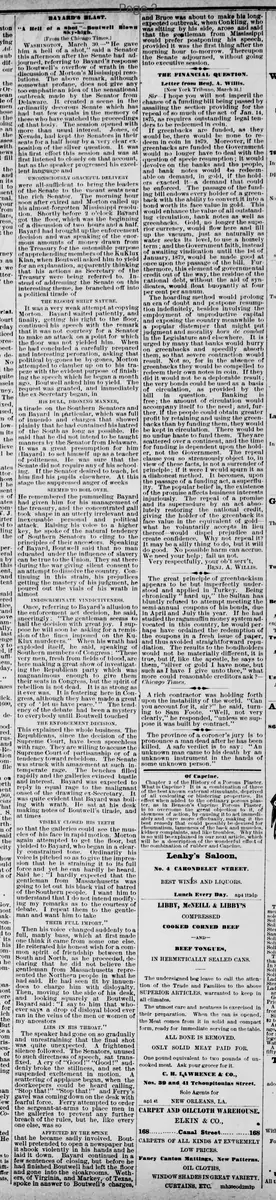
[From the Chicago Times.]
WASHINGTON, March 30.—"He gave him a hell of a shot," said a Senator this afternoon after the Senate had adjourned, referring to Bayard's response to Boutwell's overflow of wrath in the discussion of Morton's Mississippi resolutions. The above remark, although somewhat profane, does not give any too emphatic an idea of the sensational outbreak made by the Senator from Delaware. It created a scene in the ordinarily decorous Senate which has had but few equals in the memory of those who have watched the proceedings of that body. The session opened with more than usual interest. Jones, of Nevada, had kept the Senators in their seats for a half hour by a very clear exposition of the silver question. It was his first effort this session and was at first listened to closely on that account, but as the speaker progressed his excellent language and unconsciously graceful delivery were all-sufficient to bring the leaders of the Senate to the vacant seats near the rich Senator. The morning hour soon after expired and Morton called up his almost-forgotten Mississippi resolution. Shortly before 2 o'clock Bayard got the floor, which was the beginning of a discussion of two hours and a half. Bayard had brought up the enforcement decision and was speaking of the enormous amounts of money drawn from the Treasury for the ostensible purpose of apprehending members of the Ku Klux Klan, when Boutwell asked him to yield for an explanation, apparently thinking that his actions as Secretary of the Treasury were being referred to. Instead of addressing the Senate on this interesting theme, he branched off into a political tirade of the bloody shirt nature.
It was a very weak attempt at copying Morton. Bayard waited patiently, and finally, getting his right to the floor continued his speech with the remark that it was not courtesy for a Senator to make an attack on a point for which the floor was not yielded him. When he had concluded a carefully prepared and interesting peroration, asking that political by-gones be by-gones, Morton attempted to clamber up on to his trapeze with the evident purpose of finishing the speech which he began a month ago. Boutwell asked him to yield. The request was granted, and immediately the ex-Secretary began, in his dull, droning manner, a tirade on the Southern Senators and on Bayard in particular, which was full of innuendo and charges that showed plainly that he had contained his hatred of the South as long as possible. He said that he did not intend to be taught manners by the Senator from Delaware. It was a great presumption for him (Bayard) to set himself up as a teacher of politeness. He was sure that the Senate did not require any of his schooling. If the Senator desired to teach, let him find his pupils elsewhere. At this stage the suppressed anger of weeks seemed to boil over.
He remembered the pummeling Bayard had given him for his management of the treasury, and the concentrated gall took shape in an utterly irrelevant and inexcusable personal and political attack. Raising his voice to a higher key, he spoke of the natural tendency of Southern Senators to cling to the principles of their ancestors. Speaking of Bayard, Boutwell said that no man educated under the influence of slavery can be true to the Union. They sat there during the war giving silent consent to an attempt to dissolve the country. Continuing in this strain, his prejudices getting the mastery of his judgment, he poured out the vials of his wrath in almost indiscriminate vindictiveness.
Once, referring to Bayard's allusion to the enforcement act decision, he said, sneeringly: "The gentleman seems to hail the decision with great joy. I suppose he will soon be asking for a remission of the fines imposed on the Ku Klux murderers." When his wrath had exploded itself, he said, speaking of Southern members of Congress: "These very men, fresh from fields of blood, are here making a great show of investigating the Republican party which was magnanimous enough to give them their seats in Congress, but the spirit of rebellion is not dead. It is as strong as it ever was. It is festering here in Congress, although they have made a great cry of 'let us have peace.'" The tendency of the debate had been a mystery to everybody until Boutwell touched the enforcement decision.
This explained the whole business. The Republicans, since the decision of the Supreme Court, have been speechless with rage. They are willing to accuse the Supreme Court of partisanship or of a tendency toward rebellion. The Senate was struck with amazement at such intemperate rage. The benches filled rapidly and the galleries evinced bustle and interest. Bayard was expected to reply in equal rage to the malignant onset of the drawling ex-Secretary. It was quite evident that Bayard was boiling with wrath. He sat at his desk making notes of Boutwell's tirade, and at times visibly closed his teeth so that the galleries could see the muscles of his face in rapid motion. Morton again attempted to get the floor, but yielded to Bayard, who began in a clearly constrained tone. Ordinarily his voice is pitched so as to give the impression that he is straining it to its full force and yet he can hardly be heard. Said he: "I hardly expected that the gentleman from Massachusetts was going to let out his black vial of hatred of the Southern people. I want him to understand that I do not intend modifying my remarks as to the courtesy of debate. I repeat them to the gentleman and want him to take their full import."
Then his voice changed suddenly to a full, manly bass, which at first made one think it came from some one else. He reiterated his honest wish for a common spirit of friendship between the South and North, as he proceeded, declaring that he did not believe the gentleman from Massachusetts represented the Northern people in what he had said. He had seen fit by innuendoes to charge him with disloyalty. Then, moving to the side of his desk, and looking squarely at Boutwell, Bayard said: "I say to him that whoever says a drop of disloyal blood ever ran in the veins of the men or women of my ancestors LIES IN HIS THROAT."
The speaker had gone on so gradually and unrestraining that the final shot was quite unexpected. A frightened silence followed. The Senators, unused to such directness of speech, sat transfixed. A cry of "Good!" "Good!" suddenly broke the stillness, and set the suspended excitement in motion. A scattering of applause began, when the doorkeepers could be heard calling, "Stop that!" "Stop that!" and Ferry's gavel was coming down on the desk with fearful force. Ferry attempted to order the sergeant-at-arms to place men in the galleries to prevent any further breach of the rules, but he, like every one else, was so affected by the scene that he became sadly involved. Boutwell pretended to open a newspaper but it shook violently in his hands and he laid it down. Bayard continued in a few sentences of closing, but before he had finished Boutwell had left the floor and gone into the cloakrooms. Withers, of Virginia, and Markey, of Texas, spoke in answer to Boutwell's charges, and Bruce was about to make his long expected outbreak, when Conkling, who was sitting by his side, arose and said that the gentleman from Mississippi would prefer postponing his speech, provided it was the first thing after the morning hour to-morrow. Thereupon the Senate adjourned, without going into executive session.
What sub-type of article is it?
What themes does it cover?
What keywords are associated?
What entities or persons were involved?
Where did it happen?
Story Details
Key Persons
Location
Washington
Event Date
March 30
Story Details
During a Senate debate on Morton's Mississippi resolutions and the enforcement act decision, Boutwell launches a vitriolic attack on Bayard and Southern senators, accusing them of disloyalty due to slavery's influence and rebellion. Bayard responds by denying any disloyal blood in his ancestors, calling such accusations lies, creating a dramatic uproar with applause and calls for order.