Thank you for visiting SNEWPapers!
Sign up free
The Northwest Times
Seattle, King County, Washington
What is this article about?
The U.S. Supreme Court will hear oral arguments on October 21, 1947, regarding the constitutionality of California's alien land law in the Oyama case, involving Japanese ancestry persons and potentially hundreds of millions in land. Attorneys like A.L. Wirin prepare briefs to challenge the law.
Clipping
OCR Quality
Full Text
Law Case
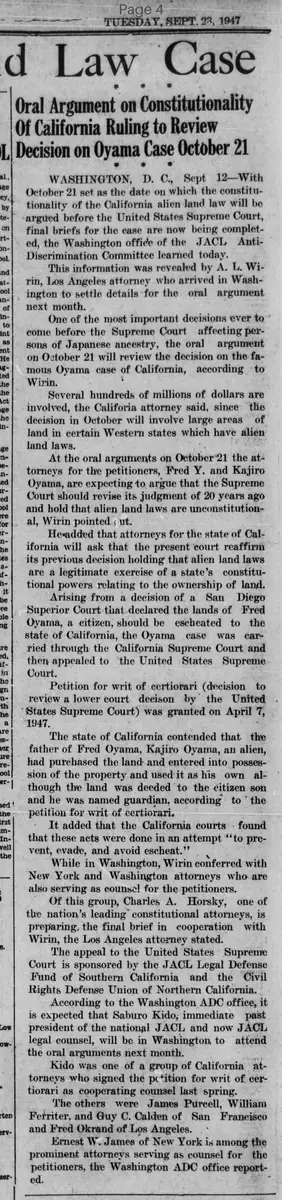
Oral Argument on Constitutionality
Of California Ruling to Review
Decision on Oyama Case October 21
WASHINGTON, D. C., Sept 12—With October 21 set as the date on which the constitutionality of the California alien land law will be argued before the United States Supreme Court, final briefs for the case are now being completed, the Washington office of the JACL Anti-Discrimination Committee learned today.
This information was revealed by A. L. Wirin, Los Angeles attorney who arrived in Washington to settle details for the oral argument next month.
One of the most important decisions ever to come before the Supreme Court affecting persons of Japanese ancestry, the oral argument on October 21 will review the decision on the famous Oyama case of California, according to Wirin.
Several hundreds of millions of dollars are involved, the California attorney said, since the decision in October will involve large areas of land in certain Western states which have alien land laws.
At the oral arguments on October 21 the attorneys for the petitioners, Fred Y. and Kajiro Oyama, are expecting to argue that the Supreme Court should revise its judgment of 20 years ago and hold that alien land laws are unconstitutional, Wirin pointed out.
He added that attorneys for the state of California will ask that the present court reaffirm its previous decision holding that alien land laws are a legitimate exercise of a state's constitutional powers relating to the ownership of land.
Arising from a decision of a San Diego Superior Court that declared the lands of Fred Oyama, a citizen, should be escheated to the state of California, the Oyama case was carried through the California Supreme Court and then appealed to the United States Supreme Court.
Petition for writ of certiorari (decision to review a lower court decision by the United States Supreme Court) was granted on April 7, 1947.
The state of California contended that the father of Fred Oyama, Kajiro Oyama, an alien, had purchased the land and entered into possession of the property and used it as his own although the land was deeded to the citizen son and he was named guardian, according to the petition for writ of certiorari.
It added that the California courts found that these acts were done in an attempt "to prevent, evade, and avoid escheat."
While in Washington, Wirin conferred with New York and Washington attorneys who are also serving as counsel for the petitioners.
Of this group, Charles A. Horsky, one of the nation's leading constitutional attorneys, is preparing the final brief in cooperation with Wirin, the Los Angeles attorney stated.
The appeal to the United States Supreme Court is sponsored by the JACL Legal Defense Fund of Southern California and the Civil Rights Defense Union of Northern California.
According to the Washington ADC office, it is expected that Saburo Kido, immediate past president of the national JACL and now JACL legal counsel, will be in Washington to attend the oral arguments next month.
Kido was one of a group of California attorneys who signed the petition for writ of certiorari as cooperating counsel last spring.
The others were James Purcell, William Ferriter, and Guy C. Calden of San Francisco and Fred Okrand of Los Angeles.
Ernest W. James of New York is among the prominent attorneys serving as counsel for the petitioners, the Washington ADC office reported.
What sub-type of article is it?
What keywords are associated?
What entities or persons were involved?
Where did it happen?
Domestic News Details
Primary Location
Washington, D. C.
Event Date
October 21
Key Persons
Outcome
several hundreds of millions of dollars are involved, affecting large areas of land in certain western states with alien land laws. petitioners seek to have the laws declared unconstitutional; california seeks reaffirmation.
Event Details
Oral arguments on the constitutionality of California's alien land law in the Oyama case will be heard by the U.S. Supreme Court on October 21. The case reviews a prior decision, stemming from a San Diego Superior Court ruling to escheat lands deeded to citizen Fred Y. Oyama but purchased by his alien father Kajiro Oyama. Final briefs are being completed by attorneys including A. L. Wirin and Charles A. Horsky. Sponsored by JACL and Civil Rights Defense Union groups.