Thank you for visiting SNEWPapers!
Sign up free
The Daily Missoulian
Missoula, Missoula County, Montana
What is this article about?
Blind Senator Thomas P. Gore of Oklahoma lectured on 'Social Duty' at Harnois Theater to a full house, introduced by Senator Joseph M. Dixon. He denounced trusts for exorbitant prices, advocated progressive reforms like nominating Woodrow Wilson, and emphasized moral character, fair government, and efficient resource use.
Clipping
OCR Quality
Full Text
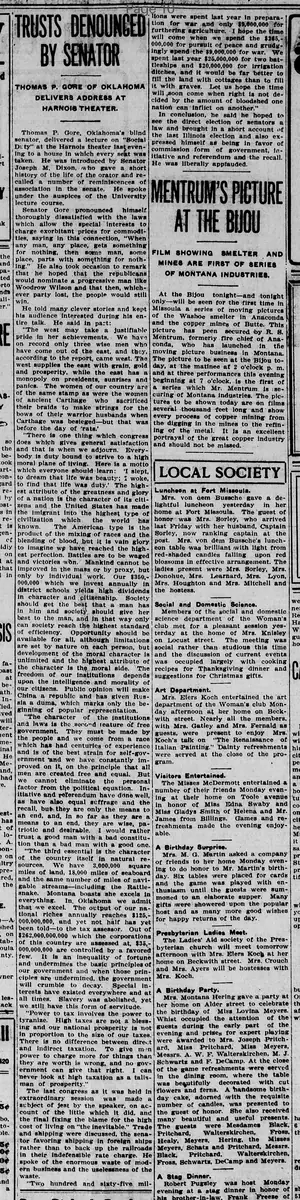
BY SENATOR
THOMAS P. GORE OF OKLAHOMA
DELIVERS ADDRESS AT
HARNOIS THEATER.
Thomas P. Gore, Oklahoma's blind senator, delivered a lecture on "Social Duty" at the Harnois theater last evening to a house in which every seat was taken. He was introduced by Senator Joseph M. Dixon, who gave a short history of the life of the orator and recalled a number of reminiscences of association in the senate. He spoke under the auspices of the University lecture course.
Senator Gore pronounced himself thoroughly dissatisfied with the laws which allow the special "interests" to charge exorbitant prices for commodities, saying in this connection, "When any man, any place, gets something for nothing, then some man, some place, parts with something for nothing." He also took occasion to remark that he hoped that the republicans would nominate a progressive man like Woodrow Wilson and that then, whichever party lost, the people would still win.
He told many clever stories and kept his audience interested during his entire talk. He said in part:
"The west may take a justifiable pride in her achievements. We have on record only three wise men who have come out of the east, and they, according to the report, came west. The west supplies the east with grain, gold and prosperity, while the east has a monopoly on presidents, sunrises and panics. The women of our country are of the same stamp as were the women of ancient Carthage who sacrificed their braids to make strings for the bows of their warrior husbands when Carthage was besieged--but that was before the day of rats.
"There is one thing which congress does which gives general satisfaction and that is when we adjourn. Everybody is duty bound to strive to a high moral plane of living. Here is a motto which everyone should learn: I slept, to dream that life was beauty; I woke, to find that life was duty. The highest attribute of the greatness and glory of a nation is the character of its citizens and the United States has made the immigrant into the highest type of civilization which the world has known. The American type is the product of the mixing of races and the blending of blood, but it is vain glory to imagine we have reached the highest perfection. Battles are to be waged and victories won. Mankind cannot be improved in the mass or by proxy, but only by individual work. Our $350,000,000 which we invest annually in district schools yields high dividends in character and citizenship. Society should get the best that a man has in him and society should give her best to the man, and in that way only can society reach the highest standard of efficiency. Opportunity should be available for all, although limitations are set by nature on each person, but development of the moral character is unlimited and the highest attribute of the character is the moral side. The freedom of our institutions depends upon the intelligence and morality of our citizens. Public opinion will make China a republic and has given Russia a duma, which marks only the beginning of popular representation.
"The character of the institutions and laws is the second feature of free government. They must be made by the people and we come from a race which has had centuries of experience and is of the best strain for self-government and we have constantly improved on it, on the principle that all men are created free and equal. But we cannot eliminate the personal factor from the political equation. Initiative and referendum have done well, as have also equal suffrage and the recall, but they are only the means to an end, and, in so far as they are a means to an end, they are wise, patriotic and desirable. I would rather trust a good man with a bad constitution than a bad man with a good one.
"The third essential is the character of the country itself in natural resources. We have 3,000,000 square miles of land, 18,000 miles of seaboard and the same number of miles of navigable streams--including the Rattlesnake. Montana boasts she excels in everything. In Oklahoma we admit that we excel. The output of our national riches annually reaches $125,000,000,000, and yet not half has yet been told--to the tax assessor. Out of $262,000,000,000 which the corporations of this country are assessed at, $35,000,000,000 are controlled by a favored few. It is an inequality of fortune and undermines the basic principles of our government and when those principles are undermined, the government will crumble to decay. Special interests have existed everywhere and at all times. Slavery was abolished, yet we still have this form of servitude.
"Power to tax involves the power to tyrannize. High taxes are not a blessing and our national prosperity is not in proportion to the size of our taxes. There is no difference between direct and indirect taxation. To give men power to charge more for things than they are worth is wrong, and no government can give that right. I can never look at high taxation as a talisman of prosperity."
The last congress as it was held in extraordinary session was made a subject of jest by the speaker, on account of the little which it did, and the final fixing the blame for the high cost of living on "the inevitable." Trade and shipping were discussed, the senator favoring shipping in foreign ships rather than to back up the railroads in their indefensible rate charge. He spoke of the enormous waste of modern business and the uselessness of the waste.
"Two hundred and sixty-five millions were spent last year in preparation for war and only $9,000,000 for furthering agriculture. I hope the time will come when we spend the $265,000,000 for pursuit of peace and grudgingly spend the $9,000,000 for war. We spent last year $25,000,000 for two battleships and $20,000,000 for irrigation ditches, and it would be far better to fill the land with cottages than to fill it with graves. Let us hope the time will soon come when right is not decided by the amount of bloodshed one nation can inflict on another."
In conclusion, he said he hoped to see the direct election of senators a law and brought in a short account of the last Illinois election and also expressed himself as being in favor of commission form of government, initiative and referendum and the recall. He was liberally applauded.
What sub-type of article is it?
What themes does it cover?
What keywords are associated?
What entities or persons were involved?
Where did it happen?
Story Details
Key Persons
Location
Harnois Theater
Event Date
Last Evening
Story Details
Senator Thomas P. Gore delivers lecture on social duty, denouncing trusts and special interests for exorbitant prices, emphasizing moral character and individual improvement, advocating progressive reforms like initiative, referendum, recall, and direct election of senators, while praising American resources and criticizing high taxes and military spending.