Thank you for visiting SNEWPapers!
Sign up free
Letter to Editor
January 16, 1793
National Gazette
Philadelphia, Philadelphia County, Pennsylvania
What is this article about?
An unsigned letter to the National Gazette praises Thomas Jefferson as a steadfast republican patriot, contrasts his humble conduct with potential aristocratic tendencies in government, and warns against eroding equality among citizens. It quotes Shakespeare and Mirabeau, referencing the French Revolution and Dutch history to argue Jefferson's abdication is an evil.
Clipping
OCR Quality
98%
Excellent
Full Text
For the NATIONAL GAZETTE.
"No might nor greatness in mortality
Can censure 'scape: back-wounding calumny
The whitest virtue strikes."
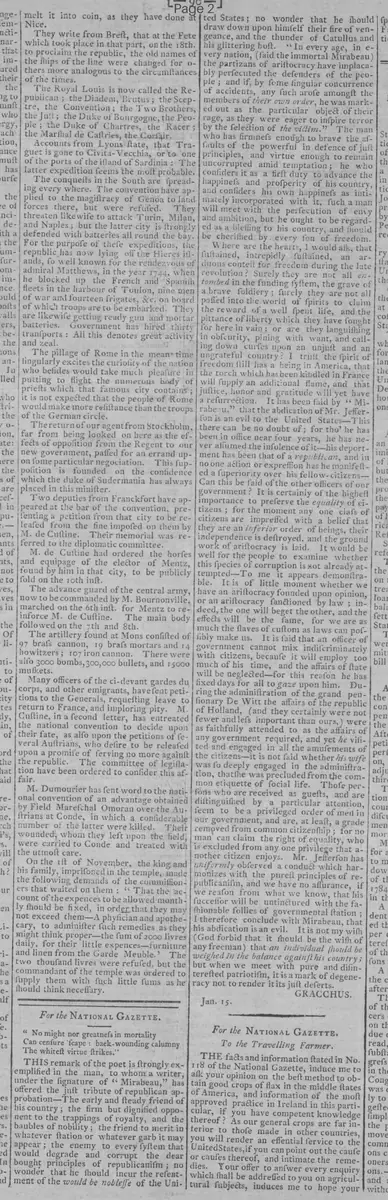
THIS remark of the poet is strongly exemplified in the man, to whom a writer, under the signature of "Mirabeau," has offered the just tribute of republican approbation—The early and steady friend of his country; the firm but dignified opponent to the trappings of royalty, and the baubles of nobility; the friend to merit in whatever station or whatever garb it may appear; the enemy to every system that would degrade and corrupt the dear bought principles of republicanism; no wonder that he should incur the resentment of the would be noblesse of the United States; no wonder that he should draw down upon himself their fire of vengeance, and the thunder of Catullus and his glittering host. "In every age, in every nation, (said the immortal Mirabeau) the partizans of aristocracy have implacably persecuted the defenders of the people; and if, by some singular concurrence of accidents, any such arose amongst the members of their own order, he was marked out as the particular object of their rage, as they were eager to inspire terror by the selection of the victim." "The man who has firmness enough to brave the assaults of the powerful in defence of just principles, and virtue enough to remain uncorrupted amid temptation; he who considers it as a first duty to advance the happiness and prosperity of his country, and considers his own happiness as intimately incorporated with it, such a man will meet with the persecution of envy and ambition, but he ought to be regarded as a blessing to his country, and should be cherished by every son of freedom. Where are the hearts, I would ask, that sustained, intrepidly sustained, an arduous contest for freedom during the late revolution? Surely they are not all entombed in the funding system, the grave of a brave old soldiery; surely they are not all passed into the world of spirits to claim the reward of a well spent life, and the pittance of liberty which they have fought for here in vain; or are they languishing in obscurity, pining with want, and calling down curses upon an unjust and an ungrateful country? I trust the spirit of freedom still has a being in America, that the torch which has been kindled in France will supply an additional flame, and that justice, honor and gratitude will yet have a resurrection. It has been said by "Mirabeau," that the abdication of Mr. Jefferson is an evil to the United States. This there can be no doubt of; for tho' he has been in office near four years, he has never assumed the insolence of it—his deportment has been that of a republican, and in no one action or expression has he manifested a superiority over his fellow-citizens—Can this be said of the other officers of our government? It is certainly of the highest importance to preserve the equality of citizens; for the moment any one class of citizens are impressed with a belief that they are an inferior order of beings, their independence is destroyed, and the ground work of aristocracy is laid. It would be well for the people to examine whether this species of corruption is not already attempted. To me it appears demonstrable. It is of little moment whether we have an aristocracy founded upon opinion, or an aristocracy sanctioned by law; indeed, the one will beget the other, and the effects will be the same, for we are as much the slaves of custom as laws can possibly make us. It is said that an officer of government cannot mix indiscriminately with citizens, because it will employ too much of his time, and the affairs of state will be neglected—for this reason he has fixed days for all to gaze upon him. During the administration of the grand pensionary De Witt the affairs of the republic of Holland, (and they certainly were not fewer and less important than ours,) were as faithfully attended to as the affairs of any government required, and yet he visited and engaged in all the amusements of the citizens—it is not said whether his wife was so deeply engaged in the administration, that she was precluded from the common etiquette of social life. Those persons who are received as guests, and are distinguished by a particular attention, seem to be a privileged order of men in our government, and are, at least, a grade removed from common citizenship; for no man can claim the right of equality, who is excluded from any one privilege that another citizen enjoys. Mr. Jefferson has uniformly observed a conduct which harmonizes with the purest principles of republicanism, and we have no assurance, if we reason from what we know, that his successor will be untinctured with the fashionable follies of governmental station; I therefore conclude with Mirabeau, that his abdication is an evil. It is not my wish (God forbid that it should be the wish of any freeman) that an individual should be weighed in the balance against his country; but when we meet with pure and disinterested patriotism, it is a mark of degeneracy not to render it its just deserts.
"No might nor greatness in mortality
Can censure 'scape: back-wounding calumny
The whitest virtue strikes."
THIS remark of the poet is strongly exemplified in the man, to whom a writer, under the signature of "Mirabeau," has offered the just tribute of republican approbation—The early and steady friend of his country; the firm but dignified opponent to the trappings of royalty, and the baubles of nobility; the friend to merit in whatever station or whatever garb it may appear; the enemy to every system that would degrade and corrupt the dear bought principles of republicanism; no wonder that he should incur the resentment of the would be noblesse of the United States; no wonder that he should draw down upon himself their fire of vengeance, and the thunder of Catullus and his glittering host. "In every age, in every nation, (said the immortal Mirabeau) the partizans of aristocracy have implacably persecuted the defenders of the people; and if, by some singular concurrence of accidents, any such arose amongst the members of their own order, he was marked out as the particular object of their rage, as they were eager to inspire terror by the selection of the victim." "The man who has firmness enough to brave the assaults of the powerful in defence of just principles, and virtue enough to remain uncorrupted amid temptation; he who considers it as a first duty to advance the happiness and prosperity of his country, and considers his own happiness as intimately incorporated with it, such a man will meet with the persecution of envy and ambition, but he ought to be regarded as a blessing to his country, and should be cherished by every son of freedom. Where are the hearts, I would ask, that sustained, intrepidly sustained, an arduous contest for freedom during the late revolution? Surely they are not all entombed in the funding system, the grave of a brave old soldiery; surely they are not all passed into the world of spirits to claim the reward of a well spent life, and the pittance of liberty which they have fought for here in vain; or are they languishing in obscurity, pining with want, and calling down curses upon an unjust and an ungrateful country? I trust the spirit of freedom still has a being in America, that the torch which has been kindled in France will supply an additional flame, and that justice, honor and gratitude will yet have a resurrection. It has been said by "Mirabeau," that the abdication of Mr. Jefferson is an evil to the United States. This there can be no doubt of; for tho' he has been in office near four years, he has never assumed the insolence of it—his deportment has been that of a republican, and in no one action or expression has he manifested a superiority over his fellow-citizens—Can this be said of the other officers of our government? It is certainly of the highest importance to preserve the equality of citizens; for the moment any one class of citizens are impressed with a belief that they are an inferior order of beings, their independence is destroyed, and the ground work of aristocracy is laid. It would be well for the people to examine whether this species of corruption is not already attempted. To me it appears demonstrable. It is of little moment whether we have an aristocracy founded upon opinion, or an aristocracy sanctioned by law; indeed, the one will beget the other, and the effects will be the same, for we are as much the slaves of custom as laws can possibly make us. It is said that an officer of government cannot mix indiscriminately with citizens, because it will employ too much of his time, and the affairs of state will be neglected—for this reason he has fixed days for all to gaze upon him. During the administration of the grand pensionary De Witt the affairs of the republic of Holland, (and they certainly were not fewer and less important than ours,) were as faithfully attended to as the affairs of any government required, and yet he visited and engaged in all the amusements of the citizens—it is not said whether his wife was so deeply engaged in the administration, that she was precluded from the common etiquette of social life. Those persons who are received as guests, and are distinguished by a particular attention, seem to be a privileged order of men in our government, and are, at least, a grade removed from common citizenship; for no man can claim the right of equality, who is excluded from any one privilege that another citizen enjoys. Mr. Jefferson has uniformly observed a conduct which harmonizes with the purest principles of republicanism, and we have no assurance, if we reason from what we know, that his successor will be untinctured with the fashionable follies of governmental station; I therefore conclude with Mirabeau, that his abdication is an evil. It is not my wish (God forbid that it should be the wish of any freeman) that an individual should be weighed in the balance against his country; but when we meet with pure and disinterested patriotism, it is a mark of degeneracy not to render it its just deserts.
What sub-type of article is it?
Persuasive
Political
Reflective
What themes does it cover?
Politics
Constitutional Rights
Morality
What keywords are associated?
Thomas Jefferson
Republicanism
Aristocracy
Mirabeau
Political Equality
American Revolution
French Revolution
Government Corruption
What entities or persons were involved?
National Gazette
Letter to Editor Details
Recipient
National Gazette
Main Argument
thomas jefferson's republican conduct exemplifies true patriotism and equality; his departure from office is an evil, as it risks the rise of aristocracy and corruption in government, undermining citizen equality.
Notable Details
Quotes Shakespeare On Calumny
Quotes Mirabeau On Persecution Of People's Defenders
References French Revolution's Torch Of Freedom
Cites De Witt's Administration In Holland As Example Of Accessible Governance