Thank you for visiting SNEWPapers!
Sign up free
Story
April 25, 1854
Loudon Free Press
Loudon, Loudon County, Roane County, Tennessee
What is this article about?
W. H. B. from Ovid, N.Y., provides a recipe for effective grafting wax using rosin, beeswax, and tallow, suitable for the climate, dated March 21, 1854.
Clipping
OCR Quality
98%
Excellent
Full Text
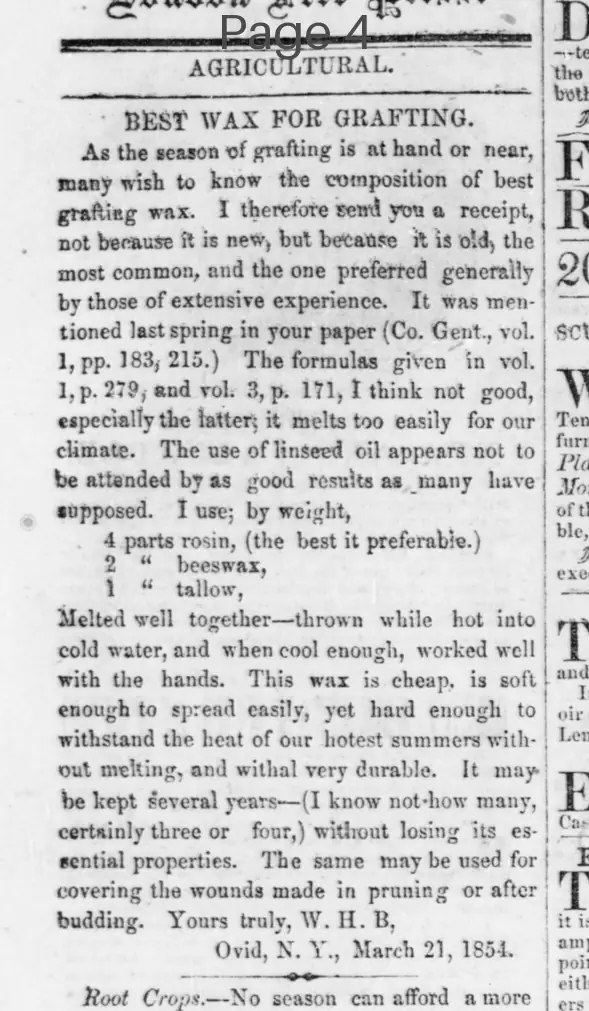
AGRICULTURAL.
BEST WAX FOR GRAFTING.
As the season of grafting is at hand or near, many wish to know the composition of best grafting wax. I therefore send you a receipt, not because it is new, but because it is old, the most common, and the one preferred generally by those of extensive experience. It was mentioned last spring in your paper (Co. Gent., vol. 1, pp. 183, 215.) The formulas given in vol. 1, p. 279, and vol. 3, p. 171, I think not good, especially the latter it melts too easily for our climate. The use of linseed oil appears not to be attended by as good results as many have supposed. I use; by weight,
4 parts rosin, (the best it preferable.)
beeswax,
tallow,
Melted well together--thrown while hot into cold water, and when cool enough, worked well with the hands. This wax is cheap, is soft enough to spread easily, yet hard enough to withstand the heat of our hottest summers without melting, and withal very durable. It may be kept several years-(I know not how many, certainly three or four, without losing its essential properties. The same may be used for covering the wounds made in pruning or after budding. Yours truly, W. H. B.
Ovid, N. Y., March 21, 1854.
BEST WAX FOR GRAFTING.
As the season of grafting is at hand or near, many wish to know the composition of best grafting wax. I therefore send you a receipt, not because it is new, but because it is old, the most common, and the one preferred generally by those of extensive experience. It was mentioned last spring in your paper (Co. Gent., vol. 1, pp. 183, 215.) The formulas given in vol. 1, p. 279, and vol. 3, p. 171, I think not good, especially the latter it melts too easily for our climate. The use of linseed oil appears not to be attended by as good results as many have supposed. I use; by weight,
4 parts rosin, (the best it preferable.)
beeswax,
tallow,
Melted well together--thrown while hot into cold water, and when cool enough, worked well with the hands. This wax is cheap, is soft enough to spread easily, yet hard enough to withstand the heat of our hottest summers without melting, and withal very durable. It may be kept several years-(I know not how many, certainly three or four, without losing its essential properties. The same may be used for covering the wounds made in pruning or after budding. Yours truly, W. H. B.
Ovid, N. Y., March 21, 1854.
What sub-type of article is it?
Agricultural Advice
Recipe
What keywords are associated?
Grafting Wax
Rosin
Beeswax
Tallow
Agriculture
Pruning
What entities or persons were involved?
W. H. B.
Where did it happen?
Ovid, N. Y.
Story Details
Key Persons
W. H. B.
Location
Ovid, N. Y.
Event Date
March 21, 1854
Story Details
A correspondent shares a preferred composition for grafting wax: 4 parts rosin, beeswax, and tallow by weight, melted together, cooled in water, and worked by hand. It is durable, cheap, and suitable for the climate, also useful for pruning wounds.