Thank you for visiting SNEWPapers!
Sign up free
Virginia Argus
Richmond, Virginia
What is this article about?
The Portuguese fortress of Almeida fell to French forces under Massena on August 28, 1810, after a powder magazine explosion destroyed half the town and killed many, forcing the governor to surrender the ammunition-depleted garrison as prisoners to France. Lord Wellington expressed regret in a dispatch, noting the unexpected loss despite strong defenses.
Clipping
OCR Quality
Full Text
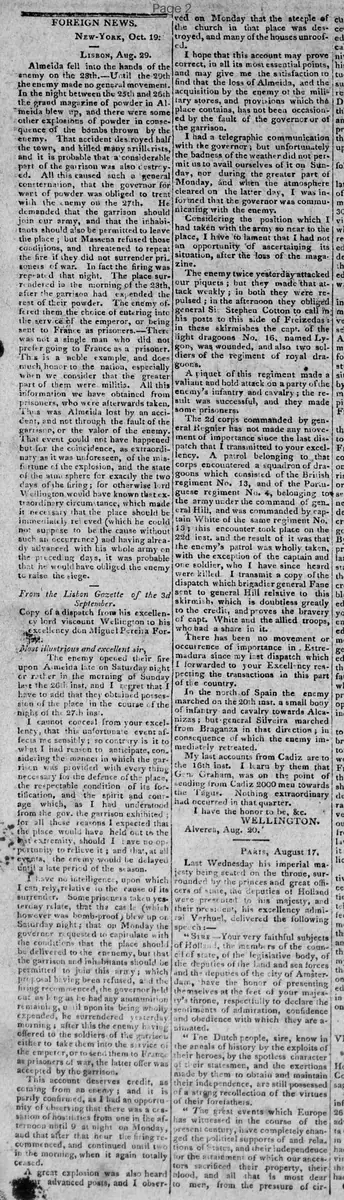
New-York, Oct. 19:
"Lisbon, Aug. 29.
Almeida fell into the hands of the enemy on the 28th. Until the 29th the enemy made no general movement.
In the night between the 25th and 26th the grand magazine of powder in Almeida blew up, and there were some other explosions of powder in consequence of the bombs thrown by the enemy. That accident destroyed half the town, and killed many artillerymen, and it is probable that a considerable part of the garrison was also destroyed. All this caused such a general consternation, that the governor for want of powder was obliged to treat with the enemy on the 27th. He demanded that the garrison should join our army, and that the inhabitants should also be permitted to leave the place; but Massena refused those conditions, and threatened to repeat the fire if they did not surrender prisoners of war. In fact the firing was repeated that night. The place surrendered in the morning of the 28th, after the garrison had expended the rest of their powder. The enemy offered them the choice of entering into the service of the emperor, or being sent to France as prisoners. There was not a single man who did not prefer going to France as a prisoner. This is a noble example, and does much honor to the nation, especially when we consider that the greater part of them were militia. All this information we have obtained from prisoners, who were afterwards taken.
Thus was Almeida lost by an accident, and not through the fault of the garrison, or the valor of the enemy. That event could not have happened but for the coincidence, as extraordinary as it was unforeseen, of the misfortune of the explosion, and the state of the atmosphere for exactly the two days of the firing; for otherwise lord Wellington would have known that extraordinary circumstance, which made it necessary that the place should be immediately relieved (which he could not suppose to be the cause without such an occurrence) and having already advanced with his whole army on the preceding days, it was probable that he would have obliged the enemy to raise the siege.
From the Lisbon Gazette of the 3d September.
Copy of a dispatch from his excellency lord viscount Wellington to his excellency don Miguel Pereira Forres:
Most illustrious and excellent sir,
The enemy opened their fire upon Almeida late on Saturday night or rather in the morning of Sunday last the 26th inst. and I regret that I have to add that they obtained possession of the place in the course of the night of the 27th inst.
I cannot conceal from your excellency, that this unfortunate event affects me sensibly; so contrary is it to what I had reason to anticipate, considering the manner in which the garrison was provided with every thing necessary for the defence of the place, the respectable condition of its fortification, and the spirit and courage which, as I had understood from the gov. the garrison exhibited; for all these reasons I expected that the place would have held out to the last extremity, should I have no opportunity to relieve it; and that, at all events, the enemy would be delayed until a late period of the season.
I have no intelligence, upon which I can rely, relative to the cause of its surrender. Some prisoners taken yesterday relate, that the castle (which however was bomb-proof) blew up on Saturday night; that on Monday the governor requested to capitulate with the conditions that the place should be delivered to the enemy, but that the garrison and inhabitants should be permitted to join this army; which proposal having been refused, and the firing recommenced, the governor held out as long as he had any ammunition remaining, until upon its being wholly expended, he surrendered yesterday morning; after this the enemy having offered to the soldiers of the garrison either to take them into the service of the emperor, or to send them to France as prisoners of war, the latter offer was accepted by the garrison.
This account deserves credit, as coming from an enemy: and it is partially confirmed, as I had an opportunity of observing that there was a cessation of hostilities from one in the afternoon until 9 at night on Monday, and that after that hour the firing recommenced, and continued until two in the morning, when it again totally ceased.
A great explosion was also heard at our advanced posts, and I observed on Monday that the steeple of
What sub-type of article is it?
What keywords are associated?
What entities or persons were involved?
Where did it happen?
Foreign News Details
Primary Location
Almeida
Event Date
Aug. 25 28
Key Persons
Outcome
explosion destroyed half the town and killed many artillerymen and probably part of the garrison; all surrendered as prisoners to france, none chose to enter french service.
Event Details
The fortress of Almeida surrendered to French forces after a powder magazine explosion on the night of Aug. 25-26, caused by enemy bombs, leading to ammunition shortage. Governor negotiated but Massena refused terms allowing garrison and inhabitants to join allied army; firing resumed, and place capitulated on Aug. 28 morning after expending remaining powder. Wellington's dispatch notes regret over the loss despite strong defenses and expected prolonged resistance.