Thank you for visiting SNEWPapers!
Sign up free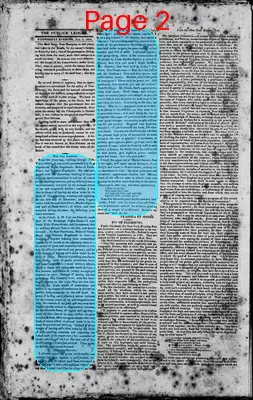
Letter to Editor
January 4, 1815
Norfolk Gazette And Publick Ledger
Norfolk, Virginia
What is this article about?
In 1814, the author walks through Norfolk's Wide-Water-Street and Market-Square, contrasting past commercial bustle with current wartime military presence, idle recruits, high food prices, and poverty, exemplified by a poor woman's lost meal and charitable aid.
Clipping
OCR Quality
98%
Excellent
Full Text
For the Ledger.
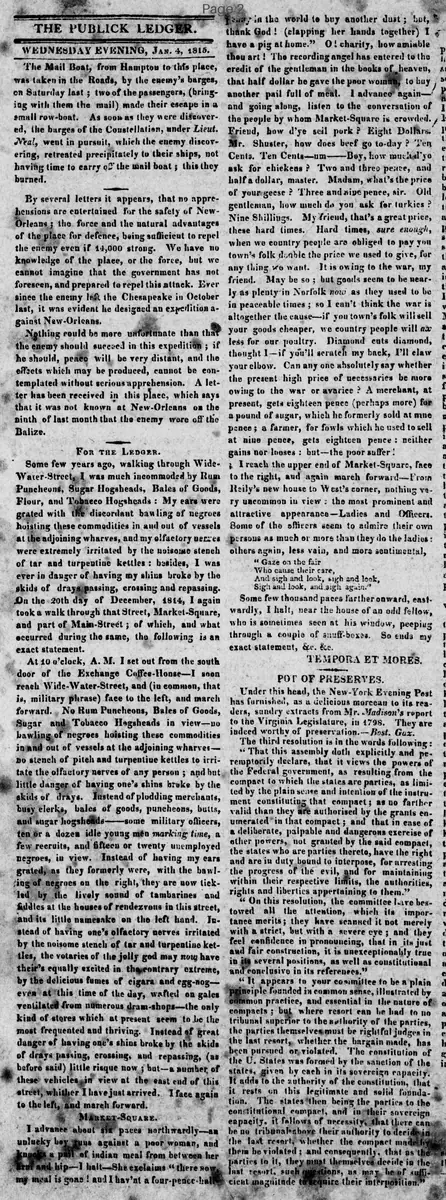
Some few years ago, walking through Wide-Water-Street, I was much incommoded by Rum Puncheons, Sugar Hogsheads, Bales of Goods, Flour, and Tobacco Hogsheads: My ears were grated with the discordant bawling of negroes hoisting these commodities in and out of vessels at the adjoining wharves, and my olfactory nerves were extremely irritated by the noisome stench of tar and turpentine kettles: besides, I was ever in danger of having my shins broke by the skids of drays passing, crossing and repassing.
On the 20th day of December, 1814, I again took a walk through that Street, Market-Square, and part of Main-Street; of which, and what occurred during the same, the following is an exact statement.
At 10 o'clock, A. M. I set out from the south door of the Exchange Coffee-House--I soon reach Wide-Water-Street, and (in common, that is, military phrase) face to the left, and march forward. No Rum Puncheons, Bales of Goods, Sugar and Tobacco Hogsheads in view--no bawling of negroes hoisting these commodities in and out of vessels at the adjoining wharves--no stench of pitch and turpentine kettles to irritate the olfactory nerves of any person; and but little danger of having one's shins broke by the skids of drays. Instead of plodding merchants, busy clerks, bales of goods, puncheons, butts, and sugar hogsheads---some military officers, ten or a dozen idle young men marking time, a few recruits, and fifteen or twenty unemployed negroes, in view. Instead of having my ears grated, as they formerly were, with the bawling of negroes on the right, they are now tickled by the lively sound of tambourines and fiddles at the houses of rendezvous in this street, and its little namesake on the left hand. Instead of having one's olfactory nerves irritated by the noisome stench of tar and turpentine kettles, the votaries of the jolly god may now have theirs equally excited in the contrary extreme, by the delicious fumes of cigars and egg-nog--even at this time of the day, wafts on gales ventilated from numerous dram-shops-the only kind of stores which at present seem to be the most frequented and thriving. Instead of great danger of having one's shins broke by the skids of drays passing, crossing, and repassing, (as before said) little risque now; but--a number of these vehicles in view at the east end of this street, whither I have just arrived. I face again to the left, and march forward.
MARKET-SQUARE.
I advance about six paces northwardly-an unlucky boy runs against a poor woman, and knocks a pail of indian meal from between her arm and hip--I halt-She exclaims "there now my meal is gone! and I haven't a cent in the world to buy another bushel; but, thank God! (clapping her hands together) I have a pig at home." O! charity, how amiable thou art! The recording angel has entered to the credit of the gentleman in the books of heaven, that half dollar he gave the poor woman, to buy another pail full of meal. I advance again--and going along, listen to the conversation of the people by whom Market-Square is crowded.
Friend, how d'ye sell pork? Eight Dollars. Mr. Shuster, how does beef go to-day? Ten Cents. Ten Cents--um--Boy, how much d'ye ask for chickens? Two and three pence, and half a dollar, master. Madam, what's the price of your geese? Three and nine pence, sir. Old gentleman, how much do you ask for turkeys? Nine Shillings. My friend, that's a great price, these hard times. Hard times, sure enough, when we country people are obliged to pay you town's folk double the price we used to give, for any thing we want. It is owing to the war, my friend. May be so; but goods seem to be nearly as plenty in Norfolk now as they used to be in peaceable times; so I can't think the war is altogether the cause-if you town's folk will sell your goods cheaper, we country people will ask less for our poultry. Diamond cuts diamond, thought I-if you'll scratch my back, I'll claw your elbow. Can any one absolutely say whether the present high price of necessaries be more owing to the war or avarice? A merchant, at present, gets eighteen pence (perhaps more) for a pound of sugar, which he formerly sold at nine pence; a farmer, for fowls which he used to sell at nine pence, gets eighteen pence: neither gains nor loses: but-the poor suffer!
I reach the upper end of Market-Square, face to the right, and again march forward--From Reily's new house to West's corner, nothing very uncommon in view: the most prominent and attractive appearance-Ladies and Officers. Some of the officers seem to admire their own persons as much or more than they do the ladies: others again, less vain, and more sentimental, "Gaze on the fair Who cause their care, And sigh and look, sigh and look, Sigh and look, and sigh again."
Some few thousand paces farther onward, eastwardly, I halt, near the house of an odd fellow, who is sometimes seen at his window, peeping through a couple of snuff-boxes. So ends my exact statement, &c. &c.
Some few years ago, walking through Wide-Water-Street, I was much incommoded by Rum Puncheons, Sugar Hogsheads, Bales of Goods, Flour, and Tobacco Hogsheads: My ears were grated with the discordant bawling of negroes hoisting these commodities in and out of vessels at the adjoining wharves, and my olfactory nerves were extremely irritated by the noisome stench of tar and turpentine kettles: besides, I was ever in danger of having my shins broke by the skids of drays passing, crossing and repassing.
On the 20th day of December, 1814, I again took a walk through that Street, Market-Square, and part of Main-Street; of which, and what occurred during the same, the following is an exact statement.
At 10 o'clock, A. M. I set out from the south door of the Exchange Coffee-House--I soon reach Wide-Water-Street, and (in common, that is, military phrase) face to the left, and march forward. No Rum Puncheons, Bales of Goods, Sugar and Tobacco Hogsheads in view--no bawling of negroes hoisting these commodities in and out of vessels at the adjoining wharves--no stench of pitch and turpentine kettles to irritate the olfactory nerves of any person; and but little danger of having one's shins broke by the skids of drays. Instead of plodding merchants, busy clerks, bales of goods, puncheons, butts, and sugar hogsheads---some military officers, ten or a dozen idle young men marking time, a few recruits, and fifteen or twenty unemployed negroes, in view. Instead of having my ears grated, as they formerly were, with the bawling of negroes on the right, they are now tickled by the lively sound of tambourines and fiddles at the houses of rendezvous in this street, and its little namesake on the left hand. Instead of having one's olfactory nerves irritated by the noisome stench of tar and turpentine kettles, the votaries of the jolly god may now have theirs equally excited in the contrary extreme, by the delicious fumes of cigars and egg-nog--even at this time of the day, wafts on gales ventilated from numerous dram-shops-the only kind of stores which at present seem to be the most frequented and thriving. Instead of great danger of having one's shins broke by the skids of drays passing, crossing, and repassing, (as before said) little risque now; but--a number of these vehicles in view at the east end of this street, whither I have just arrived. I face again to the left, and march forward.
MARKET-SQUARE.
I advance about six paces northwardly-an unlucky boy runs against a poor woman, and knocks a pail of indian meal from between her arm and hip--I halt-She exclaims "there now my meal is gone! and I haven't a cent in the world to buy another bushel; but, thank God! (clapping her hands together) I have a pig at home." O! charity, how amiable thou art! The recording angel has entered to the credit of the gentleman in the books of heaven, that half dollar he gave the poor woman, to buy another pail full of meal. I advance again--and going along, listen to the conversation of the people by whom Market-Square is crowded.
Friend, how d'ye sell pork? Eight Dollars. Mr. Shuster, how does beef go to-day? Ten Cents. Ten Cents--um--Boy, how much d'ye ask for chickens? Two and three pence, and half a dollar, master. Madam, what's the price of your geese? Three and nine pence, sir. Old gentleman, how much do you ask for turkeys? Nine Shillings. My friend, that's a great price, these hard times. Hard times, sure enough, when we country people are obliged to pay you town's folk double the price we used to give, for any thing we want. It is owing to the war, my friend. May be so; but goods seem to be nearly as plenty in Norfolk now as they used to be in peaceable times; so I can't think the war is altogether the cause-if you town's folk will sell your goods cheaper, we country people will ask less for our poultry. Diamond cuts diamond, thought I-if you'll scratch my back, I'll claw your elbow. Can any one absolutely say whether the present high price of necessaries be more owing to the war or avarice? A merchant, at present, gets eighteen pence (perhaps more) for a pound of sugar, which he formerly sold at nine pence; a farmer, for fowls which he used to sell at nine pence, gets eighteen pence: neither gains nor loses: but-the poor suffer!
I reach the upper end of Market-Square, face to the right, and again march forward--From Reily's new house to West's corner, nothing very uncommon in view: the most prominent and attractive appearance-Ladies and Officers. Some of the officers seem to admire their own persons as much or more than they do the ladies: others again, less vain, and more sentimental, "Gaze on the fair Who cause their care, And sigh and look, sigh and look, Sigh and look, and sigh again."
Some few thousand paces farther onward, eastwardly, I halt, near the house of an odd fellow, who is sometimes seen at his window, peeping through a couple of snuff-boxes. So ends my exact statement, &c. &c.
What sub-type of article is it?
Reflective
Social Critique
Comedic
What themes does it cover?
Military War
Commerce Trade
Social Issues
What keywords are associated?
Norfolk Streets
War 1814
Market Square
High Prices
Military Officers
Poverty
Commerce Decline
Charity
Economic Hardship
What entities or persons were involved?
For The Ledger
Letter to Editor Details
Recipient
For The Ledger
Main Argument
the streets of norfolk have shifted from commercial activity to military idleness and wartime economic strain, with high prices affecting the poor more than merchants or farmers, questioning if war or avarice is the cause.
Notable Details
Contrast Between Past Commerce And 1814 Military Presence
Poor Woman's Lost Meal And Charitable Half Dollar
Market Prices: Pork 8 Dollars, Beef 10 Cents, Chickens 2 3 Pence To Half Dollar, Geese 3/9 Pence, Turkeys 9 Shillings
Quote On Officers Gazing At Ladies
Debate On High Prices Due To War Or Avarice