Thank you for visiting SNEWPapers!
Sign up free
Story
November 30, 1911
The Miller Press
Miller, Hand County, South Dakota
What is this article about?
Henry Clay Beattie, Jr., confessed to murdering his wife and was executed by electric chair in Virginia state penitentiary on November 25, 1911, after a final parting with his loyal father and prayers with spiritual advisers.
Clipping
OCR Quality
98%
Excellent
Full Text
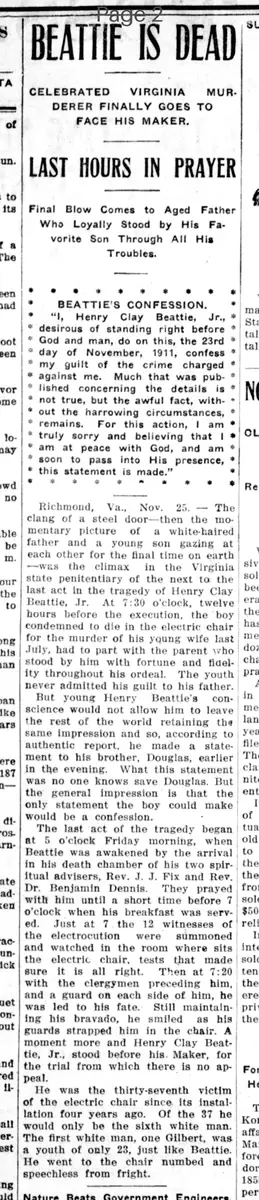
BEATTIE IS DEAD
CELEBRATED VIRGINIA MURDERER FINALLY GOES TO FACE HIS MAKER.
LAST HOURS IN PRAYER
Final Blow Comes to Aged Father Who Loyally Stood by His Favorite Son Through All His Troubles.
BEATTIE'S CONFESSION.
"I, Henry Clay Beattie, Jr., desirous of standing right before God and man, do on this, the 23rd day of November, 1911, confess my guilt of the crime charged against me. Much that was published concerning the details is not true, but the awful fact, without the harrowing circumstances, remains. For this action, I am truly sorry and believing that I am at peace with God, and am soon to pass into His presence, this statement is made."
Richmond, Va., Nov. 25. - The clang of a steel door—then the momentary picture of a white-haired father and a young son gazing at each other for the final time on earth—was the climax in the Virginia state penitentiary of the next to the last act in the tragedy of Henry Clay Beattie, Jr. At 7:30 o'clock, twelve hours before the execution, the boy condemned to die in the electric chair for the murder of his young wife last July, had to part with the parent who stood by him with fortune and fidelity throughout his ordeal. The youth never admitted his guilt to his father. But young Henry Beattie's conscience would not allow him to leave the rest of the world retaining the same impression and so, according to authentic report, he made a statement to his brother, Douglas, earlier in the evening. What this statement was no one knows save Douglas. But the general impression is that the only statement the boy could make would be a confession.
The last act of the tragedy began at 5 o'clock Friday morning, when Beattie was awakened by the arrival in his death chamber of his two spiritual advisers, Rev. J. J. Fix and Rev. Dr. Benjamin Dennis. They prayed with him until a short time before 7 o'clock when his breakfast was served. Just at 7 the 12 witnesses of the electrocution were summoned and watched in the room where sits the electric chair. Tests that made sure it is all right. Then at 7:20 with the clergymen preceding him, and a guard on each side of him, he was led to his fate. Still maintaining his bravado, he smiled as his guards strapped him in the chair. A moment more and Henry Clay Beattie, Jr., stood before his Maker, for the trial from which there is no appeal.
He was the thirty-seventh victim of the electric chair since its installation four years ago. Of the 37 he would only be the sixth white man. The first white man, one Gilbert, was a youth of only 23, just like Beattie. He went to the chair numbed and speechless from fright.
CELEBRATED VIRGINIA MURDERER FINALLY GOES TO FACE HIS MAKER.
LAST HOURS IN PRAYER
Final Blow Comes to Aged Father Who Loyally Stood by His Favorite Son Through All His Troubles.
BEATTIE'S CONFESSION.
"I, Henry Clay Beattie, Jr., desirous of standing right before God and man, do on this, the 23rd day of November, 1911, confess my guilt of the crime charged against me. Much that was published concerning the details is not true, but the awful fact, without the harrowing circumstances, remains. For this action, I am truly sorry and believing that I am at peace with God, and am soon to pass into His presence, this statement is made."
Richmond, Va., Nov. 25. - The clang of a steel door—then the momentary picture of a white-haired father and a young son gazing at each other for the final time on earth—was the climax in the Virginia state penitentiary of the next to the last act in the tragedy of Henry Clay Beattie, Jr. At 7:30 o'clock, twelve hours before the execution, the boy condemned to die in the electric chair for the murder of his young wife last July, had to part with the parent who stood by him with fortune and fidelity throughout his ordeal. The youth never admitted his guilt to his father. But young Henry Beattie's conscience would not allow him to leave the rest of the world retaining the same impression and so, according to authentic report, he made a statement to his brother, Douglas, earlier in the evening. What this statement was no one knows save Douglas. But the general impression is that the only statement the boy could make would be a confession.
The last act of the tragedy began at 5 o'clock Friday morning, when Beattie was awakened by the arrival in his death chamber of his two spiritual advisers, Rev. J. J. Fix and Rev. Dr. Benjamin Dennis. They prayed with him until a short time before 7 o'clock when his breakfast was served. Just at 7 the 12 witnesses of the electrocution were summoned and watched in the room where sits the electric chair. Tests that made sure it is all right. Then at 7:20 with the clergymen preceding him, and a guard on each side of him, he was led to his fate. Still maintaining his bravado, he smiled as his guards strapped him in the chair. A moment more and Henry Clay Beattie, Jr., stood before his Maker, for the trial from which there is no appeal.
He was the thirty-seventh victim of the electric chair since its installation four years ago. Of the 37 he would only be the sixth white man. The first white man, one Gilbert, was a youth of only 23, just like Beattie. He went to the chair numbed and speechless from fright.
What sub-type of article is it?
Crime Story
Tragedy
Historical Event
What themes does it cover?
Crime Punishment
Justice
Tragedy
What keywords are associated?
Murder Confession
Electric Chair Execution
Father Son Parting
Virginia Penitentiary
What entities or persons were involved?
Henry Clay Beattie, Jr.
Douglas Beattie
Rev. J. J. Fix
Rev. Dr. Benjamin Dennis
Where did it happen?
Richmond, Va., Virginia State Penitentiary
Story Details
Key Persons
Henry Clay Beattie, Jr.
Douglas Beattie
Rev. J. J. Fix
Rev. Dr. Benjamin Dennis
Location
Richmond, Va., Virginia State Penitentiary
Event Date
November 25, 1911
Story Details
Henry Clay Beattie, Jr., confessed his guilt in murdering his wife on November 23, 1911, parted with his father, prayed with advisers, and was executed by electric chair on November 25, 1911, maintaining bravado until the end.