Thank you for visiting SNEWPapers!
Sign up free
Literary
September 3, 1818
Alexandria Gazette & Daily Advertiser
Alexandria, Virginia
What is this article about?
This essay discusses 'castle-building'—imaginative daydreaming—as a refuge from boredom and a tool for mental and moral enhancement, drawing on an acquaintance's habits and literary examples like Alnaschar. It warns of excesses leading to impracticality and misanthropy, advocating moderation. Signed Curio.
Clipping
OCR Quality
95%
Excellent
Full Text
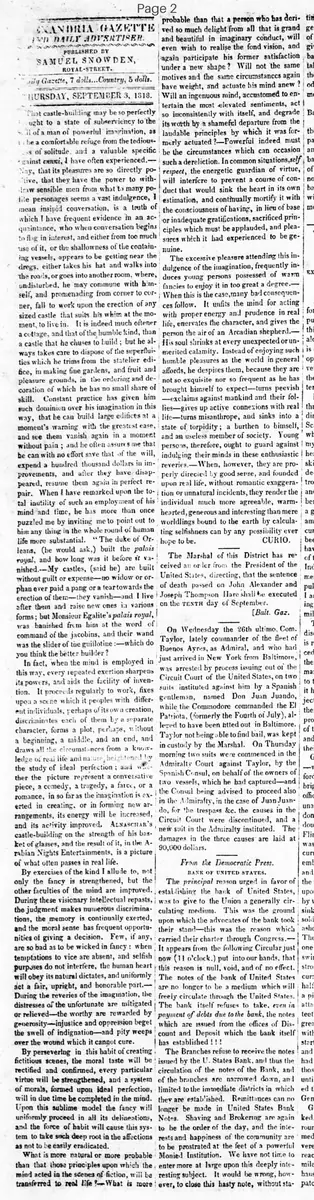
That castle-building may be so perfectly brought to a state of subserviency to the will of a man of powerful imagination, as he a comfortable refuge from the tediousness of solitude, and a valuable specific against ennui, I have often experienced.
Nay, that its pleasures are so directly palliative, that they have the power to withdraw sensible men from what to many polite personages seems a vast indulgence, I mean insipid conversation, is a truth of which I have frequent evidence in an acquaintance, who when conversation begins to flag in interest, and either from too much use of it, or the shallowness of the containing vessels, appears to be getting near the dregs, either takes his hat and walks into the roads, or goes into another room, where, undisturbed, he may commune with himself, and promenading from corner to corner, fall to work upon the erection of any sized castle that suits his whim at the moment, to live in. It is indeed much oftener a cottage, and that of the humble kind, than a castle that he chooses to build: but he always takes care to dispose of the superfluities which he trims from the statelier edifice, in making fine gardens, and fruit and pleasure grounds, in the ordering and decoration of which he has no small share of skill. Constant practice has given him such dominion over his imagination in this way, that he can build large edifices at a moment's warning with the greatest ease, and see them vanish again in a moment without pain; and he often assures me that he can with no effort save that of the will, expend a hundred thousand dollars in improvements, and after they have disappeared, resume them again in perfect repair. When I have remarked upon the total inutility of such an employment of his mind and time, he has more than once puzzled me by inviting me to point out to him any thing in the whole round of human life more substantial. "The duke of Orleans, (he would ask,) built the palais royal, and how long was it before it vanished.--My castles, (said he) are built without guilt or expense-no widow or orphan ever paid a pang or a tear towards the erection of them-they vanish-and I live after them and raise new ones in various forms; but Monsieur Egalite's palais royal, was banished from him at the word of command of the Jacobins, and their wand was the slider of the guillotine :-which do you think the better builder?"
In fact, when the mind is employed in this way, every repeated exertion sharpens its powers, and aids the facility of invention. It proceeds regularly to work, fixes upon a scene which it peoples with different individuals, perhaps of its own creation, discriminates each of them by a separate character, forms a plot, perhaps, without a beginning, a middle, and an end, and draws all the circumstances from a knowledge of real life and nature, heightened by the study of ideal perfection; and whether the picture represent a conservative piece, a comedy, a tragedy, a farce, or a romance, in so far as the imagination is exerted in creating, or in forming new arrangements, its energy will be increased, and its activity improved. Alnaschar's castle-building on the strength of his basket of glasses, and the result of it, in the Arabian Nights Entertainments, is a picture of what often passes in real life.
By exercises of the kind I allude to, not only the fancy is strengthened, but the other faculties of the mind are improved. During these visionary intellectual repasts, the judgment makes numerous discriminations, the memory is continually exerted, and the moral sense has frequent opportunities of giving a decision. Few, if any, are so bad as to be wicked in fancy: when temptations to vice are absent, and selfish purposes do not interfere, the human heart will obey its natural dictates, and uniformly act a fair, upright, and honorable part.
During the reveries of the imagination, the distresses of the unfortunate are mitigated or relieved-the worthy are rewarded by generosity-injustice and oppression beget the swell of indignation-and pity weeps over the wound which it cannot cure.
By persevering in this habit of creating fictitious scenes, the moral taste will be rectified and confirmed, every particular virtue will be strengthened, and a system of morals, formed upon ideal perfection, will in due time be completed in the mind. Upon this sublime model the fancy will uniformly proceed in all its delineations, and the force of habit will cause this system to take such deep root in the affections as not to be easily eradicated.
What is more natural or more probable than that those principles upon which the mind acted in the scenes of fiction, will be transferred to real life?-- What is more probable than that a person who has derived so much delight from all that is grand and beautiful in imaginary conduct, will even wish to realise the fond vision, and again participate his former satisfaction under a new shape? Will not the same motives and the same circumstances again have weight, and actuate his mind anew? Will an ingenuous mind, accustomed to entertain the most elevated sentiments, act so inconsistently with itself, and degrade its worth by a shameful departure from the laudable principles by which it was formerly actuated?-Powerful indeed must be the circumstances which can occasion such a dereliction. In common situations, self respect, the energetic guardian of virtue, will interfere to prevent a course of conduct that would sink the heart in its own estimation, and continually mortify it with the consciousness of having, in lieu of base or inadequate gratifications, sacrificed principles which must be applauded, and pleasures which it had experienced to be genuine.
The excessive pleasure attending this indulgence of the imagination, frequently induces young persons possessed of warm fancies to enjoy it in too great a degree.- When this is the case, many bad consequences follow. It unfits the mind for acting with proper energy and prudence in real life, enervates the character, and gives the person the air of an Arcadian shepherd.- His soul shrinks at every unexpected or unmerited calamity. Instead of enjoying such humble pleasures as the world in general affords, he despises them, because they are not so exquisite nor so frequent as he has brought himself to expect--turns peevish -exclaims against mankind and their follies-gives up active connexions with real life-turns misanthrope, and sinks into a state of torpidity; a burthen to himself, and an useless member of society. Young persons, therefore, ought to guard against indulging their minds in these enthusiastic reveries.-When, however, they are properly directed by good sense, and founded upon real life, without romantic exaggeration or unnatural incidents, they render the individual much more agreeable, warm-hearted, generous and interesting than mere worldlings bound to the earth by calculating selfishness can by any possibility ever hope to be.
CURIO.
Nay, that its pleasures are so directly palliative, that they have the power to withdraw sensible men from what to many polite personages seems a vast indulgence, I mean insipid conversation, is a truth of which I have frequent evidence in an acquaintance, who when conversation begins to flag in interest, and either from too much use of it, or the shallowness of the containing vessels, appears to be getting near the dregs, either takes his hat and walks into the roads, or goes into another room, where, undisturbed, he may commune with himself, and promenading from corner to corner, fall to work upon the erection of any sized castle that suits his whim at the moment, to live in. It is indeed much oftener a cottage, and that of the humble kind, than a castle that he chooses to build: but he always takes care to dispose of the superfluities which he trims from the statelier edifice, in making fine gardens, and fruit and pleasure grounds, in the ordering and decoration of which he has no small share of skill. Constant practice has given him such dominion over his imagination in this way, that he can build large edifices at a moment's warning with the greatest ease, and see them vanish again in a moment without pain; and he often assures me that he can with no effort save that of the will, expend a hundred thousand dollars in improvements, and after they have disappeared, resume them again in perfect repair. When I have remarked upon the total inutility of such an employment of his mind and time, he has more than once puzzled me by inviting me to point out to him any thing in the whole round of human life more substantial. "The duke of Orleans, (he would ask,) built the palais royal, and how long was it before it vanished.--My castles, (said he) are built without guilt or expense-no widow or orphan ever paid a pang or a tear towards the erection of them-they vanish-and I live after them and raise new ones in various forms; but Monsieur Egalite's palais royal, was banished from him at the word of command of the Jacobins, and their wand was the slider of the guillotine :-which do you think the better builder?"
In fact, when the mind is employed in this way, every repeated exertion sharpens its powers, and aids the facility of invention. It proceeds regularly to work, fixes upon a scene which it peoples with different individuals, perhaps of its own creation, discriminates each of them by a separate character, forms a plot, perhaps, without a beginning, a middle, and an end, and draws all the circumstances from a knowledge of real life and nature, heightened by the study of ideal perfection; and whether the picture represent a conservative piece, a comedy, a tragedy, a farce, or a romance, in so far as the imagination is exerted in creating, or in forming new arrangements, its energy will be increased, and its activity improved. Alnaschar's castle-building on the strength of his basket of glasses, and the result of it, in the Arabian Nights Entertainments, is a picture of what often passes in real life.
By exercises of the kind I allude to, not only the fancy is strengthened, but the other faculties of the mind are improved. During these visionary intellectual repasts, the judgment makes numerous discriminations, the memory is continually exerted, and the moral sense has frequent opportunities of giving a decision. Few, if any, are so bad as to be wicked in fancy: when temptations to vice are absent, and selfish purposes do not interfere, the human heart will obey its natural dictates, and uniformly act a fair, upright, and honorable part.
During the reveries of the imagination, the distresses of the unfortunate are mitigated or relieved-the worthy are rewarded by generosity-injustice and oppression beget the swell of indignation-and pity weeps over the wound which it cannot cure.
By persevering in this habit of creating fictitious scenes, the moral taste will be rectified and confirmed, every particular virtue will be strengthened, and a system of morals, formed upon ideal perfection, will in due time be completed in the mind. Upon this sublime model the fancy will uniformly proceed in all its delineations, and the force of habit will cause this system to take such deep root in the affections as not to be easily eradicated.
What is more natural or more probable than that those principles upon which the mind acted in the scenes of fiction, will be transferred to real life?-- What is more probable than that a person who has derived so much delight from all that is grand and beautiful in imaginary conduct, will even wish to realise the fond vision, and again participate his former satisfaction under a new shape? Will not the same motives and the same circumstances again have weight, and actuate his mind anew? Will an ingenuous mind, accustomed to entertain the most elevated sentiments, act so inconsistently with itself, and degrade its worth by a shameful departure from the laudable principles by which it was formerly actuated?-Powerful indeed must be the circumstances which can occasion such a dereliction. In common situations, self respect, the energetic guardian of virtue, will interfere to prevent a course of conduct that would sink the heart in its own estimation, and continually mortify it with the consciousness of having, in lieu of base or inadequate gratifications, sacrificed principles which must be applauded, and pleasures which it had experienced to be genuine.
The excessive pleasure attending this indulgence of the imagination, frequently induces young persons possessed of warm fancies to enjoy it in too great a degree.- When this is the case, many bad consequences follow. It unfits the mind for acting with proper energy and prudence in real life, enervates the character, and gives the person the air of an Arcadian shepherd.- His soul shrinks at every unexpected or unmerited calamity. Instead of enjoying such humble pleasures as the world in general affords, he despises them, because they are not so exquisite nor so frequent as he has brought himself to expect--turns peevish -exclaims against mankind and their follies-gives up active connexions with real life-turns misanthrope, and sinks into a state of torpidity; a burthen to himself, and an useless member of society. Young persons, therefore, ought to guard against indulging their minds in these enthusiastic reveries.-When, however, they are properly directed by good sense, and founded upon real life, without romantic exaggeration or unnatural incidents, they render the individual much more agreeable, warm-hearted, generous and interesting than mere worldlings bound to the earth by calculating selfishness can by any possibility ever hope to be.
CURIO.
What sub-type of article is it?
Essay
What themes does it cover?
Moral Virtue
Temperance
What keywords are associated?
Imagination
Castle Building
Moral Improvement
Daydreaming
Reverie
Ennui
Virtue
Fancy
What entities or persons were involved?
Curio
Literary Details
Author
Curio
Subject
On Castle Building And The Imagination
Key Lines
That Castle Building May Be So Perfectly Brought To A State Of Subserviency To The Will Of A Man Of Powerful Imagination, As He A Comfortable Refuge From The Tediousness Of Solitude, And A Valuable Specific Against Ennui, I Have Often Experienced.
The Duke Of Orleans, (He Would Ask,) Built The Palais Royal, And How Long Was It Before It Vanished. My Castles, (Said He) Are Built Without Guilt Or Expense No Widow Or Orphan Ever Paid A Pang Or A Tear Towards The Erection Of Them They Vanish And I Live After Them And Raise New Ones In Various Forms; But Monsieur Egalite's Palais Royal, Was Banished From Him At The Word Of Command Of The Jacobins, And Their Wand Was The Slider Of The Guillotine : Which Do You Think The Better Builder?
By Persevering In This Habit Of Creating Fictitious Scenes, The Moral Taste Will Be Rectified And Confirmed, Every Particular Virtue Will Be Strengthened, And A System Of Morals, Formed Upon Ideal Perfection, Will In Due Time Be Completed In The Mind.
What Is More Natural Or More Probable Than That Those Principles Upon Which The Mind Acted In The Scenes Of Fiction, Will Be Transferred To Real Life?
Young Persons, Therefore, Ought To Guard Against Indulging Their Minds In These Enthusiastic Reveries. When, However, They Are Properly Directed By Good Sense, And Founded Upon Real Life, Without Romantic Exaggeration Or Unnatural Incidents, They Render The Individual Much More Agreeable, Warm Hearted, Generous And Interesting Than Mere Worldlings Bound To The Earth By Calculating Selfishness Can By Any Possibility Ever Hope To Be.