Thank you for visiting SNEWPapers!
Sign up free
River Falls Journal
River Falls, Saint Croix County, Pierce County, Wisconsin
What is this article about?
Article on wood decay caused by fungi and bacteria, prevented by antiseptics and oils; historical preservation examples from Baltic and Egypt; critical for U.S. railroads using millions of ties annually, with government research to extend timber life and save costs.
Clipping
OCR Quality
Full Text
Piles driven by the hut dwellers of the Baltic centuries ago are as sound today as when first placed. The wooden coffins in which the Egyptians buried their dead are still preserved in perfect condition after thousands of years of service.
The longevity of timber under these two extremes of climate and moisture conditions has naturally made people ask, what causes wood decay? The answer is, fungi and bacteria, low forms of plant life which live in the wood and draw their nourishment from it. The little organisms are so little that a microscope is required to see them, yet their work results in the destruction of billions of feet of timber each year and the railroad corporation with its cross tie bill running up into seven figures and the farmer who spends a hundred or so dollars a year for fence posts are alike drawing upon the knowledge of experts in all parts of the world in efforts to learn the most economical and most satisfactory method of preserving wood against the inroads of decay. In studying the means of preventing decay wood-preserving experts have learned many things about the obnoxious fungi which sap the life of timber.
The small organisms can grow either in light or in total darkness; but all of them require requisite amounts of air, food, moisture and heat. If one or more of these essential requirements is lacking, they cannot live, and the decay of timber will not take place. Wood constantly submerged in water never rots, simply because there is an insufficient supply of air. This condition accounts for the soundness of the old Baltic piles. On the other hand, if wood can be kept air-dry it will not decay because there will then be too little moisture. The timber used by the Egyptians will last indefinitely so long as it is bone-dry.
There are a great many cases, however, where it is impossible to keep wood submerged in water, or in an absolutely air-dry condition. In fact, a large percentage of the timber which is used is exposed to the weather, and is subjected to decay simply because it contains enough air and enough water for the decomposing organisms to get a foothold. Decay is most serious where the atmosphere is warm and damp, because these conditions are most favorable for its development. In the coal mines of Pennsylvania timber decays in two or three years because the temperature is warm and constant and the air is damp. And in the south, the warm, humid atmosphere often causes the timber to rapidly decompose.
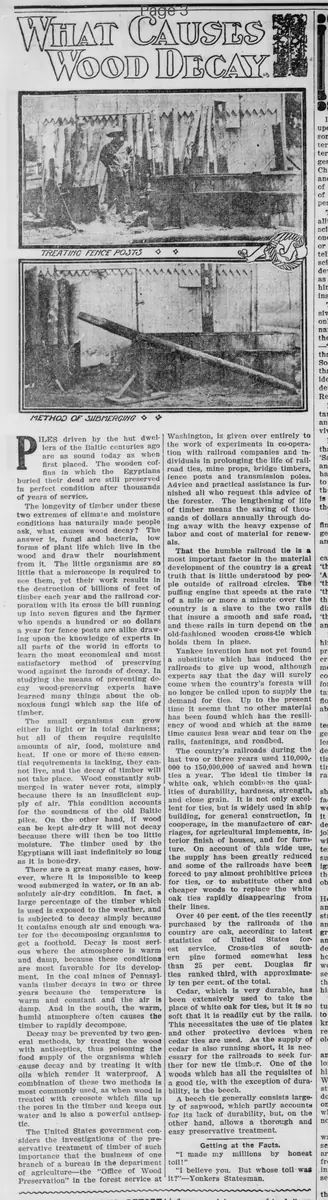
Decay may be prevented by two general methods, by treating the wood with antiseptics, thus poisoning the food supply of the organisms which cause decay and by treating it with oils which render it waterproof. A combination of these two methods is most commonly used, as when wood is treated with creosote which fills up the pores in the timber and keeps out water and is also a powerful antiseptic.
The United States government considers the investigations of the preservative treatment of timber of such importance that the business of one branch of a bureau in the department of agriculture—the "Office of Wood Preservation" in the forest service at Washington, is given over entirely to the work of experiments in co-operation with railroad companies and individuals in prolonging the life of railroad ties, mine props, bridge timbers, fence posts and transmission poles. Advice and practical assistance is furnished all who request this advice of the forester. The lengthening of life of timber means the saving of thousands of dollars annually through doing away with the heavy expense of labor and cost of material for renewals.
That the humble railroad tie is a most important factor in the material development of the country is a great truth that is little understood by people outside of railroad circles. The puffing engine that speeds at the rate of a mile or more a minute over the country is a slave to the two rails that insure a smooth and safe road, and these rails in turn depend on the old-fashioned wooden cross-tie which holds them in place. Yankee invention has not yet found a substitute which has induced the railroads to give up wood, although experts say that the day will surely come when the country's forests will no longer be called upon to supply the demand for ties. Up to the present time it seems that no other material has been found which has the resiliency of wood and which at the same time causes less wear and tear on the rails, fastenings, and roadbed.
The country's railroads during the last two or three years used 110,000,000 to 150,000,000 of sawed and hewn ties a year. The ideal tie timber is white oak, which combines the qualities of durability, hardness, strength and close grain. It is not only excellent for ties, but is widely used in ship building, for general construction, in cooperage, in the manufacture of carriages, for agricultural implements, interior finish of houses, and for furniture. On account of this wide use, the supply has been greatly reduced and some of the railroads have been forced to pay almost prohibitive prices for ties, or to substitute other and cheaper woods to replace the white oak ties rapidly disappearing from their lines.
Over 40 per cent. of the ties recently purchased by the railroads of the country are oak, according to latest statistics of United States forest service. Cross-ties of southern pine formed somewhat less than 25 per cent. Douglas fir ties ranked third, with approximately ten per cent. of the total. Cedar, which is very durable, has been extensively used to take the place of white oak for ties, but it is so soft that it is readily cut by the rails. This necessitates the use of tie plates and other protective devices when cedar ties are used. As the supply of cedar is also running short, it is necessary for the railroads to seek further for new tie timber. One of the woods which has all the requisites of a good tie, with the exception of durability, is the beech. A beech tie generally consists largely of sapwood, which partly accounts for its lack of durability, but, on the other hand, allows a thorough and easy preservative treatment.
What sub-type of article is it?
What themes does it cover?
What keywords are associated?
Where did it happen?
Story Details
Location
Baltic, Egypt, Pennsylvania Coal Mines, Southern United States, Washington
Story Details
The article discusses causes of wood decay by fungi and bacteria, which require air, moisture, heat, and food; historical examples of preserved wood in Baltic piles and Egyptian coffins; prevention methods using antiseptics and oils like creosote; importance for railroads, with statistics on tie usage and types; and U.S. government efforts in wood preservation.