Thank you for visiting SNEWPapers!
Sign up free
Constitutional Whig
Richmond, Virginia
What is this article about?
General Lafayette delivers an impromptu speech in the French Chamber of Deputies on June 6 opposing the double vote law, defending the Charter and Constituent Assembly. The motion passes amid applause from the left. A later debate on mayoral elections leads to heated exchanges praising and criticizing the Constituent Assembly.
Clipping
OCR Quality
Full Text
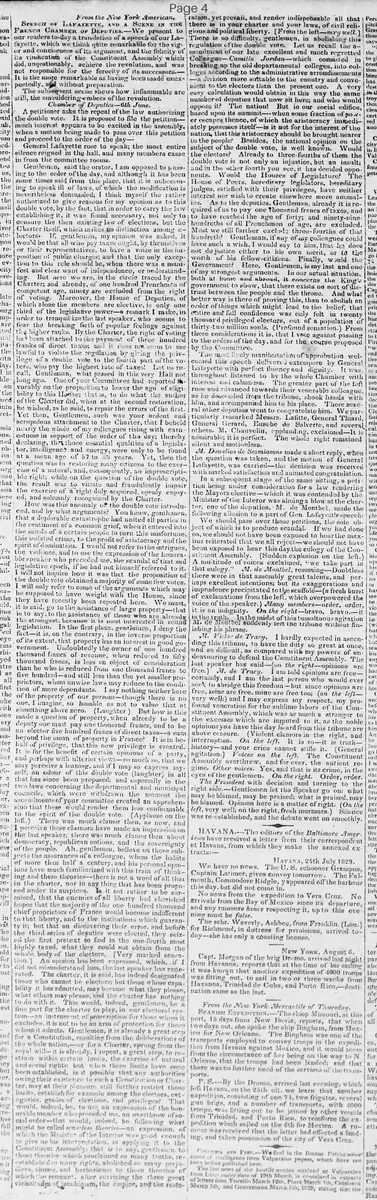
Speech of Lafayette, and a Scene in the French Chamber of Deputies. We present to our readers to-day a translation of a speech of our Lafayette, which we think quite remarkable for the vigor and conciseness of its argument, and the felicity of its vindication of the Constituent Assembly which did, unquestionably, achieve the revolution, and was not responsible for the ferocity of its successors.—It is the more remarkable as having been made unexpectedly, without preparation.
The subsequent scene shews how inflammable are still, the smouldering embers of the revolution.
Chamber of Deputies—6th June.
A petitioner asks the repeal of the law authorizing the double vote. It is proposed to file the petition—much interest appears to be excited in the assembly, when a motion being made to pass over this petition and proceed to the order of the day—
General Lafayette rose to speak; the most entire silence reigned in the hall, and many members came in from the committee rooms.
Gentlemen, said the orator, I am opposed to passing to the order of the day, and although it has been some times said from this place, that it is unbecoming to speak ill of laws, of which the modification is nevertheless demanded; I think myself the rather authorized to give reasons for my opinion as to this double vote, by the fact, that in order to carry the law establishing it, it was found necessary, not only to censure the then existing law of elections, but the Charter itself, which makes no distinction among electors. If, gentlemen, my opinion was asked, it would be that all who pay taxes ought, by themselves or their representatives, to have a voice in the imposition of public charges; and that the only exception to this rule should be, when there was a manifest and clear want of independence, or understanding.
But here we are, in the circle traced by the Charter: and already, of one hundred Frenchmen of competent age, ninety are excluded from the right of voting. Moreover, the House of Deputies, of which alone the members are elective, is only one third of the legislative power—a remark I make, in order to tranquillize the last speaker, who seems to fear the breaking forth of popular feelings against the higher ranks. By the Charter, the right of voting has been attached to the payment of three hundred francs of direct taxes; and it does not seem to me lawful to violate the regulation by giving the privilege of a double vote to the fourth part of the voters, who pay the highest rate of taxes! Let us recall, Gentlemen, what passed in this very Hall not long ago. One of your Committees had reported favorably on the proposition to lower the age of eligibility to this House; that is, to do what the author of the Charter did, when at the second restoration, he wished, as he said, to repair the errors of the first. Yet then, Gentlemen, such was your ardent and scrupulous attachment to the Charter, that I beheld nearly the whole of my colleagues rising with earnestness in support of the order of the day; thereby declaring, that those essential qualities of a legislator, intelligence and energy, were only to be found at a mean age of 57 to 58 years. Yet, then the question was to restoring many citizens to the exercise of a natural, and, consequently, an imprescriptible right; while on the question of the double vote, the result was to vitiate and fraudulently impair the exercise of a right duly acquired, openly enjoyed, and solemnly recognized by the Charter.
How was this anomaly of the double vote introduced, and by what arguments? You know, gentlemen, that a deplorable catastrophe had united all parties in the sentiment of a common grief, when it entered into the minds of a certain people to turn this misfortune, this isolated crime, to the profit of aristocracy and the spirit of domination. I would not refer to the intrigues, the violence, and to use the expression of the honorable speaker who preceded me, the scandal of that sad legislative epoch, if he had not himself referred to it. I will not inquire how it was that the proposition of the double vote obtained a majority of some few votes. I will only refer to some of the arguments which may be supposed to have weight with the House, since they have recently been repeated here. We must, it is said, go to the assistance of large property—that is to say, to the assistance of those who are already the strongest, because it is most interested in sound legislation. In the first place, gentlemen, I deny the fact—it is, on the contrary, in the inverse proportion of its extent, that property has an interest in good government. Undoubtedly the owner of one hundred thousand francs of revenue, when reduced to fifty thousand francs, is less an object of consideration than he who is reduced from one thousand francs to five hundred—and still less than the yet smaller proprietors, whom unwise laws may reduce to the condition of mere dependants. I say nothing neither here of the property of our persons—though there is no one, I imagine, so humble as not to value that at something above zero.
(Laughter) But how is this made a question of property, when already to be a deputy one must pay one thousand francs, and to be an elector five hundred francs of direct taxes—a sum beyond the mean of property in France? It is in behalf of privilege, that this new privilege is created. It is for the benefit of certain opinions of a party, and perhaps with ulterior views—so much so, that we may perceive a leaning, and if I may so express myself, an odour of this double vote (laughter) in all that has since been proposed; and especially in the two laws concerning the departmental and municipal councils, which were withdrawn the moment the amendments of your committee created an apprehension that these would render them less conformable to the spirit of the double vote. (Applause on the left.) There was much clamor then, as now, and I perceive these clamors have made an impression on the last speaker; there was much clamor then about democracy, republican notions, and the sovereignty of the people. Ah, gentlemen, believe on these subjects the assurances of a colleague, whom the habits of more than half a century, and his personal opinions have much familiarized with this train of thinking and these theories—there is not a word of all that in the charter, nor in any thing that has been proposed under its auspices. Is it not rather to be surmised, that the enemies of all liberty had cherished hopes that the majority of the one hundred thousand chief proprietors of France would become indifferent to that liberty, and to the institutions which guarantee it; but that on discovering their error, and before the third series of deputies were elected, they seized the first pretext to find in the one-fourth most highly taxed, what they could not obtain from the whole body of the electors. [Very marked sensation.] An opinion has been expressed, which, if I did not misunderstand him, the last speaker has reiterated. The charter, it is said, has indeed designated those who cannot be electors; but those whose capability it has admitted, may become what they please, what others may please, and the charter has nothing to do with it. This would, indeed, gentlemen, be a fine part for the charter to play, in our electoral system—an instrument of proscription for those whom it excludes, it is not to be an arm of protection for those whom it admits. Gentlemen, it is already a great step for a Constitution, resulting from the deliberations of the whole nation, or for a Charter, sprung from the royal will—it is already, I repeat, a great step, to restrain within certain limits, the exercise of natural and social rights: but when these limits have once been established, is it possible that any authorities owing their existence to such a Constitution or Charter, may at their pleasure still further restrict those limits, establish for example among the electors, categories, grades of elections, and privileges? That would, indeed, be, to use, an expression of the honorable member who preceded me, an overthrow of social order—that would, indeed, be following what might be called senseless theories—an expression, of which the Minister of the Interior was good enough to give us his interpretation, in applying it to the Constituent Assembly: that is to say, gentlemen, to those theories which proclaimed so many truths, re-established so many rights, abolished so many prejudices, abuses, and barbarisms; to those theories of which the remains, after surviving the three great vicissitudes of jacobinism, the empire, and the restoration, yet prevail, and render indispensable all that there is in your charter and your laws, of civil, religious and political liberty. [From the left—very well.]
There is no difficulty, gentlemen, in abolishing this regulation of the double vote. Let us recall the amendment of our late excellent and much regretted Colleague—Camille Jordan—which consisted in breaking up the old departmental colleges, into colleges according to the administrative arrondissements—a division more suitable to the country and convenient to the electors than the present one. A very easy calculation would obtain in this way the same number of deputies that now sit here; and who would oppose it? The nation! But in our social edifice, based upon its summit—when some fraction of power escapes thence, of which the aristocracy immediately possesses itself—is it not for the interest of the nation, that this aristocracy should be brought nearer to the people? Besides, the national opinion on the subject of the double vote, is well known. Would the electors? Already to three-fourths of them the double vote is not only an injustice, but an insult; and in the other fourth you see, it has decided opponents. Would the Houses of Legislature? The House of Peers, hereditary legislators, hereditary judges, satisfied with their privileges, have neither interest nor wish to create elsewhere more anomalies. As to the deputies, Gentleman, already it is required of us to pay one thousand francs of taxes, and to have reached the age of forty; and ninety-nine-hundredths of all Frenchmen of age, are excluded. Must we still further exclude three-fourths of that hundred? Gentleman, if any of my colleagues could have such a wish, I would say to him, that he does not do justice either to his own merit, or to the worth of his fellow-citizens. Finally, would the Government? Here, Gentlemen, is my last and one of my strongest arguments. In our actual situation, both at home and abroad, it concerns the King government to show, that there exists no sort of distrust between the people and the throne. And what better way is there of proving this, than to abolish an order of things which might lead to the belief, that entire and full confidence was only felt in twenty thousand privileged electors, out of a population of thirty-two million souls. (Profound sensation.) From these considerations it is, that I vote against passing to the orders of the day, and for the course proposed by the Committee.
The most lively manifestation of approbation welcomed this speech delivered extempore by General Lafayette with perfect fluency and dignity. It was, throughout listened to by the whole Chamber with interest and calmness. The greater part of the left rose and advanced towards their venerable colleague, as he descended from the tribune, shook hands with him, and accompanied him to his place. There several other deputies went to congratulate him. We particularly remarked Messrs. Lafitte, General Thiard, General Gerard, Eusebe de Salverte, and several others. M. Chauvelin, applauding, exclaimed It is admirable; it is perfect.
The whole right remained silent and motionless.
M. Donalien de Sesmaisons made a short reply, when the question was taken, and the motion of General Lafayette, was carried—the decision was received with marked satisfaction and animated congratulation.
In a subsequent stage of the same sitting, a petition being under consideration for a law rendering the Mayors elective—which it was contended by the Minister of the Interior was aiming a blow at the charter, one of the deputies, M. de Montbel, made the following allusion to a part of Gen. Lafayette's speech:
We should pass over these petitions, the sole object of which is to produce scandal. If we had done so, we should not have been exposed to hear the maxims reiterated that we all reject—we should not have been exposed to hear this day, the eulogy of the Constituent Assembly. (Sudden explosion on the left.)
A multitude of voices exclaimed, "we take part in that eulogy." M. de Montbel, resuming—Doubtless there were in that assembly great talents, and perhaps excellent intentions; but its exaggerations and imprudence precipitated to the scaffold—(a fresh burst of exclamations from the left, which overpowered the voice of the speaker.) Many members—order, order. it is an indignity. On the right—bravo, bravo.—it is the truth. In the midst of this tumultuous agitation M. de Montbel suddenly left the tribune without finishing his phrase.
M. Victor de Tracy, I hardly expected in ascending this tribune, to have the duty so great at once, and so difficult, as compared with my powers of endeavouring to defend the Constituent Assembly. The last speaker has said—(on the right—opinions are free.)' M. de Tracy. I am told opinions are free—certainly, and I am the last person who would ever seek to abridge this freedom—but since opinions are free, mine are free too; (on the left—very well;) and I may express my respect, my profound veneration for the sublime labors of the Constituent Assembly, which was as much a stranger to the excesses which are imputed to it, as the noble opinions you have this day heard from this tribune are above censure. (Violent clamors in the right, and interruption. On the left. It is so—it is truth—history—and your cries cannot stifle it. (General agitation.) Voices on the left. The Constituent Assembly overthrew, and for ever, the ancient regime. Other voices. Yes, and that is its crime, in the eyes of the gentlemen. On the right. Order, order.
The President with decision and turning to the right side.—Gentlemen let the Speaker go on: what may be blamed, may be praised; what is praised, may be blamed. Opinion here is a matter of right. (On the left, very well; on the right, fresh murmurs.) Silence was re-established, and the debate went on smoothly.
What sub-type of article is it?
What keywords are associated?
What entities or persons were involved?
Where did it happen?
Foreign News Details
Primary Location
Chamber Of Deputies, France
Event Date
6th June
Key Persons
Outcome
lafayette's motion against passing to the order of the day carried; heated debate on constituent assembly with applause from the left and silence from the right.
Event Details
General Lafayette speaks against the double vote law, defending the Charter and Constituent Assembly, arguing for equal voting rights based on taxes paid. The speech is applauded by the left. Later, during debate on elective mayors, M. de Montbel criticizes the Constituent Assembly, leading to outbursts; M. Victor de Tracy defends it, and the president calls for order.