Thank you for visiting SNEWPapers!
Sign up free
Richmond Enquirer
Richmond, Richmond County, Virginia
What is this article about?
In Washington, Pa., Messrs. M'Cook and McClelland discovered large quantities of gas while boring for salt water on Little Chartier's Creek. The gas, possibly hydrogen or 'fire damp,' erupts brilliantly and causes tremors, with salt water jets up to 70 feet. Reported August 6 after incident on July 23.
Clipping
OCR Quality
Full Text
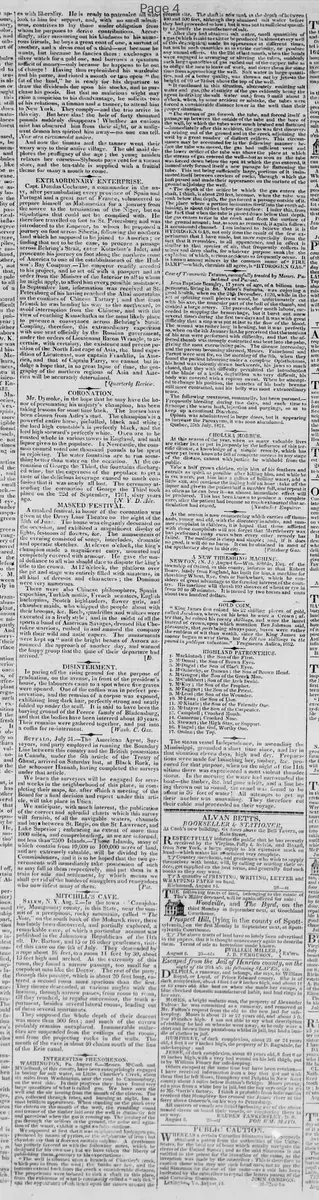
WASHINGTON, Pa. August 6. Messrs. M'Cook and McClelland, of this county, have been enterprisingly engaged in boring for salt water, on Little Chartier's Creek, about six miles from Washington, near the road to Cannonsburg, on the west side. In their progress they have found very large quantities of what is called gas. We have seen the well and the air issuing from the mouth of the cistern. The gas, collected through tubes, and burning at night, has a most brilliant appearance. When standing on the plank over the cistern on the mouth of the well, the rumbling sound and tremor of the timber laid over the well is distinctly felt and perceived! when the gas is coming up. The issuing of the gas through three orifices in the ground, the noise and agitation of the water, exhibit a sight awful and sublime.
We supposed at first that it was sulphuretted hydrogen gas produced by means of pyrites, or the sulphurate of iron; but chymists say that it does not contain sulphur. A gentleman has politely favored us with the following notes, which he designed for his own use; but we have taken the liberty of publishing them, contrary to his expectations:
"The well is situated upon a branch of Chartier's creek, which puts in from the west; the banks are low, and the bottoms extend back from the creek a considerable distance. The proprietors were induced to sink a shaft in this place, from the existence of what is commonly called a "salt lick," and the appearance of salt dried upon the stones around the present site. The shaft is now sunk to the depth of between 400 and 500 feet, although they obtained salt water before they had proceeded so low ; but it was not in sufficient quantity to justify the manufacture of salt.
"After they had obtained salt water, small quantities of a gas (which is said to exist or be produced in almost every well of this description) made its appearance at different times, but not in such quantities as to excite curiosity, or produce any unusual effects. On the 23d of last month, when the hands were engaged in arranging or altering the tubes, suddenly such large quantities of gas rushed out of the copper tube as to oblige the men to leave off work, and deter them for some time from approaching the well. Salt water in large quantities, and of a better quality, was thrown out by jets—to the height of 60 or 70 feet above the top of the well.
It continued in this situation, alternately emitting salt water and gas, (the elasticity of the gas evidently being the agent in driving the salt water out.) from 9 until about 3 o'clock, when, by some accident or mistake, the tubes were forced a considerable distance lower in the well than their proper situation.
"The stream of gas forsook the tube, and forced itself a passage up between the outside of the tube and the bore of the well, by which the tubes were much bruised and flattened—immediately after this accident, the gas was first discovered arising out of the ground and in the creek adjoining the well by a great number of distinct orifices. This circumstance may be accounted for in the following manner : before the tube was moved, the gas had sufficient vent and the lower orifice of the tube was above the place at which the stream of gas entered the well—but as soon as the tube was forced down below the spot at which the gas entered, it immediately formed itself a new passage by flattening the tube. This not being sufficiently large, portions of it insinuated itself between crevices of rocks, through which the gas passed and made their appearance on the surface of the ground adjoining the well.
The depth of the orifice by which the gas enters the shaft, I think, is about 210 feet, because, when the tube was sunk below that depth, the gas forced a passage outside of it. The place where a portion insinuates itself into the earth adjoining, is about 60 feet below the surface: I infer this, from the fact that when the tube is passed down below that depth, the gas ceases to rise in the creek and from the surface of the ground around; but, as soon as removed, it again follows its accustomed channel. I am induced to believe that it is HYDROGEN GAS, not only from the result of the few experiments that I have made, but more especially from the fact that it resembles, to all appearance, and in effect is similar to that species of air, that frequently collects in mines and deep shafts, for whatever purpose sunk ; by the explosion of which, serious accidents so frequently occur. It is known among miners by the common name of "FIRE DAMP"—which, chemists all agree, is "HYDROGEN GAS."
What sub-type of article is it?
What keywords are associated?
What entities or persons were involved?
Where did it happen?
Domestic News Details
Primary Location
Washington, Pa.
Event Date
August 6
Key Persons
Outcome
large quantities of gas and better quality salt water discovered; tubes bruised and flattened; no injuries reported.
Event Details
While boring for salt water to a depth of 400-500 feet near Little Chartier's Creek, large quantities of gas erupted on July 23, driving salt water jets up to 70 feet. Gas issues through orifices, causes rumbling and tremors, burns brilliantly, and is believed to be hydrogen or fire damp.