Thank you for visiting SNEWPapers!
Sign up free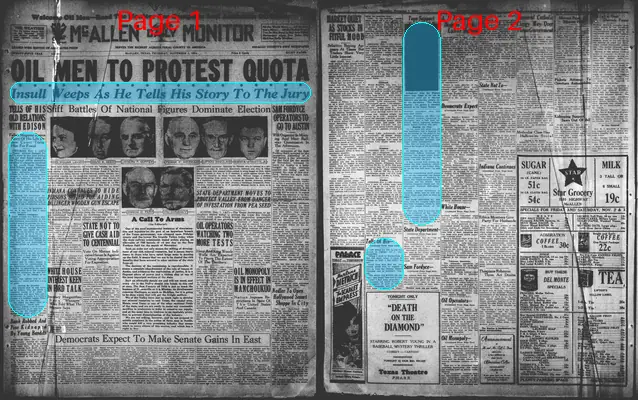
Mcallen Daily Monitor
Mcallen, Brownsville, Harlingen, Hidalgo County, Cameron County, Texas
What is this article about?
In Chicago on Nov. 1, Samuel Insull, on trial for mail fraud, tearfully testifies about his life: boyhood in London, early work with Thomas Edison in New York and Schenectady, move to Chicago in 1892 to lead utility companies, innovations in electrical generation, and financial difficulties during consolidation and World War I.
Merged-components note: Continuation of the Insull fraud trial story across pages.
Clippings
1 of 2
OCR Quality
Full Text
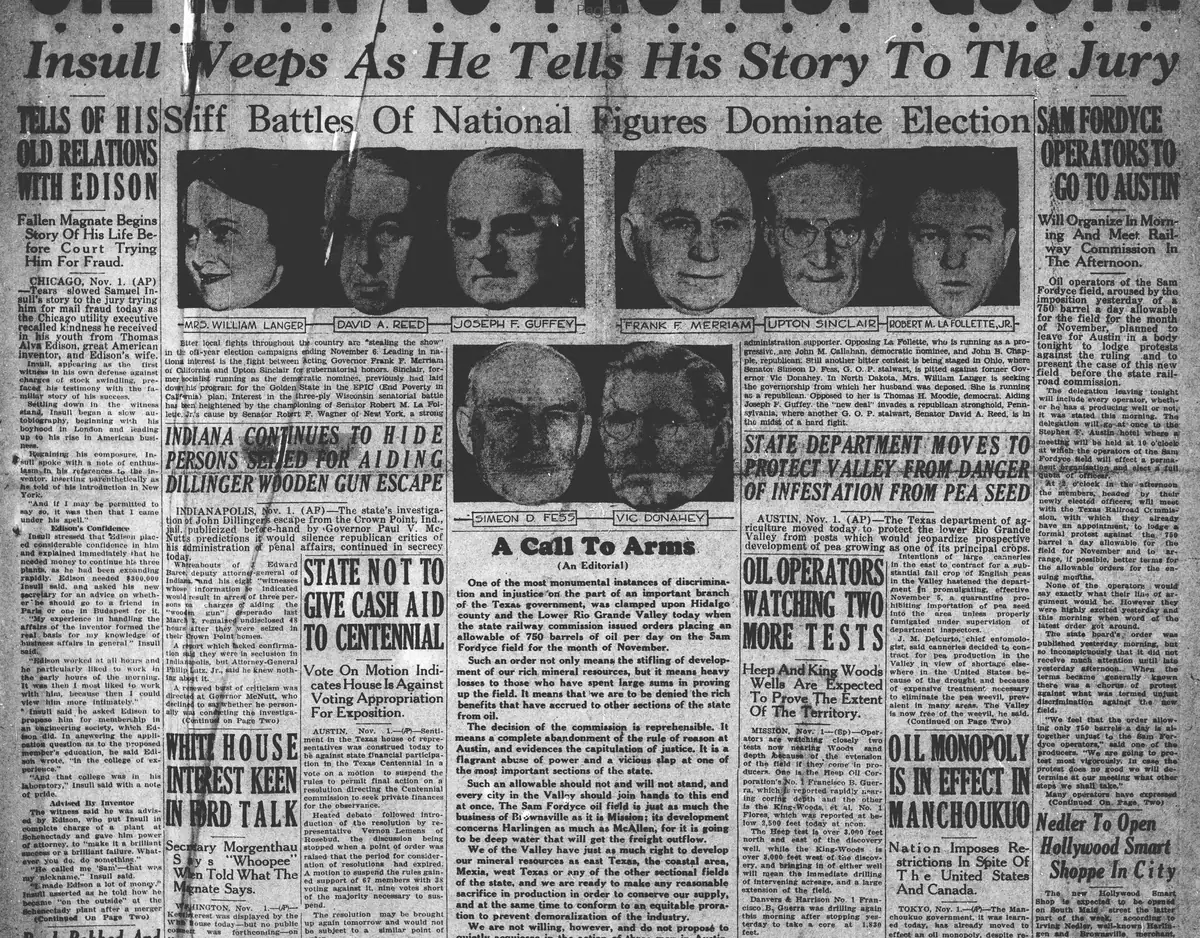
Fallen Magnate Begins Story Of His Life Before Court Trying Him For Fraud.
CHICAGO, Nov. 1. (AP)
Tears slowed Samuel Insull's story to the jury trying him for mail fraud today as the Chicago utility executive recalled kindness he received in his youth from Thomas Alva Edison, great American inventor, and Edison's wife.
Insull, appearing as the first witness in his own defense against charges of stock swindling, prefaced his testimony with the familiar story of his success.
Settling down in the witness stand, Insull began a slow autobiography, beginning with his boyhood in London and leading up to his rise in American business.
Regaining his composure, Insull spoke with a note of enthusiasm in his references to the inventor, inserting parenthetically as he told of his introduction in New York.
"And if I may be permitted to say so, it was then that I came under his spell."
Edison's Confidence
Insull stressed that Edison placed considerable confidence in him and explained immediately that he needed money to continue his three plants, as he had been expanding rapidly. Edison needed $300,000 Insull said, and asked his new secretary for advice on whether he should go to a friend in Paris or one in Budapest for it.
My experience in handling the affairs of the inventor formed the real basis for my knowledge of business affairs in general, Insull said.
Edison worked at all hours and he particularly liked to work in the early hours of the morning.
I was then I most liked to work with him, because then I could view him more intimately.
Insull said he asked Edison to propose him for membership in an engineering society, which Edison did. In answering the application question as to the proposed member's education, he said Edison wrote, "in the college of experience."
And that college was in his laboratory, Insull said with a note of pride.
Advised By Inventor
The witness said he was advised by Edison, who put Insull in complete charge of a plant at Schenectady and gave him power of attorney to "make it a brilliant success or a brilliant failure. Whatever you do, do something."
"He called me 'Sam'—that was my nickname," Insull said.
Insull asserted as he told how he made Edison a lot of money.
Insull became "on the outside" at the Schenectady plant after a merger
(Continued On Page Two)
Tells Of His-
(Continued From Page One)
in 1892 which led him to ask two friends in Chicago for a new connection.
"When I went to Schenectady I had 600 men; when I came to Chicago in 1892, I had 6,000," he said.
Insull then said that his two friends asked him to suggest a man to head the Chicago Edison Company and he proposed himself.
"The salary was $12,000 per annum," said Insull "less than a third of what I had been receiving."
Thompson led Insull through a brief history of each of Insull's major companies, and Insull told with pride of introducing bigger electrical generators than had been used before.
Judge Wilkerson cut short one of Insull's answers, remarking to Thompson that it had been answered. Before beginning another, Insull leaned forward and said:
Bearing On Case
"If the court will allow me, all this experience has a bearing on my knowledge of the absolute intrinsic value of electrical properties, and those bought by the Corporation Securities Company and Insull Utility Investments."
The first of those two corporations is the target of the mail fraud case.
He installed me for the Commonwealth Edison Company of Chicago "the largest steam prime move producing electricity in the world," he told the jury.
"I was honored with having operated the first telephone switchboard outside of the United States, for its first half hour," he said later.
While consolidating small plants into his big companies—the Public Service Company of Northern Illinois, the Commonwealth Edison Company and the Middle West Utilities Company—Insull met "innumerable financial difficulties," he said.
When a banker threatened to foreclose, Insull said he told him "your doors may close as soon as mine."
His worst difficulties he said were with the Peoples Light Gas and Coke Company, which in 1918 was two jumps ahead of the sheriff.
"That was while I was still acting as president of the Illinois Defense Council," he interposed.
"The company drifted into difficulties, partly, I think because I was giving all my attention to my war office."
What sub-type of article is it?
What themes does it cover?
What keywords are associated?
What entities or persons were involved?
Where did it happen?
Story Details
Key Persons
Location
Chicago
Event Date
Nov. 1
Story Details
Samuel Insull testifies in his mail fraud trial, recounting his boyhood in London, meeting and working closely with Thomas Edison in New York and Schenectady, moving to Chicago in 1892 to lead utility companies, introducing large electrical generators, consolidating plants despite financial difficulties, and serving in the Illinois Defense Council during World War I.