Thank you for visiting SNEWPapers!
Sign up free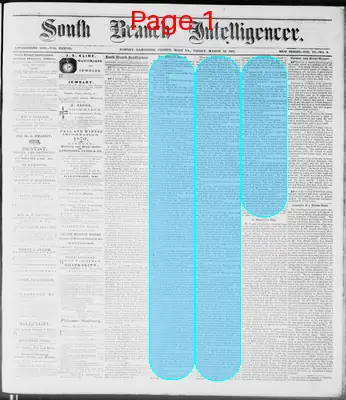
Literary
March 10, 1871
South Branch Intelligencer
Romney, Hampshire County, West Virginia
What is this article about?
Mr. Sterling learns of Mr. Granger's death and laments his loaned $300. Mrs. Granger and her children sacrifice to repay the debt honorably. Moved by their self-denial, Mr. Sterling cancels the note, realizing the moral cost, and becomes a kinder man.
Clipping
OCR Quality
95%
Excellent
Full Text
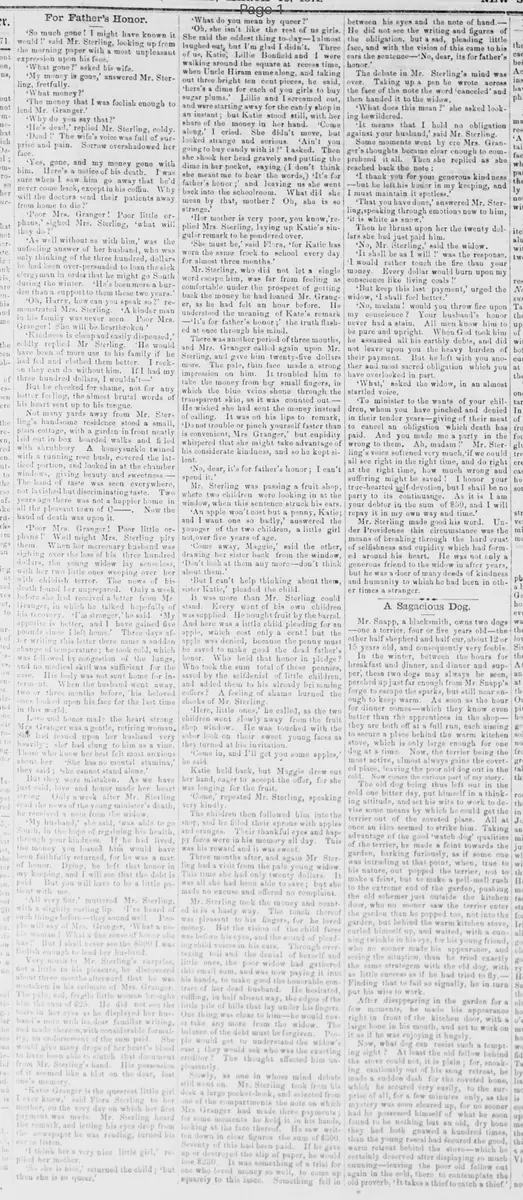
For Father's Honor.
“So much gone! I might have known it would!” said Mr. Sterling, looking up from the morning paper with a most unpleasant expression upon his face.
“What gone?” asked his wife.
“My money is gone,” answered Mr. Sterling, fretfully.
“What money?”
“The money that I was foolish enough to lend Mr. Granger.”
“Why do you say that?”
“He's dead,” replied Mr. Sterling, coldly.
“Dead!” The wife's voice was full of surprise and pain. Sorrow overshadowed her face.
“Yes, gone, and my money gone with him. Here's a notice of his death. I was sure when I saw him go away that he'd never come back, except in his coffin. Why will the doctors send their patients away from home to die?”
“Poor Mrs. Granger! Poor little orphans,” sighed Mrs. Sterling, “what will they do?”
“As well without as with him,” was the unfeeling answer of her husband, who was only thinking of the three hundred dollars he had been over-persuaded to loan the sick clergyman in order that he might go South during the winter. “He's been more a burden than a support to them these two years.”
“Oh, Harry, how can you speak so?” remonstrated Mrs. Sterling. “A kinder man in his family was never seen. Poor Mrs. Granger! She will be heartbroken!”
“Kindness is cheap and easily dispensed,” coldly replied Mr. Sterling. “He would have been of more use to his family if he had fed and clothed them better. I reckon they can do without him. If I had my three hundred dollars, I wouldn't—”
But he checked for shame, not for any better feeling, the almost brutal words of his heart sent up to his tongue.
Not many yards away from Mr. Sterling's handsome residence stood a small, plain cottage, with a garden in front neatly laid out in box bordered walks and filled with shrubbery. A honeysuckle twined with a running rose bush, covered the latticed portico, and looked in at the chamber windows, giving beauty and sweetness. The hand of taste was seen everywhere, not lavished but discriminating taste. Two years ago there was not a happier home in all the pleasant town of C——. Now the hand of death was upon it.
“Poor Mrs. Granger! Poor little orphans!” Well might Mrs. Sterling pity them. When her mercenary husband was sighing over the loss of his three hundred dollars, the young widow lay senseless, with her two little ones weeping over her with childish terror. The news of his death found her unprepared. Only a week before she had received a letter from Mr. Granger, in which he talked hopefully of his recovery. “I'm stronger,” he said; “my appetite is better, and I have gained five pounds since I left home.” Three days after writing this letter there came a sudden change of temperature; he took cold, which was followed by congestion of the lungs, and no medical skill was sufficient for the case. His body was not sent home for interment. When the husband went away, two or three months before, his beloved ones looked upon his face for the last time in this world.
Love and honor made the heart strong. Mrs. Granger was a gentle, retiring woman. She had leaned upon her husband very heavily; she had clung to him as a vine. Those who knew her best felt most anxious about her. She has no mental stamina, they said; she cannot stand alone.
But they were mistaken. As we have just said, love and honor made her heart strong. Only a week after Mr. Sterling read the news of the young minister's death, he received a note from the widow.
“My husband,” she said, “was able to go South, in the hope of regaining his health, through your kindness. If he had lived, the money you loaned him would have been faithfully returned, for he was a man of honor. Dying, he left that honor in my keeping, and I will see that the debt is paid. But you will have to be a little patient with me.”
“All very fine,” muttered Mr. Sterling, with a slightly curling lip. “I've heard of such things before—they sound well. So people will say of Mrs. Granger, 'What a noble woman! What a fine sense of honor she has!' But I shall never see the money I was foolish enough to lend her husband.”
Very much to Mr. Sterling's surprise, not a little to his pleasure, he discovered about three months afterward that he was mistaken in his estimate of Mrs. Granger. The pale, sad, fragile little woman brought him the sum of $50. He did not see the tears in her eyes as he displayed her husband's note with its dear familiar writing, and made thereon, with considerable formality, an endorsement of the sum paid. She would give many drops of her heart's blood to have been able to clutch that document from Mr. Sterling's hand. His possession of it seemed like a blot on the dear, lost one's memory.
“Katie Granger is the queerest little girl I ever knew,” said Flora Sterling to her mother, on the very day on which her first payment was made. Mr. Sterling heard the remark, and letting his eyes drop from the newspaper he was reading, turned his ear to listen.
“I think her a very nice little girl,” replied her mother.
“She is nice,” returned the child; “but then she is so queer.”
“What do you mean by queer?”
“Oh, she isn't like the rest of us girls. She said the oddest thing to-day—I almost laughed out, but I'm glad I didn't. Three of us, Katie, Lillie Bonfield and I were walking around the square at recess time, when Uncle Hiram came along, and taking out three bright ten-cent pieces, he said, 'Here's a dime for each of you girls to buy sugar plums.' Lillie and I screamed out, and were starting away for the candy shop in an instant; but Katie stood still, with her share of the money in her hand. 'Come along,' I cried. She didn't move, but looked strange and serious. 'Ain't you going to buy candy with it?' I asked. Then she shook her head gravely and putting the dime in her pocket, saying (I don't think she meant me to hear the words,) 'It's for father's honor;' and leaving us she went back into the schoolroom. What did she mean by that, mother? Oh, she is so strange.”
“Her mother is very poor, you know,” replied Mrs. Sterling, laying up Katie's singular remark to be pondered over.
“She must be,” said Flora, “for Katie has worn the same frock to school every day for almost three months.”
Mr. Sterling, who did not let a single word escape him, was far from feeling as comfortable under the prospect of getting back the money he had loaned Mr. Granger, as he had felt an hour before. He understood the meaning of Kate's remark—'It's for father's honor:' the truth flashed at once through his mind.
There was another period of three months, and Mrs. Granger called again upon Mr. Sterling, and gave him twenty-five dollars more. The pale, thin face made a strong impression on him. It troubled him to take the money from her small fingers, in which the blue veins shone through the transparent skin, as it was counted out. He wished she had sent the money instead of calling. It was on his lips to remark, “Do not trouble or pinch yourself faster than is convenient, Mrs. Granger,” but cupidity whispered that she might take advantage of his considerate kindness, and so he kept silent.
“No, dear, it's for father's honor; I can't spend it.”
Mr. Sterling was passing a fruit shop, where two children were looking in at the window, when this sentence struck his ears.
“An apple won't cost but a penny, Katie; and I want one so badly,” answered the younger of the two children, a little girl not over five years of age.
“Come away, Maggie,” said the other, drawing her sister back from the window, “Don't look at them any more—don't think about them.”
“But I can't help thinking about them, sister Katie,” pleaded the child.
It was more than Mr. Sterling could stand. Every want of his own children was supplied. He bought fruit by the barrel. And here was a little child pleading for an apple, which cost only a cent! but the apple was denied, because the penny must be saved to make good the dead father's honor. Who held that honor in pledge? Who took the sum total of these pennies, saved by the self-denial of little children, and added them to his already brimming coffers? A feeling of shame burned the cheeks of Mr. Sterling.
“Here, little ones,” he called, as the two children went slowly away from the fruit shop window. He was touched with the sober look on their sweet young faces as they turned at his invitation.
“Come in, and I'll get you some apples,” he said.
Katie held back, but Maggie drew out her hand, eager to accept the offer, for she was longing for the fruit.
“Come,” repeated Mr. Sterling, speaking very kindly.
The children then followed him into the shop, and he filled their aprons with apples and oranges. Their thankful eyes and happy faces were in his memory all day. This was his reward and it was sweet.
Three months after, and again Mr. Sterling had a visit from the pale young widow. This time she had only twenty dollars. It was all she had been able to save; but she made no excuse and offered no complaint. Mr. Sterling took the money and counted it in a hasty way. The touch thereof was pleasant to his fingers, for he loved money. But the vision of the child faces was before his eyes, and the sound of pleading child voices in his ears. Through over-taxing toil and the denial of herself and little ones, the poor widow had gathered this small sum, and was now paying it into his hands, to make good the honorable contract of her dead husband. He hesitated, riffling in half absent way, the edges of the little pile of bills that lay under his fingers. One thing was clear to him—he would never take any more from the widow. The balance of the debt must be forgiven. People would get to understand the widow's case; they would ask who was the exacting creditor? The thought affected him unpleasantly.
Slowly, as one in whose mind debate still went on, Mr. Sterling took from his desk a large pocket-book, and selected from one of the compartments the note on which Mrs. Granger had made three payments; for some moments he held it in his hands, looking at the face thereof. He saw written down in clear figures the sum of $300. Seventy of this had been paid. If he gave up or destroyed the slip of paper, he would lose $230. It was something of a trial for one who loved money so well, to come up squarely to this issue. Something fell in between his eyes and the note of hand.—He did not see the writing and figures of the obligation, but a sad, pleading little face, and with the vision of this came to his ears the sentence—'No, dear, it's for father's honor.'
The debate in Mr. Sterling's mind was over. Taking up a pen he wrote across the face of the note the word 'canceled' and then handed it to the widow.
“What does this mean?” she asked looking bewildered.
“It means that I hold no obligation against your husband,” said Mr. Sterling.
Some moments went by ere Mrs. Granger's thoughts became clear enough to comprehend it all. Then she replied as she reached back the note:
“I thank you for your generous kindness—but he left his honor in my keeping, and I must maintain it spotless.”
“That you have done,” answered Mr. Sterling, speaking through emotions new to him, “it is white as snow.”
Then he thrust upon her the twenty dollars she had just paid him.
“No. Mr. Sterling,” said the widow.
“It shall be as I will!” was the response.
“I would rather touch the fire than your money. Every dollar would burn upon my conscience like living coals!”
“But keep this last payment,” urged the widow, “I shall feel better.”
“No, madam! would you throw fire upon my conscience? Your husband's honor never had a stain. All men know him to be pure and upright. When God took him he assumed all his earthly debts, and did not leave upon you the heavy burden of their payment. But he left with you another and most sacred obligation which you have overlooked in part.”
“What,” asked the widow, in an almost startled voice.
“To minister to the wants of your children, whom you have pinched and denied in their tender years—giving of their meat to cancel an obligation which death has paid. And you made me a party in the wrong to them. Ah, madam!” Mr. Sterling's voice softened very much, “if we could all see right in the right time, and do right at the right time, how much wrong and suffering might be saved! I honor your true-hearted self-devotion, but I shall be no party to its continuance. As it is I am your debtor in the sum of $50, and I will repay it in my own way and time.”
Mr. Sterling made good his word. Under Providence this circumstance was the means of breaking through the hard crust of selfishness and cupidity which had formed around his heart. He was not only a generous friend to the widow in after years, but he was a doer of many deeds of kindness and humanity to which he had been in other times a stranger.
“So much gone! I might have known it would!” said Mr. Sterling, looking up from the morning paper with a most unpleasant expression upon his face.
“What gone?” asked his wife.
“My money is gone,” answered Mr. Sterling, fretfully.
“What money?”
“The money that I was foolish enough to lend Mr. Granger.”
“Why do you say that?”
“He's dead,” replied Mr. Sterling, coldly.
“Dead!” The wife's voice was full of surprise and pain. Sorrow overshadowed her face.
“Yes, gone, and my money gone with him. Here's a notice of his death. I was sure when I saw him go away that he'd never come back, except in his coffin. Why will the doctors send their patients away from home to die?”
“Poor Mrs. Granger! Poor little orphans,” sighed Mrs. Sterling, “what will they do?”
“As well without as with him,” was the unfeeling answer of her husband, who was only thinking of the three hundred dollars he had been over-persuaded to loan the sick clergyman in order that he might go South during the winter. “He's been more a burden than a support to them these two years.”
“Oh, Harry, how can you speak so?” remonstrated Mrs. Sterling. “A kinder man in his family was never seen. Poor Mrs. Granger! She will be heartbroken!”
“Kindness is cheap and easily dispensed,” coldly replied Mr. Sterling. “He would have been of more use to his family if he had fed and clothed them better. I reckon they can do without him. If I had my three hundred dollars, I wouldn't—”
But he checked for shame, not for any better feeling, the almost brutal words of his heart sent up to his tongue.
Not many yards away from Mr. Sterling's handsome residence stood a small, plain cottage, with a garden in front neatly laid out in box bordered walks and filled with shrubbery. A honeysuckle twined with a running rose bush, covered the latticed portico, and looked in at the chamber windows, giving beauty and sweetness. The hand of taste was seen everywhere, not lavished but discriminating taste. Two years ago there was not a happier home in all the pleasant town of C——. Now the hand of death was upon it.
“Poor Mrs. Granger! Poor little orphans!” Well might Mrs. Sterling pity them. When her mercenary husband was sighing over the loss of his three hundred dollars, the young widow lay senseless, with her two little ones weeping over her with childish terror. The news of his death found her unprepared. Only a week before she had received a letter from Mr. Granger, in which he talked hopefully of his recovery. “I'm stronger,” he said; “my appetite is better, and I have gained five pounds since I left home.” Three days after writing this letter there came a sudden change of temperature; he took cold, which was followed by congestion of the lungs, and no medical skill was sufficient for the case. His body was not sent home for interment. When the husband went away, two or three months before, his beloved ones looked upon his face for the last time in this world.
Love and honor made the heart strong. Mrs. Granger was a gentle, retiring woman. She had leaned upon her husband very heavily; she had clung to him as a vine. Those who knew her best felt most anxious about her. She has no mental stamina, they said; she cannot stand alone.
But they were mistaken. As we have just said, love and honor made her heart strong. Only a week after Mr. Sterling read the news of the young minister's death, he received a note from the widow.
“My husband,” she said, “was able to go South, in the hope of regaining his health, through your kindness. If he had lived, the money you loaned him would have been faithfully returned, for he was a man of honor. Dying, he left that honor in my keeping, and I will see that the debt is paid. But you will have to be a little patient with me.”
“All very fine,” muttered Mr. Sterling, with a slightly curling lip. “I've heard of such things before—they sound well. So people will say of Mrs. Granger, 'What a noble woman! What a fine sense of honor she has!' But I shall never see the money I was foolish enough to lend her husband.”
Very much to Mr. Sterling's surprise, not a little to his pleasure, he discovered about three months afterward that he was mistaken in his estimate of Mrs. Granger. The pale, sad, fragile little woman brought him the sum of $50. He did not see the tears in her eyes as he displayed her husband's note with its dear familiar writing, and made thereon, with considerable formality, an endorsement of the sum paid. She would give many drops of her heart's blood to have been able to clutch that document from Mr. Sterling's hand. His possession of it seemed like a blot on the dear, lost one's memory.
“Katie Granger is the queerest little girl I ever knew,” said Flora Sterling to her mother, on the very day on which her first payment was made. Mr. Sterling heard the remark, and letting his eyes drop from the newspaper he was reading, turned his ear to listen.
“I think her a very nice little girl,” replied her mother.
“She is nice,” returned the child; “but then she is so queer.”
“What do you mean by queer?”
“Oh, she isn't like the rest of us girls. She said the oddest thing to-day—I almost laughed out, but I'm glad I didn't. Three of us, Katie, Lillie Bonfield and I were walking around the square at recess time, when Uncle Hiram came along, and taking out three bright ten-cent pieces, he said, 'Here's a dime for each of you girls to buy sugar plums.' Lillie and I screamed out, and were starting away for the candy shop in an instant; but Katie stood still, with her share of the money in her hand. 'Come along,' I cried. She didn't move, but looked strange and serious. 'Ain't you going to buy candy with it?' I asked. Then she shook her head gravely and putting the dime in her pocket, saying (I don't think she meant me to hear the words,) 'It's for father's honor;' and leaving us she went back into the schoolroom. What did she mean by that, mother? Oh, she is so strange.”
“Her mother is very poor, you know,” replied Mrs. Sterling, laying up Katie's singular remark to be pondered over.
“She must be,” said Flora, “for Katie has worn the same frock to school every day for almost three months.”
Mr. Sterling, who did not let a single word escape him, was far from feeling as comfortable under the prospect of getting back the money he had loaned Mr. Granger, as he had felt an hour before. He understood the meaning of Kate's remark—'It's for father's honor:' the truth flashed at once through his mind.
There was another period of three months, and Mrs. Granger called again upon Mr. Sterling, and gave him twenty-five dollars more. The pale, thin face made a strong impression on him. It troubled him to take the money from her small fingers, in which the blue veins shone through the transparent skin, as it was counted out. He wished she had sent the money instead of calling. It was on his lips to remark, “Do not trouble or pinch yourself faster than is convenient, Mrs. Granger,” but cupidity whispered that she might take advantage of his considerate kindness, and so he kept silent.
“No, dear, it's for father's honor; I can't spend it.”
Mr. Sterling was passing a fruit shop, where two children were looking in at the window, when this sentence struck his ears.
“An apple won't cost but a penny, Katie; and I want one so badly,” answered the younger of the two children, a little girl not over five years of age.
“Come away, Maggie,” said the other, drawing her sister back from the window, “Don't look at them any more—don't think about them.”
“But I can't help thinking about them, sister Katie,” pleaded the child.
It was more than Mr. Sterling could stand. Every want of his own children was supplied. He bought fruit by the barrel. And here was a little child pleading for an apple, which cost only a cent! but the apple was denied, because the penny must be saved to make good the dead father's honor. Who held that honor in pledge? Who took the sum total of these pennies, saved by the self-denial of little children, and added them to his already brimming coffers? A feeling of shame burned the cheeks of Mr. Sterling.
“Here, little ones,” he called, as the two children went slowly away from the fruit shop window. He was touched with the sober look on their sweet young faces as they turned at his invitation.
“Come in, and I'll get you some apples,” he said.
Katie held back, but Maggie drew out her hand, eager to accept the offer, for she was longing for the fruit.
“Come,” repeated Mr. Sterling, speaking very kindly.
The children then followed him into the shop, and he filled their aprons with apples and oranges. Their thankful eyes and happy faces were in his memory all day. This was his reward and it was sweet.
Three months after, and again Mr. Sterling had a visit from the pale young widow. This time she had only twenty dollars. It was all she had been able to save; but she made no excuse and offered no complaint. Mr. Sterling took the money and counted it in a hasty way. The touch thereof was pleasant to his fingers, for he loved money. But the vision of the child faces was before his eyes, and the sound of pleading child voices in his ears. Through over-taxing toil and the denial of herself and little ones, the poor widow had gathered this small sum, and was now paying it into his hands, to make good the honorable contract of her dead husband. He hesitated, riffling in half absent way, the edges of the little pile of bills that lay under his fingers. One thing was clear to him—he would never take any more from the widow. The balance of the debt must be forgiven. People would get to understand the widow's case; they would ask who was the exacting creditor? The thought affected him unpleasantly.
Slowly, as one in whose mind debate still went on, Mr. Sterling took from his desk a large pocket-book, and selected from one of the compartments the note on which Mrs. Granger had made three payments; for some moments he held it in his hands, looking at the face thereof. He saw written down in clear figures the sum of $300. Seventy of this had been paid. If he gave up or destroyed the slip of paper, he would lose $230. It was something of a trial for one who loved money so well, to come up squarely to this issue. Something fell in between his eyes and the note of hand.—He did not see the writing and figures of the obligation, but a sad, pleading little face, and with the vision of this came to his ears the sentence—'No, dear, it's for father's honor.'
The debate in Mr. Sterling's mind was over. Taking up a pen he wrote across the face of the note the word 'canceled' and then handed it to the widow.
“What does this mean?” she asked looking bewildered.
“It means that I hold no obligation against your husband,” said Mr. Sterling.
Some moments went by ere Mrs. Granger's thoughts became clear enough to comprehend it all. Then she replied as she reached back the note:
“I thank you for your generous kindness—but he left his honor in my keeping, and I must maintain it spotless.”
“That you have done,” answered Mr. Sterling, speaking through emotions new to him, “it is white as snow.”
Then he thrust upon her the twenty dollars she had just paid him.
“No. Mr. Sterling,” said the widow.
“It shall be as I will!” was the response.
“I would rather touch the fire than your money. Every dollar would burn upon my conscience like living coals!”
“But keep this last payment,” urged the widow, “I shall feel better.”
“No, madam! would you throw fire upon my conscience? Your husband's honor never had a stain. All men know him to be pure and upright. When God took him he assumed all his earthly debts, and did not leave upon you the heavy burden of their payment. But he left with you another and most sacred obligation which you have overlooked in part.”
“What,” asked the widow, in an almost startled voice.
“To minister to the wants of your children, whom you have pinched and denied in their tender years—giving of their meat to cancel an obligation which death has paid. And you made me a party in the wrong to them. Ah, madam!” Mr. Sterling's voice softened very much, “if we could all see right in the right time, and do right at the right time, how much wrong and suffering might be saved! I honor your true-hearted self-devotion, but I shall be no party to its continuance. As it is I am your debtor in the sum of $50, and I will repay it in my own way and time.”
Mr. Sterling made good his word. Under Providence this circumstance was the means of breaking through the hard crust of selfishness and cupidity which had formed around his heart. He was not only a generous friend to the widow in after years, but he was a doer of many deeds of kindness and humanity to which he had been in other times a stranger.
What sub-type of article is it?
Prose Fiction
What themes does it cover?
Moral Virtue
Death Mortality
What keywords are associated?
Father's Honor
Debt Repayment
Widow Sacrifice
Children Self Denial
Moral Redemption
Family Devotion
Literary Details
Title
For Father's Honor.
Key Lines
“It's For Father's Honor;'
“No, Dear, It's For Father's Honor; I Can't Spend It.”
“It Means That I Hold No Obligation Against Your Husband,”
“Your Husband's Honor Never Had A Stain. All Men Know Him To Be Pure And Upright.”