Thank you for visiting SNEWPapers!
Sign up free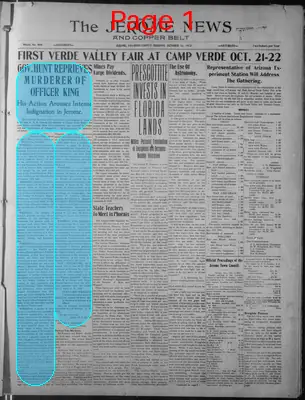
The Jerome News And Copper Belt
Jerome, Yavapai County, Arizona
What is this article about?
Arizona Governor Geo. W. P. Hunt grants reprieves to four convicted murderers—William Campbell, Eduardo Perez, N. B. Chavez (killer of Officer Chas. King), and Miguel Peralta—postponing their Oct. 11, 1912 executions to April 12, 1913, to allow legislative review of capital punishment abolition. The decision sparks intense indignation in Jerome.
Clipping
OCR Quality
Full Text
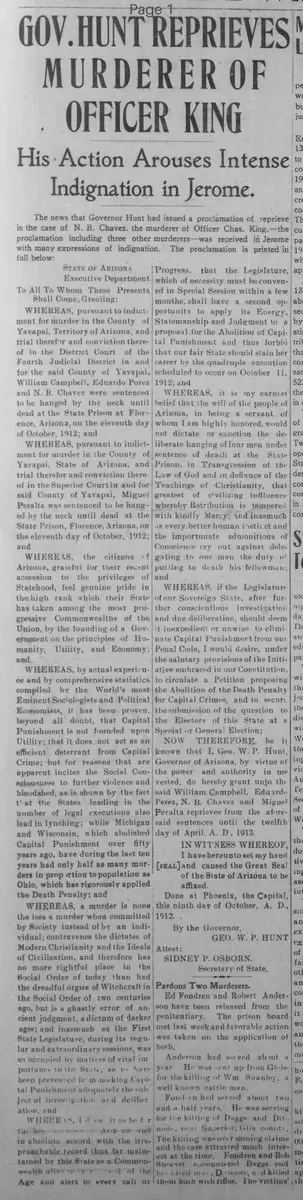
Murderer of
Officer
King
His Action
In Arouses Intense
Indignation in Jerome.
The news that Governor Hunt had issued a proclamation of reprieve in the case of N. B. Chavez, the murderer of Officer Chas. King—the proclamation including three other murderers—was received in Jerome with many expressions of indignation. The proclamation is printed in full below:
STATE OF ARIZONA
Executive Department
To All To Whom These Presents Shall Come, Greeting:
WHEREAS, pursuant to indictment for murder in the County of Yavapai, Territory of Arizona, and trial therefor and conviction thereof in the District Court of the Fourth Judicial District in and for the said County of Yavapai, William Campbell, Eduardo Perez and N. B. Chavez were sentenced to be hanged by the neck until dead at the State Prison at Florence, Arizona, on the eleventh day of October, 1912; and
WHEREAS, pursuant to indictment for murder in the County of Yavapai, State of Arizona, and trial therefor and conviction thereof in the Superior Court in and for said County of Yavapai, Miguel Peralta was sentenced to be hanged by the neck until dead at the State Prison, Florence, Arizona, on the eleventh day of October, 1912; and
WHEREAS, the citizens of Arizona, grateful for their recent accession to the privileges of Statehood, feel genuine pride in the high rank which their State has taken among the most progressive Commonwealths of the Union, by the founding of a Government on the principles of Humanity, Utility, and Economy; and
WHEREAS, by actual experience and by comprehensive statistics compiled by the World's most Eminent Sociologists and Political Economists, it has been proven, beyond all doubt, that Capital Punishment is not founded upon Utility; that it does not act as an efficient deterrent from Capital Crime; but for reasons that are apparent incites the Social Consciousness to further violence and bloodshed, as is shown by the fact that the States leading in the number of legal executions also lead in lynching; while Michigan and Wisconsin, which abolished Capital Punishment over fifty years ago, have during the last ten years had only half as many murders in proportion to population as Ohio, which has rigorously applied the Death Penalty: and
WHEREAS, a murder is none the less a murder when committed by Society instead of by an individual; contravenes the dictates of Modern Christianity and the Ideals of Civilization, and therefore has no more rightful place in the Social Order of today than had the dreadful orgies of Witchcraft in the Social Order of two centuries ago, but is a ghastly error of ancient judgment, a dictum of darker ages; and inasmuch as the First State Legislature, during its regular and extraordinary sessions, was so occupied by matters of vital importance to the State, as to have been prevented from making Capital Punishment adequately the subject of investigation and deliberation, and
WHEREAS, I deem it to be for the best interests of Arizona and in absolute accord with the irreproachable record thus far maintained by this State as a Commonwealth alive to every principle of the Age and alert to every call of Progress, that the Legislature, which of necessity must be convened in Special Session within a few months, shall have a second opportunity to apply its Energy, Statesmanship and Judgment to a proposal for the Abolition of Capital Punishment and thus forbid that our fair State should stain her career by the quadruple execution scheduled to occur on October 11, 1912; and
WHEREAS, it is my earnest belief that the will of the people of Arizona, in being a servant of whom I am highly honored, would not dictate or sanction the deliberate hanging of four men under sentence of death at the State Prison, in Transgression of the Law of God and in defiance of the Teachings of Christianity, that greatest of civilizing influences whereby Retribution is tempered with kindly Mercy; and inasmuch as every better human instinct and the importunate admonitions of Conscience cry out against delegating to one man the duty of putting to death his fellowman; and
WHEREAS, if the Legislature of our Sovereign State, after further conscientious investigation and due deliberation, should deem it inexpedient or unwise to eliminate Capital Punishment from our Penal Code, I would desire, under the salutary provisions of the Initiative embraced in our Constitution, to circulate a Petition proposing the Abolition of the Death Penalty for Capital Crimes, and to secure the submission of the question to the Electors of this State at a Special or General Election;
NOW, THEREFORE, be it known that I, Geo. W. P. Hunt, Governor of Arizona, by virtue of the power and authority in me vested, do hereby grant unto the said William Campbell, Eduardo Perez, N. B. Chavez and Miguel Peralta reprieves from the aforesaid sentences until the twelfth day of April, A. D., 1913.
IN WITNESS WHEREOF, I have hereunto set my hand and caused the Great Seal of the State of Arizona to be affixed.
Done at Phoenix, the Capital, this ninth day of October, A. D., 1912.
By the Governor,
GEO. W. P. HUNT
Attest:
SIDNEY P. OSBORN,
Secretary of State.
What sub-type of article is it?
What keywords are associated?
What entities or persons were involved?
Where did it happen?
Domestic News Details
Primary Location
Jerome, Arizona
Event Date
October 9, 1912
Key Persons
Outcome
reprieves granted to four convicted murderers, postponing executions from october 11, 1912, to april 12, 1913; intense indignation in jerome.
Event Details
Governor Hunt issues a proclamation reprieving N. B. Chavez, convicted of murdering Officer Chas. King, along with William Campbell, Eduardo Perez, and Miguel Peralta, all sentenced to hang on October 11, 1912. The reprieve allows time for the legislature to consider abolishing capital punishment, citing its ineffectiveness and inhumanity. The news is received with indignation in Jerome.