Thank you for visiting SNEWPapers!
Sign up free
The Wheeling Repository
Wheeling, Ohio County, West Virginia
What is this article about?
In July 1807, British Commodore J. E. Douglas threatens to blockade Norfolk, Virginia, over a local resolution restricting communication with the British consul amid Chesapeake deserter tensions. Mayor Richard E. Lee replies firmly, defending American sovereignty. Envoy L. W. Tazewell meets Douglas, who disavows threats and seeks amicable resolution.
Merged-components note: These components form a single narrative story about the exchange of letters between the British commodore and the Mayor of Norfolk, including the report on the deputy's visit. Relabeled from 'foreign_news' to 'story' as it is a full narrative article on a domestic incident involving international tension from a US perspective.
Clippings
1 of 2
OCR Quality
Full Text
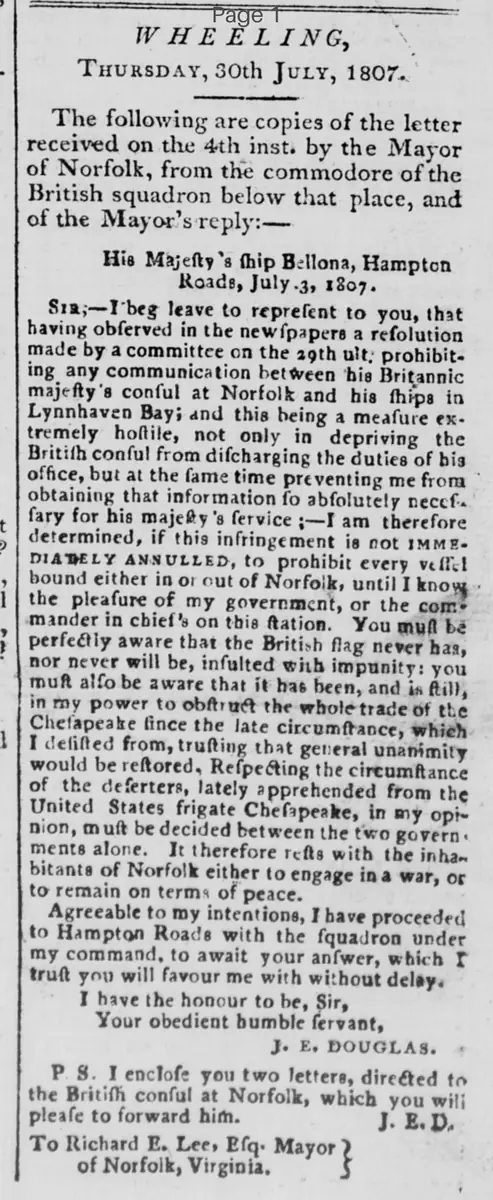
Thursday, 30th July, 1807.
The following are copies of the letter received on the 4th inst. by the Mayor of Norfolk, from the commodore of the British squadron below that place, and of the Mayor's reply:--
His Majesty's ship Bellona, Hampton Roads, July 3, 1807.
Sir;--I beg leave to represent to you, that having observed in the newspapers a resolution made by a committee on the 29th ult: prohibiting any communication between his Britannic majesty's consul at Norfolk and his ships in Lynnhaven Bay; and this being a measure extremely hostile, not only in depriving the British consul from discharging the duties of his office, but at the same time preventing me from obtaining that information so absolutely necessary for his majesty's service;--I am therefore determined, if this infringement is not IMMEDIATELY ANNULLED, to prohibit every vessel bound either in or out of Norfolk, until I know the pleasure of my government, or the commander in chief's on this station. You must be perfectly aware that the British flag never has, nor never will be, insulted with impunity: you must also be aware that it has been, and is still, in my power to obstruct the whole trade of the Chesapeake since the late circumstance, which I desisted from, trusting that general unanimity would be restored. Respecting the circumstance of the deserters, lately apprehended from the United States frigate Chesapeake, in my opinion, must be decided between the two governments alone.
It therefore rests with the inhabitants of Norfolk either to engage in a war, or to remain on terms of peace.
Agreeable to my intentions, I have proceeded to Hampton Roads with the squadron under my command, to await your answer, which I trust you will favour me with without delay.
I have the honour to be, Sir,
Your obedient humble servant,
J. E. DOUGLAS.
P.S. I enclose you two letters, directed to the British consul at Norfolk, which you will please to forward him.
J. E. D.
To
Richard
E.
Lee,
Esq. Mayor
of
Norfolk,
Virginia.
Answer
Norfolk, July 4, 1807.
Sir,—I have received your menacing letter of yesterday. The day on which this answer is written ought of itself to prove to the subjects of your sovereign, that the American people are not to be intimidated by menace, or induced to adopt any measures except by a sense of their perfect propriety. Seduced by the false shew of security, they may be sometimes surprised and slaughtered, while unprepared to resist a supposed friend: that delusive security is now however passed forever. The late occurrence has taught us to confide our safety no longer to any thing but our own force. We do not seek hostility, nor shall we avoid it. We are prepared for the worst you may attempt, and will do whatever shall be judged proper to repel force, whensoever your efforts shall render any act of ours necessary. Thus much for the threats of your letter, which can be considered in no other light than as addressed to the supposed fears of our citizens.
In answer to that part of it which is particularly addressed to me, as the first judicial officer of this borough, I have but to say, that you must be aware that the judiciary of no country possesses any other powers than those conferred upon it by the law.
The same channel through which you have derived the intelligence stated by yourself, must have also announced to you, that the act of which you complain is an act of individuals, and not of the government. If this act be wrong and illegal, the judiciary of this country, whensoever the case is properly brought before it, will take care to do its duty. At present it hath no judicial information of any outrage on the laws, and therefore will not act.
If you, Sir, please to consider this act of individuals as extremely hostile, and shall commence hostility without waiting the decision of our two governments, although you yourself acknowledge that it properly belongs to them alone to decide, the inhabitants of Norfolk will conform to your example, and protect themselves against any lawless aggression which may be made upon their persons or property. They therefore leave it with you "either to engage in war, or remain on terms of peace" until the pleasure of our respective governments shall be known.
Your letters directed to the British consul at this place have been forwarded to him.
I have the honour to be, Sir,
Your most obedient servant,
RICHARD E. LEE, Mayor.
To John E. Douglas, Esq. commanding his B. M. ships in Hampton Roads.
Mr. L. W. Tazewell, who was deputed to convey the reply of the Mayor of Norfolk to the insulting letter of commodore Douglass, of the British squadron, has addressed to the Mayor a report detailing his reception and the conversation on board. The following sketch may serve to give an idea of what passed at the interview. Mr. Tazewell was received in a very respectful manner by Douglass himself, and conducted to the cabin, where he found all the captains of the squadron.
Douglass read the Mayor's letter himself very attentively, and it passed round and was read by the other captains.—Douglass said his letter must have been misapprehended; that it contained no expressions of menace which he recollected; and that it certainly was not his intention to use language which could be construed into a menace. Mr. T. recited the particular expressions in the letter which he conceived to be the language of threat. Douglas assured him, upon his honour, that "if any expression in the letter wore the appearance of threat, it was not intended to be so understood."—He then adverted to the conclusion of the Mayor's letter, which leaves the alternative of peace or war to himself, and said he had no orders, nor did he expect any, to commit any act of hostility; and that he had no disposition to commit any. Mr. Tazewell then stated to him many insulting menaces which had been communicated in Norfolk as coming from him. Douglas positively denied ever having uttered any such, and appealed to his officers if they had heard him, at any time, even while speaking confidentially to them, utter such expressions; the officers unanimously declared they had not.
A desultory conversation took place between Mr. Tazewell, Douglas, and the other captains, which continued nearly an hour. "I described to them (says Mr. T.) as well as I was able, the sentiments which universally prevailed through the country at this time, the cause from whence it proceeded, and the effects it would produce, provided any effort on their part should be made to oppose the public resolves as to intercourse or supplies. I explicitly declared that we had as yet received no authority from our government to proceed to acts of aggression; but that we were authorised and were prepared for defence, and for the protection of ourselves and our property; to prove which I placed in the hands of captain Douglas an extract from the letter of governor Cabell to brigadier-general Mathews, which I had made for that purpose, and concluded by warning him again not to send any of his officers or people on shore, for if he did, the arm of the civil authority I did not believe would be able to protect them from the vengeance of an enraged people; that this might lead to consequences which might possibly be yet averted, and if he was sincere in the sentiments he had expressed, he would
be anxious to prevent such results. Capt. Douglas and all the captains declared that they were aware of the present state of the public feelings, and deplored the circumstance which excited it; that they did not intend to expose any of their people to the resentment of ours, which they could conceive was highly inflamed; that as to supplies, they did not want any at present, but when they did, they should not attempt to procure them in any way which would excite the opposition of the citizens of this country.—Upon the subject of intercourse,—he did not expect to hold any with the people of this country, nor was there any occasion for it. He only wished to be permitted freely to communicate with the accredited officers of his government here, who had been formally received and recognized by our executive, and whose functions he presumed none but the government had a right to put down. The particular manner in which this communication might be carried on was a matter indifferent to him, provided it was kept free and open.
On the day after Mr. Tazewell was on board, commodore Douglas wrote a second letter to the Mayor of Norfolk. In this letter he merely acknowledges the receipt of the Mayor's reply to his former one, (the object of which, he says, was to request that the British consul might be restored to his powers;) and declares that so far as he was concerned, every exertion consistent with the honour of his flag would be made, to bring matters to an amicable termination.
From Norfolk, July 6.
We do not know how to reconcile the friendly declarations of commodore Douglas with a fact of which we are well assured. A boat from the commodore's ship was employed a considerable time on Saturday in sounding the channel of Elizabeth river, almost up to Craney island, about four miles below this place. Captain Davis, of the barque Petersburg, arrived yesterday from Madeira, was boarded from commodore Douglas's squadron in Hampton roads, and treated very politely. The brig Ruby, captain Chapman, from Guadaloupe, was also boarded, treated rudely but permitted to pass. If the British commander is disposed for peace, he should cease to stop vessels in the waters of the United States. On Saturday morning, two young men, (one an apprentice to Mr. Vanholt, hat-
What sub-type of article is it?
What themes does it cover?
What keywords are associated?
What entities or persons were involved?
Where did it happen?
Story Details
Key Persons
Location
Norfolk, Virginia; Hampton Roads
Event Date
July 3 6, 1807
Story Details
British Commodore Douglas sends a threatening letter to Norfolk Mayor Lee demanding annulment of a local resolution restricting British consul communications amid Chesapeake deserter tensions, threatening blockade. Mayor Lee replies defiantly, asserting legal and sovereign rights. Envoy Tazewell meets Douglas, who disavows threats and seeks peace. Douglas sends a conciliatory follow-up. Reports of British boat sounding river and boarding vessels raise suspicions.