Thank you for visiting SNEWPapers!
Sign up free
Daily National Intelligencer
Washington, District Of Columbia
What is this article about?
Article highlights Duke of Athol's sustainable timber harvesting from ancestral plantings, contrasting with deforestation in Delaware and Maryland due to overexploitation, urging tree planting and better land management for economic improvement.
Clipping
OCR Quality
Full Text
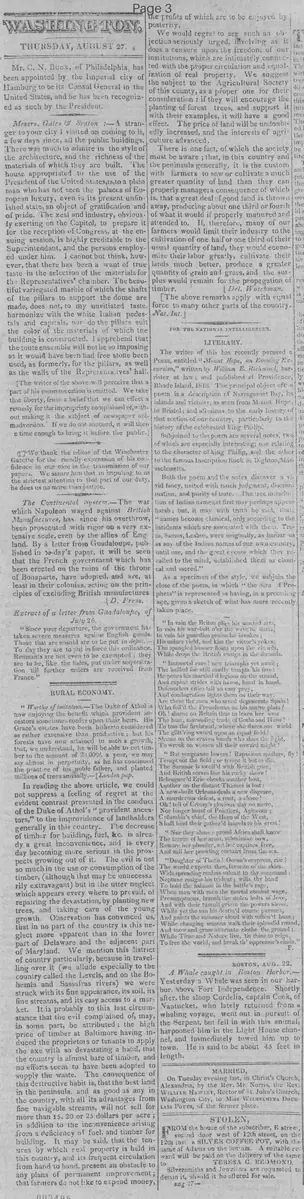
"Worthy of imitation.—The Duke of Athol is now enjoying the benefit which provident ancestors sometimes confer upon their heirs. His Grace's estates have been hitherto considered as rather extensive than productive; but his forests have now attained to such a growth, that, we understand, he will be able to cut timber to the amount of 20,000l. a year, we may say almost in perpetuity, as he has continued the practice of his noble father, and planted millions of trees annually.—[London pap.
In reading the above article, we could not suppress a feeling of regret at the evident contrast presented in the conduct of the Duke of Athol's "provident ancestors," to the improvidence of landholders generally in this country. The decrease of timber for building, fuel, &c. is already a great inconvenience, and is every day becoming more serious in the prospects growing out of it. The evil is not so much in the use or consumption of the timber, (although that may be unnecessarily extravagant) but in the utter neglect which appears every where to prevail, of repairing the devastation, by planting new trees, and taking care of the young growth. Observation has convinced us, that in no part of the country is this neglect more apparent than in the lower part of Delaware and the adjacent part of Maryland. We mention this district of country particularly, because in travelling over it (we allude especially to the country called the Levels, and on the Bohemia and Sassafras rivers) we were struck with its fine appearance, its soil, its fine streams, and its easy access to a market. It is probably to this last circumstance that the evil complained of, may in some part, be attributed; the high price of timber at Baltimore having induced the proprietors or tenants to apply the axe with so devastating a hand, that the country is almost bare of timber, and no efforts seem to have been adopted to supply the waste. The consequence of this destructive habit is, that the best land in the peninsula, and as good as any in the country, with all its advantages from fine navigable streams, will not sell for more than 15, 20 or 25 dollars per acre; in addition to the inconvenience arising from a deficiency of fuel, and timber for building. It may be said, that the tenures by which real property is held in this country, and its frequent circulation from hand to hand, present an obstacle to any plans of permanent improvement; that farmers do not like to expend money, the profits of which are to be enjoyed by posterity.
We would regret to see such an objection seriously urged, involving as it does a censure upon the freedom of our institutions, which are intimately connected with the proper circulation and equalization of real property. We suggest the subject to the Agricultural Society of this county, as a proper one for their consideration: if they will encourage the planting of forest trees, and support it with their examples, it will have a good effect. The price of land will be undoubtedly increased, and the interests of agriculture advanced.
There is one fact, of which the society must be aware; that, in this country and the peninsula generally, it is the custom with farmers to sow or cultivate a much greater quantity of land than they can properly manage; a consequence of which is, that a great deal of good land is thrown away, producing about one third or fourth of what it would if properly manured and attended to. If, therefore, many of our farmers would limit their industry to the cultivation of one half or one third of their usual quantity of land, they would economise their labor greatly, cultivate their lands much better, produce a greater quantity of grain and grass, and the surplus would remain for the propagation of timber.
Del. Watchman.
The above remarks apply with equal force to many other parts of the country.
Nat. Int.
What sub-type of article is it?
What themes does it cover?
What keywords are associated?
What entities or persons were involved?
Where did it happen?
Story Details
Key Persons
Location
Lower Part Of Delaware And Adjacent Part Of Maryland, The Levels, Bohemia And Sassafras Rivers, Baltimore
Story Details
Duke of Athol benefits from ancestors' tree planting yielding 20,000l. timber annually in perpetuity. Contrasts with improvident landholders in Delaware and Maryland causing deforestation, low land values, and fuel shortages due to overharvesting for Baltimore market. Urges planting trees, better land management, and Agricultural Society involvement to boost economy and agriculture.