Thank you for visiting SNEWPapers!
Sign up free
Story
April 26, 1882
Alexandria Gazette
Alexandria, Alexandria County, District Of Columbia
What is this article about?
This article from Popular Science Monthly advises that milk should be consumed in small, slow mouthfuls like infants do, to allow proper digestion and avoid indigestion, especially if taken after other foods. It criticizes skimpy use in puddings and praises Scottish practices.
Clipping
OCR Quality
88%
Good
Full Text
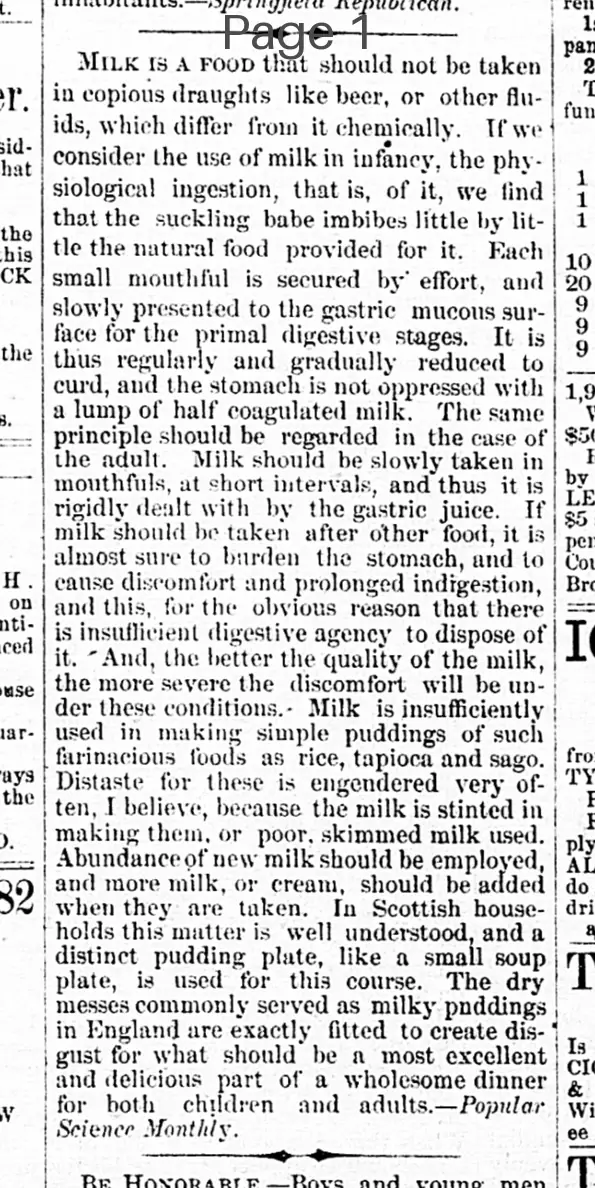
Milk is a food that should not be taken in copious draughts like beer or other fluids, which differ from it chemically. If we consider the use of milk in infancy, the physiological ingestion, that is, of it, we find that the suckling babe imbibes little by little the natural food provided for it. Each small mouthful is secured by effort, and slowly presented to the gastric mucous surface for the primal digestive stages. It is thus regularly and gradually reduced to curd, and the stomach is not oppressed with a lump of half coagulated milk. The same principle should be regarded in the case of the adult. Milk should be slowly taken in mouthfuls, at short intervals, and thus it is rigidly dealt with by the gastric juice. If milk should be taken after other food, it is almost sure to burthen the stomach, and to cause discomfort and prolonged indigestion, and this, for the obvious reason that there is insufficient digestive agency to dispose of it. And, the better the quality of the milk, the more severe the discomfort will be under these conditions. Milk is insufficiently used in making simple puddings of such farinaceous foods as rice, tapioca and sago. Distaste for these is engendered very often, I believe, because the milk is stinted in making them, or poor, skimmed milk used. Abundance of new milk should be employed, and more milk, or cream, should be added when they are taken. In Scottish households this matter is well understood, and a distinct pudding plate, like a small soup plate, is used for this course. The dry messes commonly served as milky puddings in England are exactly fitted to create disgust for what should be a most excellent and delicious part of a wholesome dinner for both children and adults. -Popular Science Monthly
What sub-type of article is it?
Medical Curiosity
What themes does it cover?
Misfortune
Moral Virtue
What keywords are associated?
Milk Digestion
Indigestion
Dietary Advice
Puddings
Gastric Juice
Infant Feeding
Story Details
Story Details
Advises adults to consume milk slowly in small mouthfuls to mimic infant digestion, avoid taking it after meals to prevent indigestion, and use abundantly in puddings to enhance appeal, contrasting Scottish and English practices.