Thank you for visiting SNEWPapers!
Sign up free
Letter to Editor
June 21, 1855
Watchman And Observer
Richmond, Virginia
What is this article about?
From Liberty County, Georgia, May 20, 1855: Reports promising crop prospects amid poverty and distress, praises a public meeting for relief funds, links charity to Christianity, and summarizes a church communion service with 14 new members and Rev. D. L. Buttolph's sermon on the joys sustaining Christ through the cross.
Clipping
OCR Quality
98%
Excellent
Full Text
For the Watchman and Observer:
LIBERTY CO., GEO., 20th May, 1855.
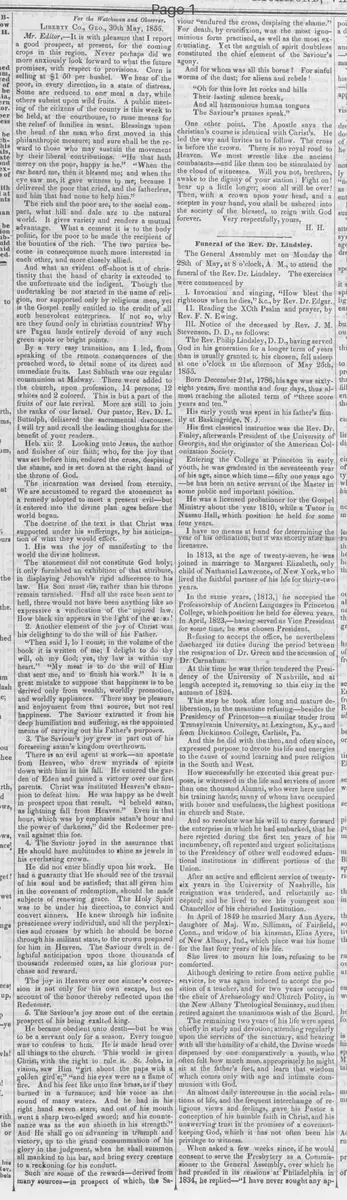
Mr. Editor,—It is with pleasure that I report a good prospect, at present, for the coming crops in this region. Never perhaps did we more anxiously look forward to what the future promises, with respect to provisions. Corn is selling at $1.50 per bushel. We hear of the poor, in every direction, in a state of distress. Some are reduced to one meal a day, while others subsist upon wild fruits. A public meeting of the citizens of the county is this week to be held, at the courthouse, to raise means for the relief of families in want. Blessings upon the head of the man who first moved in this philanthropic measure; and sure shall be the reward to those who may sustain the movement by their liberal contributions. "He that hath mercy on the poor, happy is he." "When the ear heard me, then it blessed me; and when the eye saw me, it gave witness to me; because I delivered the poor that cried, and the fatherless, and him that had none to help him."
The rich and the poor are, to the social compact, what hill and dale are to the natural world. It gives variety and renders a mutual advantage. What a cement it is to the body politic, for the poor to be made the recipient of the bounties of the rich. The two parties become in consequence much more interested in each other, and more closely allied.
And what an evident off-shoot is it of Christianity that the hand of charity is extended to the unfortunate and the indigent. Though the undertaking be not started in the name of religion, nor supported only by religious men, yet is the Gospel really entitled to the credit of all such benevolent enterprises. If not so, why are they found only in Christian countries? Why are Pagan lands entirely devoid of any such green spots or bright points.
By a very easy transition, am I led, from speaking of the remote consequences of the preached word, to detail some of its direct and immediate fruits. Last Sabbath was our regular communion at Midway. There were added to the church, upon profession, 14 persons; 12 whites and 2 colored. This is but a part of the fruits of our late revival. More are still to join the ranks of our Israel. Our pastor, Rev. D. L. Buttolph, delivered the sacramental discourse. I will try and recall the leading thoughts for the benefit of your readers.
Heb. xii: 2. Looking unto Jesus, the author and finisher of our faith; who, for the joy that was set before him, endured the cross, despising the shame, and is set down at the right hand of the throne of God.
The incarnation was devised from eternity. We are accustomed to regard the atonement as a remedy adopted to meet a present evil—but it entered into the divine plan ages before the world began.
The doctrine of the text is that Christ was supported under his sufferings, by his anticipation of what they would effect.
1. His was the joy of manifesting to the world the divine holiness.
The atonement did not constitute God holy; it only furnished an exhibition of that attribute, in displaying Jehovah's rigid adherence to his law. His Son must die, rather than his throne remain tarnished. Had all the race been sent to hell, there would not have been anything like so expressive a vindication of the injured law. How black sin appears in the light of the cross!
2. Another element of the joy of Christ was his delighting to do the will of his Father.
"Then said I, lo I come; in the volume of the book it is written of me; I delight to do thy will, oh my God; yea, thy law is within my heart." "My meat is to do the will of Him that sent me, and to finish his work." It is a great mistake to suppose that happiness is to be derived only from wealth, worldly promotion, and worldly appliances. There may be pleasure and enjoyment from that source, but not real happiness. The Saviour extracted it from his deep humiliation and suffering, as the appointed means of carrying out his Father's purposes.
3. The Saviour's joy grew in part out of his foreseeing Satan's kingdom overthrown.
There is an evil agent at work—an apostate from Heaven, who drew myriads of spirits down with him in his fall. He entered the garden of Eden and gained a victory over our first parents. Christ was instituted Heaven's champion to defeat him. He was happy as he dwelt in prospect upon that result. "I beheld Satan as lightning fall from Heaven." Even in that hour, which was by emphasis Satan's hour and the power of darkness, did the Redeemer prevail against this foe.
4. The Saviour joyed in the assurance that He should have multitudes to shine as jewels in his everlasting crown.
He did not enter blindly upon his work. He had a guaranty that He should see of the travail of his soul and be satisfied; that all given him in the covenant of redemption, should be made subjects of renewing grace. The Holy Spirit was to be under his direction, to convict and convert sinners. He knew through his infinite prescience every individual, and all the perplexities and crosses by which he should be borne through his militant state, to the crown prepared for him in Heaven. The Saviour dwelt in delightful anticipation upon those thousands of thousands redeemed ones, as his glorious purchase and reward.
The joy in Heaven over one sinner's conversion is not only for his own escape, but on account of the honor thereby reflected upon the Redeemer.
5. The Saviour's joy arose out of the certain prospect of his being exalted king.
He became obedient unto death—but he was to be a servant only for a season. Every tongue was to confess to him. He is made head over all things to the church. This world is given Christ, with the right to rule it. St. John, in vision, saw Him "girt about the paps with a golden girdle;" "and his eyes were as a flame of fire. And his feet like unto fine brass, as if they burned in a furnace; and his voice as the sound of many waters. And he had in his right hand seven stars; and out of his mouth went a sharp two-edged sword; and his countenance was as the sun shineth in his strength." And He shall go on advancing in triumph and victory, up to the grand consummation of his glory in the judgment, when he shall summon all mankind to his bar, and bring every creature to a reckoning for his conduct.
Such are some of the rewards—derived from many sources—in prospect of which, the Saviour "endured the cross, despising the shame."
For death, by crucifixion, was the most ignominious form practised, as well as the most excruciating. Yet the anguish of spirit doubtless constituted the chief element of the Saviour's agony.
And for whom was all this borne? For sinful worms of the dust; for aliens and rebels!
"Oh for this love let rocks and hills
Their lasting silence break,
And all harmonious human tongues
The Saviour's praises speak."
One other point. The Apostle says the Christian's course is identical with Christ's. He led the way and invites us to follow. The cross is before the crown. There is no royal road to Heaven. We must wrestle like the ancient combatants—and like them too be stimulated by the cloud of witnesses. Will you not, brethren, awake to the dignity of your station! Fight on! bear up a little longer; soon all will be over!
Then, with a crown upon your head, and a sceptre in your hand, you shall be ushered into the society of the blessed, to reign with God forever.
Very respectfully, yours,
H. H.
LIBERTY CO., GEO., 20th May, 1855.
Mr. Editor,—It is with pleasure that I report a good prospect, at present, for the coming crops in this region. Never perhaps did we more anxiously look forward to what the future promises, with respect to provisions. Corn is selling at $1.50 per bushel. We hear of the poor, in every direction, in a state of distress. Some are reduced to one meal a day, while others subsist upon wild fruits. A public meeting of the citizens of the county is this week to be held, at the courthouse, to raise means for the relief of families in want. Blessings upon the head of the man who first moved in this philanthropic measure; and sure shall be the reward to those who may sustain the movement by their liberal contributions. "He that hath mercy on the poor, happy is he." "When the ear heard me, then it blessed me; and when the eye saw me, it gave witness to me; because I delivered the poor that cried, and the fatherless, and him that had none to help him."
The rich and the poor are, to the social compact, what hill and dale are to the natural world. It gives variety and renders a mutual advantage. What a cement it is to the body politic, for the poor to be made the recipient of the bounties of the rich. The two parties become in consequence much more interested in each other, and more closely allied.
And what an evident off-shoot is it of Christianity that the hand of charity is extended to the unfortunate and the indigent. Though the undertaking be not started in the name of religion, nor supported only by religious men, yet is the Gospel really entitled to the credit of all such benevolent enterprises. If not so, why are they found only in Christian countries? Why are Pagan lands entirely devoid of any such green spots or bright points.
By a very easy transition, am I led, from speaking of the remote consequences of the preached word, to detail some of its direct and immediate fruits. Last Sabbath was our regular communion at Midway. There were added to the church, upon profession, 14 persons; 12 whites and 2 colored. This is but a part of the fruits of our late revival. More are still to join the ranks of our Israel. Our pastor, Rev. D. L. Buttolph, delivered the sacramental discourse. I will try and recall the leading thoughts for the benefit of your readers.
Heb. xii: 2. Looking unto Jesus, the author and finisher of our faith; who, for the joy that was set before him, endured the cross, despising the shame, and is set down at the right hand of the throne of God.
The incarnation was devised from eternity. We are accustomed to regard the atonement as a remedy adopted to meet a present evil—but it entered into the divine plan ages before the world began.
The doctrine of the text is that Christ was supported under his sufferings, by his anticipation of what they would effect.
1. His was the joy of manifesting to the world the divine holiness.
The atonement did not constitute God holy; it only furnished an exhibition of that attribute, in displaying Jehovah's rigid adherence to his law. His Son must die, rather than his throne remain tarnished. Had all the race been sent to hell, there would not have been anything like so expressive a vindication of the injured law. How black sin appears in the light of the cross!
2. Another element of the joy of Christ was his delighting to do the will of his Father.
"Then said I, lo I come; in the volume of the book it is written of me; I delight to do thy will, oh my God; yea, thy law is within my heart." "My meat is to do the will of Him that sent me, and to finish his work." It is a great mistake to suppose that happiness is to be derived only from wealth, worldly promotion, and worldly appliances. There may be pleasure and enjoyment from that source, but not real happiness. The Saviour extracted it from his deep humiliation and suffering, as the appointed means of carrying out his Father's purposes.
3. The Saviour's joy grew in part out of his foreseeing Satan's kingdom overthrown.
There is an evil agent at work—an apostate from Heaven, who drew myriads of spirits down with him in his fall. He entered the garden of Eden and gained a victory over our first parents. Christ was instituted Heaven's champion to defeat him. He was happy as he dwelt in prospect upon that result. "I beheld Satan as lightning fall from Heaven." Even in that hour, which was by emphasis Satan's hour and the power of darkness, did the Redeemer prevail against this foe.
4. The Saviour joyed in the assurance that He should have multitudes to shine as jewels in his everlasting crown.
He did not enter blindly upon his work. He had a guaranty that He should see of the travail of his soul and be satisfied; that all given him in the covenant of redemption, should be made subjects of renewing grace. The Holy Spirit was to be under his direction, to convict and convert sinners. He knew through his infinite prescience every individual, and all the perplexities and crosses by which he should be borne through his militant state, to the crown prepared for him in Heaven. The Saviour dwelt in delightful anticipation upon those thousands of thousands redeemed ones, as his glorious purchase and reward.
The joy in Heaven over one sinner's conversion is not only for his own escape, but on account of the honor thereby reflected upon the Redeemer.
5. The Saviour's joy arose out of the certain prospect of his being exalted king.
He became obedient unto death—but he was to be a servant only for a season. Every tongue was to confess to him. He is made head over all things to the church. This world is given Christ, with the right to rule it. St. John, in vision, saw Him "girt about the paps with a golden girdle;" "and his eyes were as a flame of fire. And his feet like unto fine brass, as if they burned in a furnace; and his voice as the sound of many waters. And he had in his right hand seven stars; and out of his mouth went a sharp two-edged sword; and his countenance was as the sun shineth in his strength." And He shall go on advancing in triumph and victory, up to the grand consummation of his glory in the judgment, when he shall summon all mankind to his bar, and bring every creature to a reckoning for his conduct.
Such are some of the rewards—derived from many sources—in prospect of which, the Saviour "endured the cross, despising the shame."
For death, by crucifixion, was the most ignominious form practised, as well as the most excruciating. Yet the anguish of spirit doubtless constituted the chief element of the Saviour's agony.
And for whom was all this borne? For sinful worms of the dust; for aliens and rebels!
"Oh for this love let rocks and hills
Their lasting silence break,
And all harmonious human tongues
The Saviour's praises speak."
One other point. The Apostle says the Christian's course is identical with Christ's. He led the way and invites us to follow. The cross is before the crown. There is no royal road to Heaven. We must wrestle like the ancient combatants—and like them too be stimulated by the cloud of witnesses. Will you not, brethren, awake to the dignity of your station! Fight on! bear up a little longer; soon all will be over!
Then, with a crown upon your head, and a sceptre in your hand, you shall be ushered into the society of the blessed, to reign with God forever.
Very respectfully, yours,
H. H.
What sub-type of article is it?
Informative
Religious
Ethical Moral
What themes does it cover?
Agriculture
Religion
Social Issues
What keywords are associated?
Crop Prospects
Poverty Distress
Charity Relief
Christian Benevolence
Church Communion
Revival Additions
Sermon Summary
Liberty County
Georgia 1855
What entities or persons were involved?
H. H.
Mr. Editor
Letter to Editor Details
Author
H. H.
Recipient
Mr. Editor
Main Argument
reports good agricultural prospects and urgent poverty relief efforts in liberty county, georgia, while emphasizing charity as a christian duty and summarizing a sermon on the joys that enabled christ to endure the cross for humanity's redemption.
Notable Details
Public Meeting At Courthouse For Poor Relief
Corn At $1.50 Per Bushel
14 New Church Members (12 Whites, 2 Colored) From Revival
Sermon On Hebrews 12:2 With Five Points Of Christ's Joy
Quotes Psalms And Other Bible Verses