Thank you for visiting SNEWPapers!
Sign up free
Letter to Editor
October 19, 1908
The Star And Newark Advertiser
Newark, Essex County, New Jersey
What is this article about?
Rev. W. S. Crowe endorses William Howard Taft for president, highlighting his legal expertise, fairness, and constitutional knowledge, while criticizing William Jennings Bryan's immature financial ideas on silver currency from his 1896 campaign.
Clipping
OCR Quality
98%
Excellent
Full Text
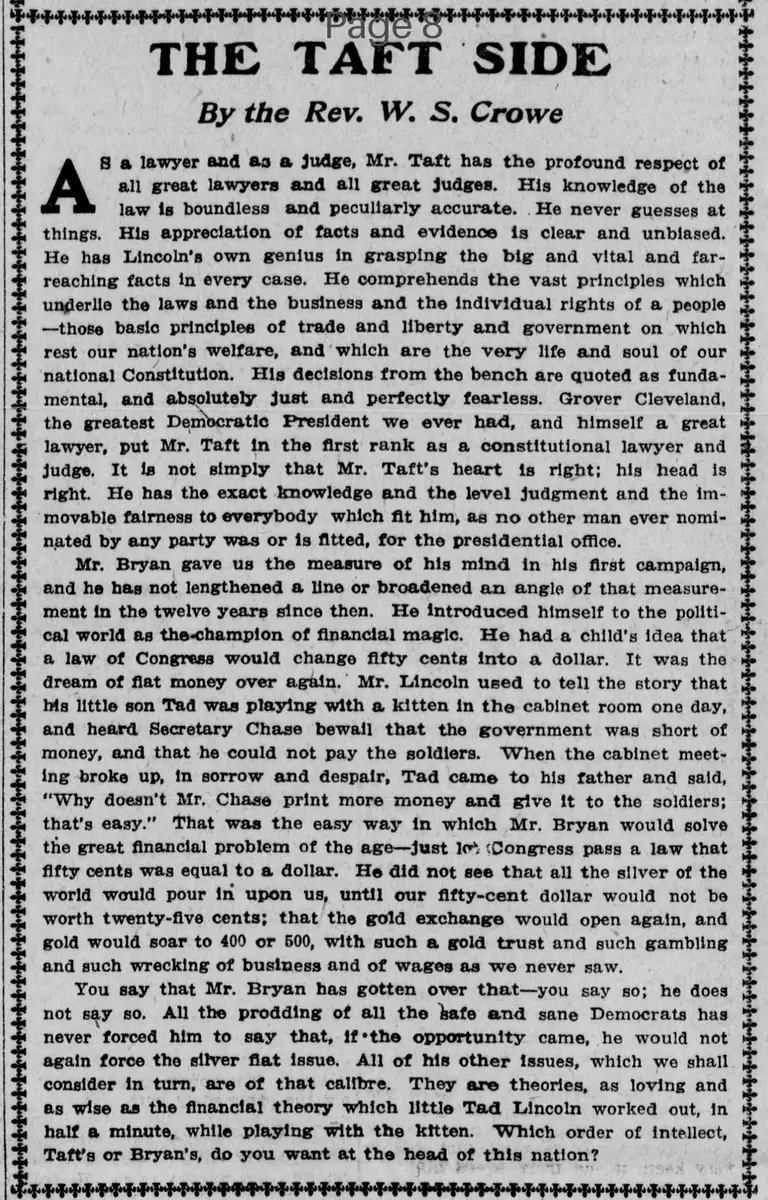
THE TAFT SIDE
By the Rev. W. S. Crowe
As a lawyer and as a judge, Mr. Taft has the profound respect of all great lawyers and all great judges. His knowledge of the law is boundless and peculiarly accurate. He never guesses at things.
His appreciation of facts and evidence is clear and unbiased.
He has Lincoln's own genius in grasping the big and vital and far-reaching facts in every case. He comprehends the vast principles which underlie the laws and the business and the individual rights of a people—those basic principles of trade and liberty and government on which rest our nation's welfare, and which are the very life and soul of our national Constitution. His decisions from the bench are quoted as fundamental, and absolutely just and perfectly fearless. Grover Cleveland, the greatest Democratic President we ever had, and himself a great lawyer, put Mr. Taft in the first rank as a constitutional lawyer and judge. It is not simply that Mr. Taft's heart is right; his head is right. He has the exact knowledge and the level judgment and the immovable fairness to everybody which fit him, as no other man ever nominated by any party was or is fitted, for the presidential office.
Mr. Bryan gave us the measure of his mind in his first campaign, and he has not lengthened a line or broadened an angle of that measurement in the twelve years since then. He introduced himself to the political world as the champion of financial magic. He had a child's idea that a law of Congress would change fifty cents into a dollar. It was the dream of flat money over again. Mr. Lincoln used to tell the story that his little son Tad was playing with a kitten in the cabinet room one day, and heard Secretary Chase bewail that the government was short of money, and that he could not pay the soldiers. When the cabinet meeting broke up in sorrow and despair, Tad came to his father and said, "Why doesn't Mr. Chase print more money and give it to the soldiers; that's easy." That was the easy way in which Mr. Bryan would solve the great financial problem of the age—just to have Congress pass a law that fifty cents was equal to a dollar. He did not see that all the silver of the world would pour in upon us, until our fifty-cent dollar would not be worth twenty-five cents; that the gold exchange would open again, and gold would soar to 400 or 500, with such a gold trust and such gambling and such wrecking of business and of wages as we never saw.
You say that Mr. Bryan has gotten over that—you say so; he does not say so. All the prodding of all the safe and sane Democrats has never forced him to say that, if the opportunity came, he would not again force the silver fiat issue. All of his other issues, which we shall consider in turn, are of that calibre. They are theories, as loving and as wise as the financial theory which little Tad Lincoln worked out, in half a minute, while playing with the kitten. Which order of intellect, Taft's or Bryan's, do you want at the head of this nation?
By the Rev. W. S. Crowe
As a lawyer and as a judge, Mr. Taft has the profound respect of all great lawyers and all great judges. His knowledge of the law is boundless and peculiarly accurate. He never guesses at things.
His appreciation of facts and evidence is clear and unbiased.
He has Lincoln's own genius in grasping the big and vital and far-reaching facts in every case. He comprehends the vast principles which underlie the laws and the business and the individual rights of a people—those basic principles of trade and liberty and government on which rest our nation's welfare, and which are the very life and soul of our national Constitution. His decisions from the bench are quoted as fundamental, and absolutely just and perfectly fearless. Grover Cleveland, the greatest Democratic President we ever had, and himself a great lawyer, put Mr. Taft in the first rank as a constitutional lawyer and judge. It is not simply that Mr. Taft's heart is right; his head is right. He has the exact knowledge and the level judgment and the immovable fairness to everybody which fit him, as no other man ever nominated by any party was or is fitted, for the presidential office.
Mr. Bryan gave us the measure of his mind in his first campaign, and he has not lengthened a line or broadened an angle of that measurement in the twelve years since then. He introduced himself to the political world as the champion of financial magic. He had a child's idea that a law of Congress would change fifty cents into a dollar. It was the dream of flat money over again. Mr. Lincoln used to tell the story that his little son Tad was playing with a kitten in the cabinet room one day, and heard Secretary Chase bewail that the government was short of money, and that he could not pay the soldiers. When the cabinet meeting broke up in sorrow and despair, Tad came to his father and said, "Why doesn't Mr. Chase print more money and give it to the soldiers; that's easy." That was the easy way in which Mr. Bryan would solve the great financial problem of the age—just to have Congress pass a law that fifty cents was equal to a dollar. He did not see that all the silver of the world would pour in upon us, until our fifty-cent dollar would not be worth twenty-five cents; that the gold exchange would open again, and gold would soar to 400 or 500, with such a gold trust and such gambling and such wrecking of business and of wages as we never saw.
You say that Mr. Bryan has gotten over that—you say so; he does not say so. All the prodding of all the safe and sane Democrats has never forced him to say that, if the opportunity came, he would not again force the silver fiat issue. All of his other issues, which we shall consider in turn, are of that calibre. They are theories, as loving and as wise as the financial theory which little Tad Lincoln worked out, in half a minute, while playing with the kitten. Which order of intellect, Taft's or Bryan's, do you want at the head of this nation?
What sub-type of article is it?
Persuasive
Political
What themes does it cover?
Politics
Economic Policy
What keywords are associated?
Taft Endorsement
Bryan Criticism
Silver Fiat
Financial Policy
Presidential Election
Constitutional Law
What entities or persons were involved?
Rev. W. S. Crowe
Letter to Editor Details
Author
Rev. W. S. Crowe
Main Argument
william howard taft is exceptionally qualified for the presidency due to his profound legal knowledge, unbiased judgment, and fairness, surpassing all others; in contrast, william jennings bryan's financial ideas, like advocating silver fiat money, demonstrate immature and dangerous thinking akin to a child's simplistic solution.
Notable Details
References Grover Cleveland's Praise Of Taft As A Constitutional Lawyer
Recounts Lincoln's Story Of Son Tad Suggesting Printing Money
Criticizes Bryan's 1896 Campaign On Silver Currency