Thank you for visiting SNEWPapers!
Sign up free
Story
July 6, 1833
New Hampshire Statesman And State Journal
Concord, Merrimack County, New Hampshire
What is this article about?
Cholera outbreak strikes Lexington, Kentucky, on June 2, killing nearly 400 in 14 days amid panic and flight; prominent citizens die, city disorganized, but heroic aid from figures like Bishop Smith; disease receding by mid-June.
Clipping
OCR Quality
98%
Excellent
Full Text
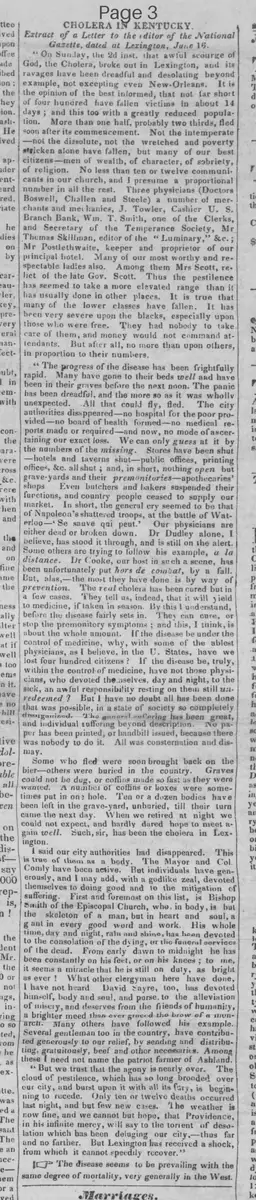
CHOLERA IN KENTUCKY.
Extract of a Letter to the Editor of the National Gazette, dated at Lexington, June 16.
"On Sunday, the 2d inst. that awful scourge of God, the Cholera, broke out in Lexington, and its ravages have been dreadful and desolating beyond example, not excepting even New-Orleans. It is the opinion of the best informed, that not far short of four hundred have fallen victims in about 14 days; and this too with a greatly reduced population. More than one half, probably two thirds, fled soon after its commencement. Not the intemperate—not the dissolute, not the wretched and poverty stricken alone have fallen, but many of our best citizens—men of wealth, of character, of sobriety, of religion. No less than ten or twelve communicants in our church, and I presume a proportional number in all the rest. Three physicians (Doctors Boswell, Challen and Steele) a number of merchants and mechanics, J. Towler, Cashier U. S. Branch Bank, Wm. T. Smith, one of the Clerks, and Secretary of the Temperance Society, Mr. Thomas Skillman, editor of the "Luminary," &c.; Mr. Postlethwaite, keeper and proprietor of our principal hotel. Many of our most worthy and respectable ladies also. Among them Mrs. Scott, relict of the late Gov. Scott. Thus the pestilence has seemed to take a more elevated range than it has usually done in other places. It is true that many of the lower classes have fallen. It has been very severe upon the blacks, especially upon those who were free. They had nobody to take care of them, and money would not command attendants. But after all, no more than upon others, in proportion to their numbers.
"The progress of the disease has been frightfully rapid. Many have gone to their beds well and have been in their graves before the next noon. The panic has been dreadful, and the more so as it was wholly unexpected. All that could fly, fled. The city authorities disappeared—no hospital for the poor provided—no board of health formed—no medical reports made or required—and now, no mode of ascertaining our exact loss. We can only guess at it by the numbers of the missing. Stores have been shut—hotels and taverns shut—public offices, printing offices, &c. all shut; and, in short, nothing open but grave-yards and their premonitories—apothecaries' shops. Even butchers and bakers suspended their functions, and country people ceased to supply our market. In short, the general cry seemed to be that of Napoleon's shattered troops, at the battle of Waterloo—'Se sauve qui peut.' Our physicians are either dead or broken down. Dr. Dudley alone, I believe, has stood it through, and is still on the alert. Some others are trying to follow his example, a la distance. Dr. Cooke, our host in such a scene, has been unfortunately put hors de combat, by a fall. But, alas,—the most they have done is by way of prevention. The real cholera has been cured but in a few cases. They tell us, indeed, that it will yield to medicine, if taken in season. By this I understand, before the disease fairly sets in. They can cure, or stop the premonitory symptoms; and this, I think, is about the whole amount. If the disease be under the control of medicine, why, with some of the ablest physicians, as I believe, in the U. States, have we lost four hundred citizens? If the disease be, truly, within the control of medicine, have not those physicians, who devoted themselves, day and night, to the sick, an awful responsibility resting on them still unredeemed? But I have no doubt all has been done that was possible, in a state of society so completely disorganized. The general suffering has been great, and individual suffering beyond description. No paper has been printed, or handbill issued, because there was nobody to do it. All was consternation and dismay.
Some who fled were soon brought back on the bier—others were buried in the country. Graves could not be dug, or coffins made so fast as they were wanted. A number of coffins or boxes were sometimes put in one hole. Ten or a dozen bodies have been left in the grave-yard, unburied, till their turn came the next day. When we retired at night we could not expect, and hardly dared hope to meet again well. Such, sir, has been the cholera in Lexington.
I said our city authorities had disappeared. This is true of them as a body. The Mayor and Col. Comly have been active. But individuals have generously, and I may add, with a godlike zeal, devoted themselves to doing good and to the mitigation of suffering. First and foremost on this list, is Bishop Smith of the Episcopal Church, who, in body, is but the skeleton of a man, but in heart and soul, a giant in every good word and work. His whole time, day and night, rain and shine, has been devoted to the consolation of the dying, or the funeral services of the dead. From early dawn to midnight he has been constantly on his feet, or on his knees; to me, it seems a miracle that he is still on duty, as bright as ever! What other clergyman here have done, I have not heard. David Sayre, too, has devoted himself, body and soul, and purse, to the alleviation of misery, and deserves from the friends of humanity, a brighter meed than ever graced the brow of a monarch. Many others have followed his example.
Several gentlemen too in the country, have contributed generously to our relief, by sending and distributing, gratuitously, beef and other necessaries. Among these I need not name the patriot farmer of Ashland.
"But we trust that the agony is nearly over. The cloud of pestilence, which has so long brooded over our city, and burst upon it with all its fury, is beginning to recede. (Only ten or twelve deaths occurred last night, and but few new cases. The weather is now fine, and we cannot but hope, that Providence, in his infinite mercy, will say to the torrent of desolation which has been deluging our city, thus far and no farther. But Lexington has received a shock, from which it cannot speedily recover."
The disease seems to be prevailing with the same degree of mortality, very generally in the West.
Extract of a Letter to the Editor of the National Gazette, dated at Lexington, June 16.
"On Sunday, the 2d inst. that awful scourge of God, the Cholera, broke out in Lexington, and its ravages have been dreadful and desolating beyond example, not excepting even New-Orleans. It is the opinion of the best informed, that not far short of four hundred have fallen victims in about 14 days; and this too with a greatly reduced population. More than one half, probably two thirds, fled soon after its commencement. Not the intemperate—not the dissolute, not the wretched and poverty stricken alone have fallen, but many of our best citizens—men of wealth, of character, of sobriety, of religion. No less than ten or twelve communicants in our church, and I presume a proportional number in all the rest. Three physicians (Doctors Boswell, Challen and Steele) a number of merchants and mechanics, J. Towler, Cashier U. S. Branch Bank, Wm. T. Smith, one of the Clerks, and Secretary of the Temperance Society, Mr. Thomas Skillman, editor of the "Luminary," &c.; Mr. Postlethwaite, keeper and proprietor of our principal hotel. Many of our most worthy and respectable ladies also. Among them Mrs. Scott, relict of the late Gov. Scott. Thus the pestilence has seemed to take a more elevated range than it has usually done in other places. It is true that many of the lower classes have fallen. It has been very severe upon the blacks, especially upon those who were free. They had nobody to take care of them, and money would not command attendants. But after all, no more than upon others, in proportion to their numbers.
"The progress of the disease has been frightfully rapid. Many have gone to their beds well and have been in their graves before the next noon. The panic has been dreadful, and the more so as it was wholly unexpected. All that could fly, fled. The city authorities disappeared—no hospital for the poor provided—no board of health formed—no medical reports made or required—and now, no mode of ascertaining our exact loss. We can only guess at it by the numbers of the missing. Stores have been shut—hotels and taverns shut—public offices, printing offices, &c. all shut; and, in short, nothing open but grave-yards and their premonitories—apothecaries' shops. Even butchers and bakers suspended their functions, and country people ceased to supply our market. In short, the general cry seemed to be that of Napoleon's shattered troops, at the battle of Waterloo—'Se sauve qui peut.' Our physicians are either dead or broken down. Dr. Dudley alone, I believe, has stood it through, and is still on the alert. Some others are trying to follow his example, a la distance. Dr. Cooke, our host in such a scene, has been unfortunately put hors de combat, by a fall. But, alas,—the most they have done is by way of prevention. The real cholera has been cured but in a few cases. They tell us, indeed, that it will yield to medicine, if taken in season. By this I understand, before the disease fairly sets in. They can cure, or stop the premonitory symptoms; and this, I think, is about the whole amount. If the disease be under the control of medicine, why, with some of the ablest physicians, as I believe, in the U. States, have we lost four hundred citizens? If the disease be, truly, within the control of medicine, have not those physicians, who devoted themselves, day and night, to the sick, an awful responsibility resting on them still unredeemed? But I have no doubt all has been done that was possible, in a state of society so completely disorganized. The general suffering has been great, and individual suffering beyond description. No paper has been printed, or handbill issued, because there was nobody to do it. All was consternation and dismay.
Some who fled were soon brought back on the bier—others were buried in the country. Graves could not be dug, or coffins made so fast as they were wanted. A number of coffins or boxes were sometimes put in one hole. Ten or a dozen bodies have been left in the grave-yard, unburied, till their turn came the next day. When we retired at night we could not expect, and hardly dared hope to meet again well. Such, sir, has been the cholera in Lexington.
I said our city authorities had disappeared. This is true of them as a body. The Mayor and Col. Comly have been active. But individuals have generously, and I may add, with a godlike zeal, devoted themselves to doing good and to the mitigation of suffering. First and foremost on this list, is Bishop Smith of the Episcopal Church, who, in body, is but the skeleton of a man, but in heart and soul, a giant in every good word and work. His whole time, day and night, rain and shine, has been devoted to the consolation of the dying, or the funeral services of the dead. From early dawn to midnight he has been constantly on his feet, or on his knees; to me, it seems a miracle that he is still on duty, as bright as ever! What other clergyman here have done, I have not heard. David Sayre, too, has devoted himself, body and soul, and purse, to the alleviation of misery, and deserves from the friends of humanity, a brighter meed than ever graced the brow of a monarch. Many others have followed his example.
Several gentlemen too in the country, have contributed generously to our relief, by sending and distributing, gratuitously, beef and other necessaries. Among these I need not name the patriot farmer of Ashland.
"But we trust that the agony is nearly over. The cloud of pestilence, which has so long brooded over our city, and burst upon it with all its fury, is beginning to recede. (Only ten or twelve deaths occurred last night, and but few new cases. The weather is now fine, and we cannot but hope, that Providence, in his infinite mercy, will say to the torrent of desolation which has been deluging our city, thus far and no farther. But Lexington has received a shock, from which it cannot speedily recover."
The disease seems to be prevailing with the same degree of mortality, very generally in the West.
What sub-type of article is it?
Disaster
Historical Event
Medical Curiosity
What themes does it cover?
Catastrophe
Misfortune
Providence Divine
What keywords are associated?
Cholera Outbreak
Lexington Kentucky
Epidemic Deaths
City Panic
Bishop Smith
Dr Dudley
Providence Mercy
What entities or persons were involved?
Bishop Smith
Dr. Dudley
David Sayre
Doctors Boswell
Challen And Steele
J. Towler
Wm. T. Smith
Thomas Skillman
Mr. Postlethwaite
Mrs. Scott
Where did it happen?
Lexington, Kentucky
Story Details
Key Persons
Bishop Smith
Dr. Dudley
David Sayre
Doctors Boswell
Challen And Steele
J. Towler
Wm. T. Smith
Thomas Skillman
Mr. Postlethwaite
Mrs. Scott
Location
Lexington, Kentucky
Event Date
Sunday, The 2d Inst. To June 16
Story Details
Cholera erupts in Lexington on June 2, claiming nearly 400 lives in 14 days despite population flight; strikes all classes, causes panic, disrupts city functions, overwhelms burials; heroic aid from Bishop Smith and others; disease begins to recede.