Thank you for visiting SNEWPapers!
Sign up free
Alexandria Daily Gazette, Commercial & Political
Alexandria, Virginia
What is this article about?
This letter critiques U.S. foreign policy under Jefferson and Madison, condemning submission to French decrees (Berlin, Milan, Rambouillet) violating neutral rights while preparing for war with Britain. It argues America should oppose French tyranny instead, highlighting events like the Chesapeake attack and failed negotiations.
Merged-components note: The letter to the editor continues across pages 2 and 3, with the conclusion spanning both components.
Clippings
1 of 2
OCR Quality
Full Text
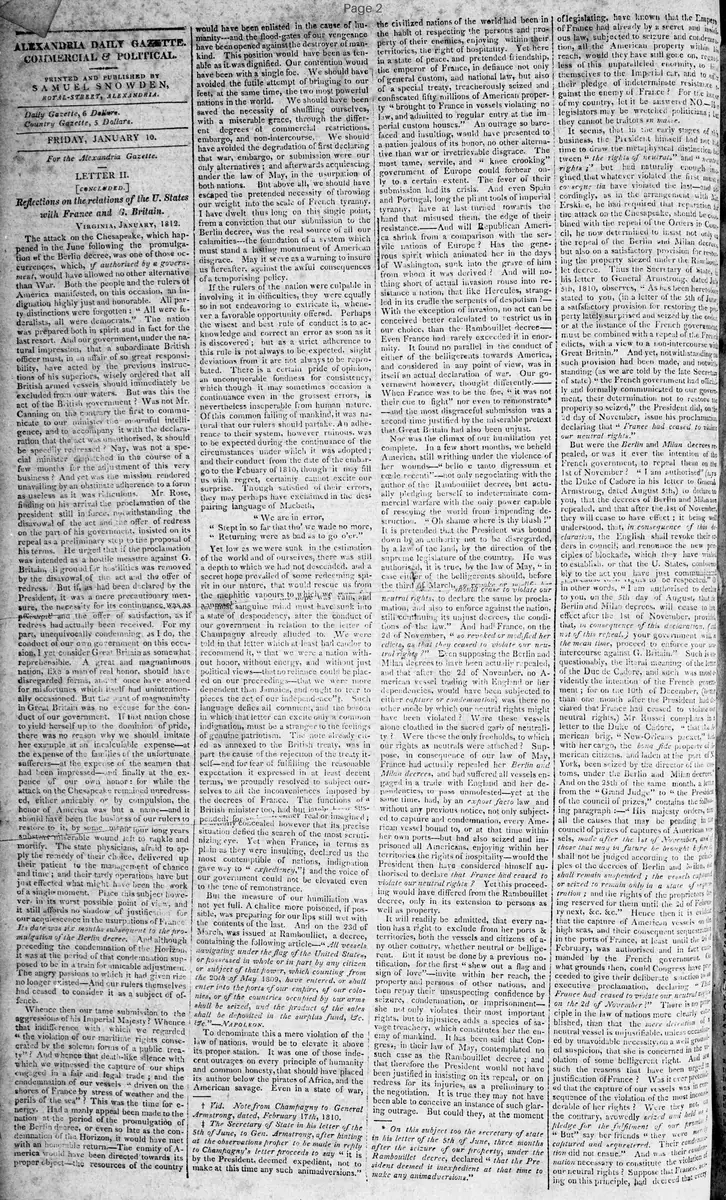
LETTER II.
[Concluded.]
Reflections on the relations of the U. States with France and G. Britain.
Virginia, January, 1812.
The attack on the Chesapeake, which happened in the June following the promulgation of the Berlin decree, was one of those occurrences, which, if authorised by a government, would have allowed no other alternative than War. Both the people and the rulers of America manifested, on this occasion, an indignation highly just and honorable. All party distinctions were forgotten: "All were federalists, all were democrats." The nation was prepared both in spirit and in fact for the last resort. And our government, under the natural impression, that a subordinate British officer must, in an affair of so great responsibility, have acted by the previous instructions of his superiors, wisely ordered that all British armed vessels should immediately be excluded from our waters. But was this the act of the British government? Was not Mr. Canning on the contrary the first to communicate to our minister the mournful intelligence, and to accompany it with the declaration that the act was unauthorised, & should be speedily redressed? Nay, was not a special minister dispatched in the course of a few months for the adjustment of this very business? And yet was the mission rendered unavailing by an obstinate adherence to a form as useless as it was ridiculous. Mr. Rose, finding on his arrival the proclamation of the president still in force, notwithstanding the disavowal of the act and the offer of redress on the part of his government, insisted on its repeal as a preliminary step to the proposal of his terms. He urged that if the proclamation was intended as a hostile measure against G. Britain, its ground for hostilities was removed by the disavowal of the act and the offer of redress. But if, as had been declared by the President, it was a mere precautionary measure, the necessity for its continuance was as much at an end by the disavowal and the offer of satisfaction, as if redress had actually been received. For my part, unequivocally condemning, as I do, the conduct of our own government on this occasion, I yet consider Great Britain as somewhat reprehensible. A great and magnanimous nation, like a man of real honor, should have disregarded forms, and at once have atoned for misfortunes which itself had unintentionally occasioned. But the want of magnanimity in Great Britain was no excuse for the conduct of our government. If that nation chose to yield herself up to the dominion of pride, there was no reason why we should imitate her example at an incalculable expense--at the expense of the families of the unfortunate sufferers--at the expense of the seamen that had been impressed--and finally at the expense of our own honor: for while the attack on the Chesapeake remained unredressed, either amicably or by compulsion, the honor of America was but a name--and it should have been the business of our rulers to restore to it, by some means or other, for four long years, this miserable wound left to rankle and mortify. The state physicians, afraid to apply the remedy of their choice, delivered up their patient to the management of chance and time; and their tardy operations have but just effected what might have been the work of a single moment. Place this subject however, in its worst possible point of view, and it still affords no shadow of justification for our acquiescence in the usurpations of France. Its date was six months subsequent to the promulgation of the Berlin decree. And although preceding the condemnation of the Horizon, it was at the period of that condemnation supposed to be in a train for amicable adjustment. The angry passions to which it had given rise no longer existed--And our rulers themselves had ceased to consider it as a subject of offence.
Whence then our tame submission to the aggressions of his Imperial Majesty? Whence that indifference with which we regarded "the violation of our maritime rights consecrated by the solemn forms of a public treaty"? And whence that death-like silence with which we witnessed the capture of our ships engaged in a fair and legal trade; and the condemnation of our vessels "driven on the shores of France by stress of weather and the perils of the sea"? This was the time for energy. Had a manly appeal been made to the nation at the period of the promulgation of the Berlin decree, or even so late as the condemnation of the Horizon, it would have met with an honorable return.--The enmity of America would have been directed towards its proper object--the resources of the country would have been enlisted in the cause of humanity---and the flood-gates of our vengeance have been opened against the destroyer of mankind. This position would have been as tenable as it was dignified. Our contention would have been with a single foe. We should have avoided the futile attempt of bringing to our feet, at the same time, the two most powerful nations in the world. We should have been saved the necessity of shuffling ourselves, with a miserable grace, through the different degrees of commercial restrictions, embargo, and non-intercourse. We should have avoided the degradation of first declaring that war, embargo, or submission were our only alternatives; and afterwards acquiescing under the law of May, in the usurpation of both nations. But above all, we should have escaped the pretended necessity of throwing our weight into the scale of French tyranny.
I have dwelt thus long on this single point, from a conviction that our submission to the Berlin decree, was the real source of all our calamities---the foundation of a system which must stand a lasting monument of American disgrace. May it serve as a warning to insure us hereafter, against the awful consequences of a temporising policy.
If the rulers of the nation were culpable in involving it in difficulties, they were equally so in not endeavoring to extricate it, whenever a favorable opportunity offered. Perhaps the wisest and best rule of conduct is to acknowledge and correct an error as soon as it is discovered; but as a strict adherence to this rule is not always to be expected, slight deviations from it are not always to be reprobated. There is a certain pride of opinion, an unconquerable fondness for consistency, which though it may sometimes occasion a continuance even in the grossest errors, is nevertheless inseparable from human nature. Of this common failing of mankind, it was natural that our rulers should partake. An adherence to their system, however ruinous, was to be expected during the continuance of the circumstances under which it was adopted; and their conduct from the date of the embargo to the February of 1810, though it may fill us with regret, certainly cannot excite our surprise. Though satisfied of their errors they may perhaps have exclaimed in the despairing language of Macbeth,
"We are in error,
Stept in so far that tho' we wade no more,
Returning were as bad as to go o'er."
Yet low as we were sunk in the estimation of the world and of ourselves, there was still a depth to which we had not descended, and a secret hope prevailed of some redeeming spirit in our nature, that would rescue us from the mephitic vapours to which a less sanguine mind must have sunk into a state of despondency, after the conduct of our government in relation to the letter of Champagny already alluded to. We were told in that letter which at least had candor to recommend it, "that we were a nation without honor, without energy, and without just political views--that no reliance could be placed on our proceedings--that we were more dependent than Jamaica, and ought to tear to pieces the act of our independence." Such language defies all comment, and the bosom in which that letter can excite only a common indignation, must be a stranger to the feelings of genuine patriotism. The note already cited as annexed to the British treaty, was in part the cause of the rejection of the treaty itself--and for fear of fulfilling the reasonable expectation it expressed in at least decent terms, we proudly resolved to subject ourselves to all the inconveniences imposed by the decrees of France. The functions of a British minister too, had but lately been suspended; for an ideal injury real or imagined; denying concealed however that its precise situation defied the search of the most scrutinizing eye. Yet when France, in terms as plain as they were insulting, declared us the most contemptible of nations, indignation gave way to "expediency," and the voice of our government could not be elevated even to the tone of remonstrance.
But the measure of our humiliation was not yet full. A chalice more poisoned, if possible, was preparing for our lips still wet with the contents of the last. And on the 23d of March, was issued at Rambouillet, a decree, containing the following article--"All vessels navigating under the flag of the United States, or possessed in whole or in part by any citizen or subject of that power, which counting from the 20th of May 1809, have entered, or shall enter into the ports of our empire, of our colonies, or of the countries occupied by our arms shall be seized, and the product of the sales shall be deposited in the surplus fund, &c. NAPOLEON."
To denominate this a mere violation of the law of nations, would be to elevate it above its proper station. It was one of those indecent outrages on every principle of humanity and common honesty, that should have placed its author below the pirates of Africa, and the American savage. Even in a state of war, the civilized nations of the world had been in the habit of respecting the persons and property of their enemies, enjoying within their territories, the right of hospitality. Yet here in a state of peace, and pretended friendship, the emperor of France, in defiance not only of general custom, and national law, but also of a special treaty, treacherously seized and confiscated fifty millions of American property "brought to France in vessels violating no law, and admitted to regular entry at the imperial custom houses." An outrage so barefaced and insulting, would have presented to a nation jealous of its honor, no other alternative than war or irretrievable disgrace. The most tame, servile, and "knee crooking" government of Europe could forbear only to a certain extent. The fever of their submission had its crisis. And even Spain and Portugal, long the pliant tools of imperial tyranny, have at last turned towards the hand that misused them, the edge of their resistance.--And will Republican America shrink from a comparison with the servile nations of Europe? Has the generous spirit which animated her in the days of Washington, sunk into the grave of him from whom it was derived? And will nothing short of actual invasion rouse into resistance a nation, that like Hercules, strangled in its cradle the serpents of despotism? With the exception of invasion, no act can be conceived better calculated to restrict us in our choice, than the Rambouillet decree. Even France had rarely exceeded it in enormity. It found no parallel in the conduct of either of the belligerents towards America and considered in any point of view, was in itself an actual declaration of war. Our government however, thought differently.-- When France was to be the foe, "it was not their cue to fight" nor even to remonstrate--and the most disgraceful submission was a second time justified by the miserable pretext that Great Britain had also been unjust.
Nor was the climax of our humiliation yet complete. In a few short months, we beheld America, still writhing under the violence of her wounds--"bello e tanto digressum et caede recenti"--not only negotiating with the author of the Rambouillet decree, but actually pledging herself to indeterminate commercial warfare with the only power capable of rescuing the world from impending destruction. "Oh shame where is thy blush!" It is pretended that the President was bound down by an authority not to be disregarded, by a law of the land, by the direction of the supreme legislature of the country. He was authorised, it is true, by the law of May, "in case either of the belligerents should, before the third of March, so revoke or modify her edicts, as that they ceased to violate our neutral rights, to declare the same by proclamation, and also to enforce against the nation, still continuing its unjust decrees, the conditions of the law." And had France, on the 2d of November, "so revoked or modified her edicts, as that they ceased to violate our neutral rights?" Even supposing the Berlin and Milan decrees to have been actually repealed, and that after the 2d of November, no American vessel trading with England or her dependencies, would have been subjected to either capture or condemnation, was there no other mode by which our neutral rights might have been violated? Were these vessels alone clothed in the sacred garb of neutrality? Were these the only freeholds, to which our rights as neutrals were attached? Suppose, in consequence of our law of May, France had actually repealed her Berlin and Milan decrees, and had suffered all vessels engaged in a trade with England and her dependencies, to pass unmolested--yet at the same time, had, by an ex post facto law, and without any previous notice, not only subjected to capture and condemnation, every American vessel bound to, or at that time within her own ports---but had also seized and imprisoned all Americans, enjoying within her territories the rights of hospitality--would the President then have considered himself authorised to declare that France had ceased to violate our neutral rights? Yet this proceeding would have differed from the Rambouillet decree, only in its extension to persons as well as property.
It will readily be admitted, that every nation has a right to exclude from her ports & territories, both the vessels and citizens of any other country, whether neutral or belligerent. But it must be done by a previous notification, for the first "shew out a flag and sign of love"--invite within her reach, the property and persons of other nations, and then repay their unsuspecting confidence by seizure, condemnation, or imprisonment-- she not only violates their most important rights, but to injustice, adds a species of savage treachery, which constitutes her the enemy of mankind. It has been said that Congress, in their law of May, contemplated no such case as the Rambouillet decree; and that therefore the President would not have been justified in insisting on its repeal, or on redress for its injuries, as a preliminary to the negotiation. It is true they may not have been able to conceive an instance of such glaring outrage. But could they, at the moment of legislating, have known that the Emperor of France had already by a secret and insidious law, subjected to seizure and condemnation, all the American property within his reach, would they have still gone on, regardless of this unparalleled enormity, to bind themselves to the Imperial car, and to offer their pledge of indeterminate resistance against the enemy of France? For the honor of my country, let it be answered NO.--Its legislators may be wretched politicians; but they cannot be traitors en masse.
It seems, that in the early stages of the business, the President himself had not had time to draw the metaphysical distinction between "the rights of neutrals" and "neutral rights;" but had naturally enough imagined that whatever violated the first must consequently have violated the last--and accordingly, as in the arrangement with Mr. Erskine, he had required that reparation in the attack on the Chesapeake, should be combined with the repeal of the Orders in Council, he now determined to insist not only on the repeal of the Berlin and Milan decrees but also on a satisfactory provision for restoring the property seized under the Rambouillet decree. Thus the Secretary of State, in his letter to General Armstrong--dated July 5th, 1810, observes, "As has been heretofore stated to you, (in a letter of the 5th of June) a satisfactory provision for restoring the property lately surprised and seized by the order, or at the instance of the French government, must be combined with a repeal of the French edicts, with a view to a non-intercourse with Great Britain." And yet, notwithstanding no such provision had been made, and notwithstanding (as we are told by the late Secretary of state) "the French government had officially and formally communicated to our government, their determination not to restore the property so seized," the President did, on the 2d day of November, issue his proclamation declaring that "France had ceased to violate our neutral rights."
But were the Berlin and Milan decrees repealed, or was it ever the intention of the French government, to repeal them on the 1st of November? "I am authorised" (says the Duke of Cadore in his letter to General Armstrong, dated August 5th,) to declare to you, that the decrees of Berlin and Milan are repealed, and that after the 1st of November they will cease to have effect; it being well understood, that, in consequence of this declaration, the English shall revoke their orders in council and renounce the new principles of blockade, which they have wished to establish, or that the U. States, conformably to the act you have just communicated shall cause their rights to be respected." Or in other words, "I am authorised to declare to you, on the 5th day of August, that the Berlin and Milan decrees, will cease to have effect after the 1st of November, provided that, in consequence of this declaration, (and not of this repeal.) your government will, in the mean time, proceed to enforce your non-intercourse against G. Britain." Such is unquestionably, the literal meaning of the letter of the Duc de Cadore, and such was most evidently the intention of the French government; for on the 10th of December, (better than one month after the President had declared that France had ceased to violate our neutral rights,) Mr. Russel complains in his letter to the Duke of Cadore, "that the American brig, "New-Orleans packet," had with her cargo, the bona fide property of American citizens, and laden at the port of New York, been seized by the director of the customs, under the Berlin and Milan decrees." And on the 25th of the same month, a letter from the "Grand Judge" to "the President of the council of prizes," contains the following paragraph :--"His majesty orders, that all the causes that may be pending in the council of prizes of captures of American vessels, made after the 1st of November, and those that may in future be brought before it, shall not be judged according to the principles of the decrees of Berlin and Milan, but shall remain suspended : the vessels captured or seized to remain only in a state of sequestration ; and the rights of the proprietors being reserved for them until the 2d of February next, &c. &c." Hence then it is evident that the capture of American vessels on the high seas, and their consequent sequestration in the ports of France, at least until the 2d February, was authorised and in fact commanded by the French government.
On what grounds then, could Congress have proceeded to give their deliberate sanction to an executive proclamation, declaring "That France had ceased to violate our neutral rights on the 2d of November?"
There is no principle in the law of nations more clearly established, than that the mere detention of a neutral vessel is unjustifiable, unless occasioned by unavoidable necessity on well grounded suspicion, that she is concerned in the violation of some belligerent right. And are such the justification of France? Was it ever pretended that the capture of our vessels was in consequence of the violation of the most important of her rights? Were they not, on the contrary, avowedly seized and held as a pledge for the fulfilment of our promise! "But" say her friends "they were not captured and sequestered. No condemnation did not ensue." And was their condemnation necessary to constitute the violation of our neutral rights? Acting on this principle, had decided that every our neutral
should be captured; and though not condemned, or applied to the use of the French government, should nevertheless be held in sequestration forever, or even for a limited term--say one or two years. Would not this have been a violation of our rights? Would the President, under such circumstances, have been authorised to issue his proclamation? And yet under circumstances precisely similar, except as to the extent of the sequestration, his proclamation was issued. And Congress, with the Berlin and Milan decrees, the letter of the Duke of Cadore, and the capture of the N. Orleans Packet staring them in the face, gave their deliberate sanction to the executive assertion, "that on the 2d of November, France had ceased to violate our neutral rights."
I have then, my dear F-, endeavored to speak in a language most traitorously applied to the administration of the Father of his country. "Our national honor is in the dust--Ill over the ocean; our reputation for faith counted; our government and people branded as cowards, incapable of being provoked to resist, and ready to receive again those chains which we had taught others to burst. Long will it be ere we shall be able to forget what we have suffered; nor will centuries suffice to raise us to the high ground from which we have fallen."
Enquiries into the past cannot, it is true, restore to us the honor we have lost: but they are not, particularly at such a juncture as this, entirely without their advantage. By awakening the mind from the sleep of confidence, they prepare it for a more impartial consideration of what is yet to come. By unfolding the errors of the past, they enable it to look with a clearer sight into futurity. It is with this view principally, that I have troubled you with a detailed, and perhaps tedious examination of the late proceedings of our government. It cannot be expected that you will agree with me on every point. Indeed if I have been successful in merely awakening your suspicions, I shall be satisfied. You will then be prepared for more unprejudiced reflection on the few observations I have yet to offer.
It is generally supposed that we are now on the eve of a British war: and that before the termination of another year, "the mingled sounds of the trumpet and the clarion" will have silenced the peaceful bustle of the present times. As the change will be a serious and important one, its causes and its consequences cannot be too attentively considered. Before we yield our assent to a measure big with the fate of our country, let us be satisfied, at least that its effects will not be ruinous. Let us be assured, that the instrument we are to use, contains no secret spring, by which its employer's life may be endangered.
To render a war, in any case justifiable, there should exist at least a probability that the end, for which it is waged, will be accomplished. It is not enough that a right has been wrested from us: we should also be assured of our ability to recover it. False power alone requires us to attempt what cannot be accomplished. Human life is too valuable to be made the sport of pride and passion. And the rulers who involve their country in a hopeless contest, take upon themselves an awful responsibility. These considerations are peculiarly important at the present time. The object of our contemplated war is, avowedly, to oblige Great Britain to respect our maritime rights. By the roar of American cannon and the valor of American patriots, she is to be compelled to repeal her orders in council, to renounce her system of blockade, and to relinquish the practice of impressing her seamen on board the merchantmen of neutrals. And can we calculate on success? Can it be supposed that principles, whether just or unjust, that have been supported "against a world in arms," will be renounced, at the command of a single nation, weak in population, and backward in the improvement of its resources? As well may we expect, that "the periwinkle of the strand, can bind in fetters the leviathan of the deep."
We may deprive G. Britain of her American possessions; we may dry up one, among the numerous sources of her revenue; we may cut from her body an excrescence, that habit has rendered important to her. But shall we then be nearer the object of our wishes? Shall we have taken a single vessel from her immense navy, at once the cause and the instrument of her injustice? It is on the ocean we are to contend for our maritime rights. A single ship of the line would be more effectual in maintaining them, than a hundred thousand regulars under the walls of Quebec. And when we have a marine proportioned to our territorial strength, we may command, perhaps, without a struggle, the respect of the world. Until then, we had better "put up our swords, the dew will rust them."
The probability is, that at the end of the war, after an incalculable expenditure of blood and treasure, we shall find G. Britain still impressing her seamen on board our merchantmen, still enforcing her system of blockade, and, perhaps at the instigation of pride, increasing the rigor of her orders in council. And for our own losses, both of men and money, the inevitable consequences of our approach to the walls of Quebec, we are to be remunerated by the conquest of Canada, and an increase of territory, already too extensive, and composed of too great a variety of parts, for the pure and wholesome principles of our republican constitution. The miscreants of the country are to be embodied, the arm of the executive strengthened, and the dangers of an immense standing force incurred--for what? For the purpose of procuring from the arm of monarchy, a little vaccine matter for our own inoculation. And will the people of the country be satisfied with this result? Will they who "asked for bread be contented with a stone?" They may, for a while, acquiesce in the war; but it will be under the impression, that they are to fight for the rights of their own country, and not for the conquest of Canada.
Dreadful as would be the consequences of a defeat in the contemplated war, there is yet more to be apprehended from our success. In my last letter I endeavored to furnish you with an estimate of the views & comparative strength of France and Great Britain. My object was to enlist your fears against that nation, who, after having destroyed the fairest portion of the world, is extending her hand towards the little remnant of liberty that is yet preserved. Already has an artful plan, in which the downfall of G. Britain is the first and most important part, been formed for its total annihilation: and it may be safely calculated that even now America is assigned a place among her sister republics of Holland, of Switzerland, and of Venice. This is no chimerical idea---no common place creature of the brain. "Lay not, I beseech you, the flattering unction to your soul." The facts already recited from the recent history of Bonaparte, assure us, that he lacks not disposition to enslave the world. Nor can it be doubted but that with the vast increase of strength to be acquired by the overthrow of Great Britain, his power would be commensurate with his ambition. And has America nothing to apprehend from such a state of things? Should not humanity prevent her from taking an active part in the destruction of Spain and Portugal, and the world? Or if she is incapable of feeling for the misfortunes of others --should not a regard for herself stay the arm that is raised against a nation, on whose success her own existence is unquestionably staked? But, say the friends of administration, though interest may oppose, honor loudly calls us to the field of battle. And can real honor require of us to engage in a contest, in which success is more to be dreaded than defeat? Is it at the command of honor, that we are about to associate ourselves with the world's dread tyrant, & to become at once the daring perpetrators of political murder and suicide? True it is, Great-Britain has given us ample cause of war. Her orders in council, unjust in their origin, are equally so in their continuance. Reduce France to a level with the other powers of Europe; and place the nation in a condition for active and successful hostilities---and then let the administration call on the country for support in the contemplated war. But while France maintains her present superiority---while she alone combines the disposition with the ability to destroy the liberties of the world----and while her injustice towards ourselves, leaves us the liberty of choosing an enemy---let not our choice fall on Great Britain.---Honor, interest and humanity, all forbid it.
And here allow me to ask why our committee of foreign relations have but partially considered a subject of so much importance, intrusted, in its fullest extent, to their care? Why have they presented us with the political telescope in an inverted position? Why, instead of pouring into the public mind a full and copious stream of information, have they endeavored to obstruct its clear and natural course? They surely could not have convinced themselves, that with France we had no longer any cause of complaint, or even war. In urging the occasional impressment of American seamen, as the most powerful reason for a war with Great-Britain, they must have overlooked the letter from Mr. Russell to the Duke of Bassano, demanding the restoration of twenty-three American seamen, impressed into the service of his Imperial Majesty, at Dantzic. In dwelling so pathetically on the continuance of the orders in council, they must have forgotten a letter from Mr. Russell to our charge des affaires in England containing the following paragraph: "I have now the satisfaction to communicate to you the liberation of the Two Brothers, the Good Intent, and the Star, three American vessels captured since the first of November, and brought into this empire or into ports under its control. I should have, no doubt, been able to announce to you the release by one general decision, of every American vessel captured since that period, if the only enquiry were, whether or not they had violated the Berlin and Milan decrees."
* It is somewhat singular that in a letter, presented to the British government, as confirming our President's declaration, "that on the 1st of November, France had ceased to violate our neutral rights," should be contained proof, not only of the capture of American vessels after that date; but also of their sequestration to the 14th of July following. Perhaps our committee, finding that this letter would not answer their purposes, determined,
And finally, in calculating the amount of British wrongs, they must have forgotten the summary of French indignity, comprised in the following questions from General Armstrong to the Duke of Cadore:
"Is the capture and condemnation of a ship, driven on the shores of France by stress of weather, and perils of the sea," (and yet unatoned for,) "nothing?" "Is the seizure and sequestration of many cargoes brought to France in ships violating no law, and admitted to regular entry at the imperial custom houses," (and yet unatoned for,) "nothing?" "Is the violation of our maritime rights, consecrated as they have been by the solemn forms of a public treaty," (and yet unatoned for,) "nothing?" "In a word, is the burning of our ships on the high seas, without other offence than that of belonging to the U. States, or other apology than was to be found in the enhanced safety of the perpetrator," (and yet unatoned for,) "nothing?" And notwithstanding this catalogue of transgressions, far exceeding in enormity all that G. Britain has ever done, the American people have been led to believe, that with France they have no cause of war.
Negotiation, long unsuccessful, is again renewed, and, as if with a view to ingratiate ourselves with his Imperial Majesty, we are prepared to enter into a ruinous contest with the only nation capable of saving the world from impending destruction.
But I feel that your patience must be exhausted, and will therefore conclude with the expression of a fervent hope, that the same harmony of sentiment, which has sweetened our earlier intercourse may extend to the period, when we shall have arrived at an age to be serviceable to our country, and from thence, through life.
Your sincere friend.
Mr. E. F.--Maryland.
in the true spirit of Dogberry's Philosophy, "to take no note of it; but let it go, and thank God, they had got rid" of a troublesome document.
† Vid. a letter from Gen. Armstrong to the Duke of Cadore, of the 10th of March, 1810.
What sub-type of article is it?
What themes does it cover?
What keywords are associated?
What entities or persons were involved?
Letter to Editor Details
Author
Mr. E. F. Maryland
Recipient
For The Alexandria Gazette
Main Argument
the u.s. government has dishonorably submitted to french violations of neutral rights through decrees like berlin and rambouillet, while unjustly preparing for war with britain; america should oppose french tyranny to preserve honor, interest, and humanity.
Notable Details