Thank you for visiting SNEWPapers!
Sign up free
Editorial
November 23, 1880
The Weekly Miner
Butte, Silver Bow County, Montana
What is this article about?
This editorial criticizes co-operative labor movements, from religious communities like the Shakers to Fourier's failed phalansteries and modern socialism advocated by Thomas Hughes, arguing they oppose natural laws of unequal wealth distribution and are doomed to fail.
Clipping
OCR Quality
95%
Excellent
Full Text
CO-OPERATIVE LABOR
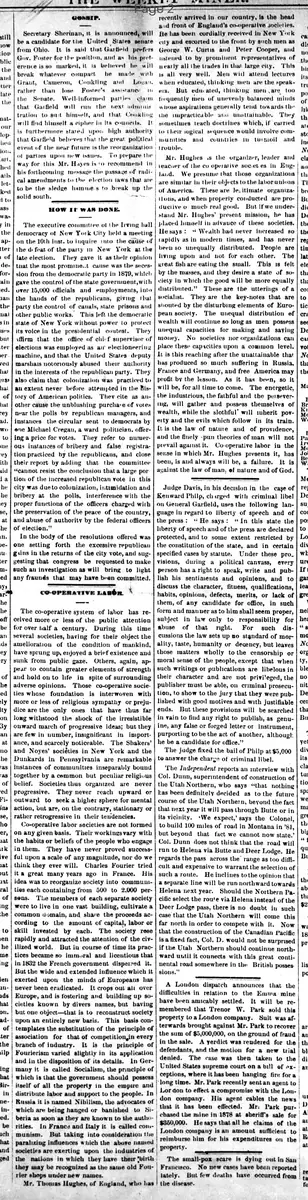
The co-operative system of labor has received more or less of the public attention for over half a century. During this time several societies, having for their object the amelioration of the condition of mankind, have sprung up, enjoyed a brief existence and sunk from public gaze. Others, again, appear to contain greater elements of strength and hold on to life in spite of surrounding adverse opinions. Those co-operative societies whose foundation is interwoven with more or less of religious sympathy or prejudice are the only ones that have thus far long withstood the shock of the irresistible onward march of progressive ideas; but they are few in number, insignificant in importance, and scarcely noticeable. The Shakers and Noyes' societies in New York and the Dunkards in Pennsylvania are remarkable instances of communities inseparably bound together by a common but peculiar religious belief. Societies thus organized are never progressive. They never reach upward or outward to seek a higher sphere for mental action, but are, on the contrary, stationary or rather retrogressive in their tendencies.
Co-operative labor societies are not formed on any given basis. Their workings vary with the habits or beliefs of the people who engage in them. They have never proved successful upon a scale of any magnitude, nor do we think they ever will. Charles Fourier tried it a great many years ago in France. His idea was to reorganize society into communities each containing from 500 to 2,000 persons. The members of each separate society were to live in one vast building, cultivate a common domain, and share the proceeds according to the amount of capital, labor or skill invested by each. The society rose rapidly and attracted the attention of the civilized world. But in course of time its practices became so immoral and licentious that in 1832 the French government dispersed it.
But the wide and extended influence which it exerted upon the minds of Europeans has never been eradicated. It crops out all over Europe, and is fostering and building up societies known by divers names, but having but one object—that is to reconstruct society upon an entirely new basis. This basis contemplates the substitution of the principle of association for that of competition in every branch of industry. It is the principle of Fourierism varied slightly in its application and in the disposition of its details. In Germany it is called Socialism, the principle of which is that the government should possess itself of all the property in the empire and distribute labor and support to the people. In Russia it is named Nihilism, the advocates of which are being hanged or banished to Siberia as soon as they are known to the authorities. In France and Italy it is called communism. But taking into consideration the paralyzing influences which the above named societies are exerting upon the industries of the nations in which they have their birth they may be recognized as the same old Fourier shops under new names.
Mr. Thomas Hughes, of England, who has recently arrived in our country, is the head and front of England's co-operative societies. He has been cordially received in New York city and escorted to the front by such men as George W. Curtis and Peter Cooper, and listened to by prominent representatives of nearly all the trades in that large city. This is all very well. Men will attend lectures when educated, thinking men are the speakers. But educated, thinking men, are too frequently men of unevenly balanced minds whose aspirations generally tend towards the impracticable and unattainable. They sometimes teach doctrines which, if carried to their logical sequence would involve communities and countries in turmoil and trouble.
Mr. Hughes is the organizer, leader and teacher of the co-operative societies in England. We presume that those organizations are similar in their objects to the labor unions of America. These are legitimate organizations, and when properly conducted are productive of much real good. But if we understand Mr. Hughes' present mission, he has placed himself in advance of these societies. He says: "Wealth had never increased so rapidly as in modern times, and has never been so unequally distributed. People are living upon and not for each other. The great fish are eating the small. This is felt by the masses, and they desire a state of society in which the good will be more equally distributed." These are the utterings of a socialist. They are the key-notes that are shouted by the disturbing elements of European society. The unequal distribution of wealth will continue so long as men possess unequal capacities for making and saving money. No societies nor organizations can place these capacities upon a common level. It is this reaching after the unattainable that has produced so much suffering in Russia, France and Germany, and free America may profit by the lesson. As it has been, so it will be, for all time to come. The energetic, the industrious, the faithful and the persevering, will gather and possess themselves of wealth, while the slothful will inherit poverty and the evils which follow in its train. It is the law of nature and of providence, and the finely spun theories of man will not prevail against it. Co-operative labor in the sense in which Mr. Hughes presents it, has been, is and always will be, a failure. It is against the law of man, of nature and of God.
The co-operative system of labor has received more or less of the public attention for over half a century. During this time several societies, having for their object the amelioration of the condition of mankind, have sprung up, enjoyed a brief existence and sunk from public gaze. Others, again, appear to contain greater elements of strength and hold on to life in spite of surrounding adverse opinions. Those co-operative societies whose foundation is interwoven with more or less of religious sympathy or prejudice are the only ones that have thus far long withstood the shock of the irresistible onward march of progressive ideas; but they are few in number, insignificant in importance, and scarcely noticeable. The Shakers and Noyes' societies in New York and the Dunkards in Pennsylvania are remarkable instances of communities inseparably bound together by a common but peculiar religious belief. Societies thus organized are never progressive. They never reach upward or outward to seek a higher sphere for mental action, but are, on the contrary, stationary or rather retrogressive in their tendencies.
Co-operative labor societies are not formed on any given basis. Their workings vary with the habits or beliefs of the people who engage in them. They have never proved successful upon a scale of any magnitude, nor do we think they ever will. Charles Fourier tried it a great many years ago in France. His idea was to reorganize society into communities each containing from 500 to 2,000 persons. The members of each separate society were to live in one vast building, cultivate a common domain, and share the proceeds according to the amount of capital, labor or skill invested by each. The society rose rapidly and attracted the attention of the civilized world. But in course of time its practices became so immoral and licentious that in 1832 the French government dispersed it.
But the wide and extended influence which it exerted upon the minds of Europeans has never been eradicated. It crops out all over Europe, and is fostering and building up societies known by divers names, but having but one object—that is to reconstruct society upon an entirely new basis. This basis contemplates the substitution of the principle of association for that of competition in every branch of industry. It is the principle of Fourierism varied slightly in its application and in the disposition of its details. In Germany it is called Socialism, the principle of which is that the government should possess itself of all the property in the empire and distribute labor and support to the people. In Russia it is named Nihilism, the advocates of which are being hanged or banished to Siberia as soon as they are known to the authorities. In France and Italy it is called communism. But taking into consideration the paralyzing influences which the above named societies are exerting upon the industries of the nations in which they have their birth they may be recognized as the same old Fourier shops under new names.
Mr. Thomas Hughes, of England, who has recently arrived in our country, is the head and front of England's co-operative societies. He has been cordially received in New York city and escorted to the front by such men as George W. Curtis and Peter Cooper, and listened to by prominent representatives of nearly all the trades in that large city. This is all very well. Men will attend lectures when educated, thinking men are the speakers. But educated, thinking men, are too frequently men of unevenly balanced minds whose aspirations generally tend towards the impracticable and unattainable. They sometimes teach doctrines which, if carried to their logical sequence would involve communities and countries in turmoil and trouble.
Mr. Hughes is the organizer, leader and teacher of the co-operative societies in England. We presume that those organizations are similar in their objects to the labor unions of America. These are legitimate organizations, and when properly conducted are productive of much real good. But if we understand Mr. Hughes' present mission, he has placed himself in advance of these societies. He says: "Wealth had never increased so rapidly as in modern times, and has never been so unequally distributed. People are living upon and not for each other. The great fish are eating the small. This is felt by the masses, and they desire a state of society in which the good will be more equally distributed." These are the utterings of a socialist. They are the key-notes that are shouted by the disturbing elements of European society. The unequal distribution of wealth will continue so long as men possess unequal capacities for making and saving money. No societies nor organizations can place these capacities upon a common level. It is this reaching after the unattainable that has produced so much suffering in Russia, France and Germany, and free America may profit by the lesson. As it has been, so it will be, for all time to come. The energetic, the industrious, the faithful and the persevering, will gather and possess themselves of wealth, while the slothful will inherit poverty and the evils which follow in its train. It is the law of nature and of providence, and the finely spun theories of man will not prevail against it. Co-operative labor in the sense in which Mr. Hughes presents it, has been, is and always will be, a failure. It is against the law of man, of nature and of God.
What sub-type of article is it?
Labor
Economic Policy
Social Reform
What keywords are associated?
Co Operative Labor
Socialism
Fourierism
Thomas Hughes
Wealth Distribution
Labor Societies
Nihilism
Communism
What entities or persons were involved?
Charles Fourier
Shakers
Noyes' Societies
Dunkards
Thomas Hughes
George W. Curtis
Peter Cooper
Editorial Details
Primary Topic
Critique Of Co Operative Labor And Socialism
Stance / Tone
Strongly Critical Of Co Operative Labor As Impractical And Contrary To Natural Laws
Key Figures
Charles Fourier
Shakers
Noyes' Societies
Dunkards
Thomas Hughes
George W. Curtis
Peter Cooper
Key Arguments
Co Operative Societies Based On Religious Sympathy Are Stationary And Retrogressive
Fourier's Phalanstery Experiment In France Failed Due To Immorality And Was Dispersed In 1832
Socialist Ideas Under Names Like Socialism, Nihilism, And Communism Harm Industries
Thomas Hughes Advocates For More Equal Wealth Distribution, But This Is Unattainable
Unequal Wealth Distribution Results From Unequal Capacities And Is A Law Of Nature
Co Operative Labor In The Sense Presented By Hughes Has Always Been And Will Be A Failure