Thank you for visiting SNEWPapers!
Sign up free
Memphis Daily Appeal
Memphis, Shelby County, Tennessee
What is this article about?
Petitions urge Congress to repeal the bankrupt law, criticized for fostering corruption, fraud, and business distrust rather than aiding honest debtors and creditors. A Syracuse, NY public meeting on Saturday advocated repeal, citing short lives of prior laws and growing opposition.
Clipping
OCR Quality
Full Text
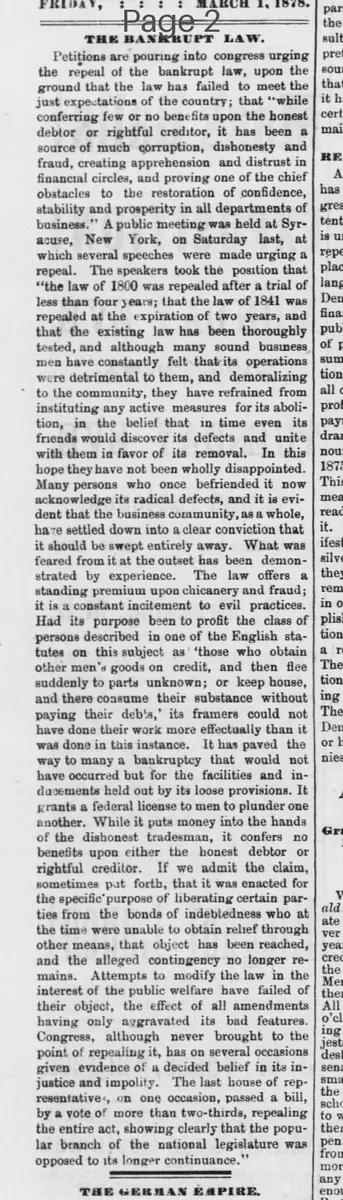
Petitions are pouring into congress urging the repeal of the bankrupt law, upon the ground that the law has failed to meet the just expectations of the country; that while conferring few or no benefits upon the honest debtor or rightful creditor, it has been a source of much corruption, dishonesty and fraud, creating apprehension and distrust in financial circles, and proving one of the chief obstacles to the restoration of confidence, stability and prosperity in all departments of business. A public meeting was held at Syracuse, New York, on Saturday last, at which several speeches were made urging a repeal. The speakers took the position that the law of 1800 was repealed after a trial of less than four years; that the law of 1841 was repealed at the expiration of two years, and that the existing law has been thoroughly tested, and although many sound business men have constantly felt that its operations were detrimental to them, and demoralizing to the community, they have refrained from instituting any active measures for its abolition, in the belief that in time even its friends would discover its defects and unite with them in favor of its removal. In this hope they have not been wholly disappointed. Many persons who once befriended it now acknowledge its radical defects, and it is evident that the business community, as a whole, have settled down into a clear conviction that it should be swept entirely away. What was feared from it at the outset has been demonstrated by experience. The law offers a standing premium upon chicanery and fraud: it is a constant incitement to evil practices. Had its purpose been to profit the class of persons described in one of the English statutes on this subject as 'those who obtain other men's goods on credit, and then flee suddenly to parts unknown; or keep house, and there consume their substance without paying their debts,' its framers could not have done their work more effectually than it was done in this instance. It has paved the way to many a bankruptcy that would not have occurred but for the facilities and inducements held out by its loose provisions. It grants a federal license to men to plunder one another. While it puts money into the hands of the dishonest tradesman, it confers no benefits upon either the honest debtor or rightful creditor. If we admit the claim, sometimes put forth, that it was enacted for the specific purpose of liberating certain parties from the bonds of indebtedness who at the time were unable to obtain relief through other means, that object has been reached, and the alleged contingency no longer remains. Attempts to modify the law in the interest of the public welfare have failed of their object, the effect of all amendments having only aggravated its bad features. Congress, although never brought to the point of repealing it, has on several occasions given evidence of a decided belief in its injustice and impolicy. The last house of representatives, on one occasion, passed a bill, by a vote of more than two-thirds, repealing the entire act, showing clearly that the popular branch of the national legislature was opposed to its longer continuance.
What sub-type of article is it?
What keywords are associated?
Where did it happen?
Domestic News Details
Primary Location
Syracuse, New York
Event Date
Saturday Last
Outcome
previous house of representatives passed repeal bill by more than two-thirds vote; law remains in effect amid widespread calls for abolition.
Event Details
Petitions to Congress seek repeal of bankrupt law for failing expectations, promoting corruption and fraud, and hindering business confidence. Public meeting in Syracuse featured speeches arguing for repeal based on past laws' short durations and current law's defects; many former supporters now oppose it.