Thank you for visiting SNEWPapers!
Sign up free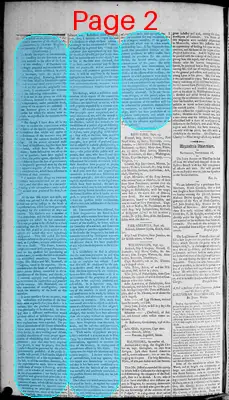
Editorial
September 18, 1802
Alexandria Advertiser And Commercial Intelligencer
Alexandria, Virginia
What is this article about?
Oliver Wolcott defends the treasury's past practices on appropriations and expenditures against a House committee's report, arguing they were sanctioned by Congress and produced no harm, while critiquing the current administration's stance. Involves figures like Gallatin, Mason, and Tazewell.
Clipping
OCR Quality
95%
Excellent
Full Text
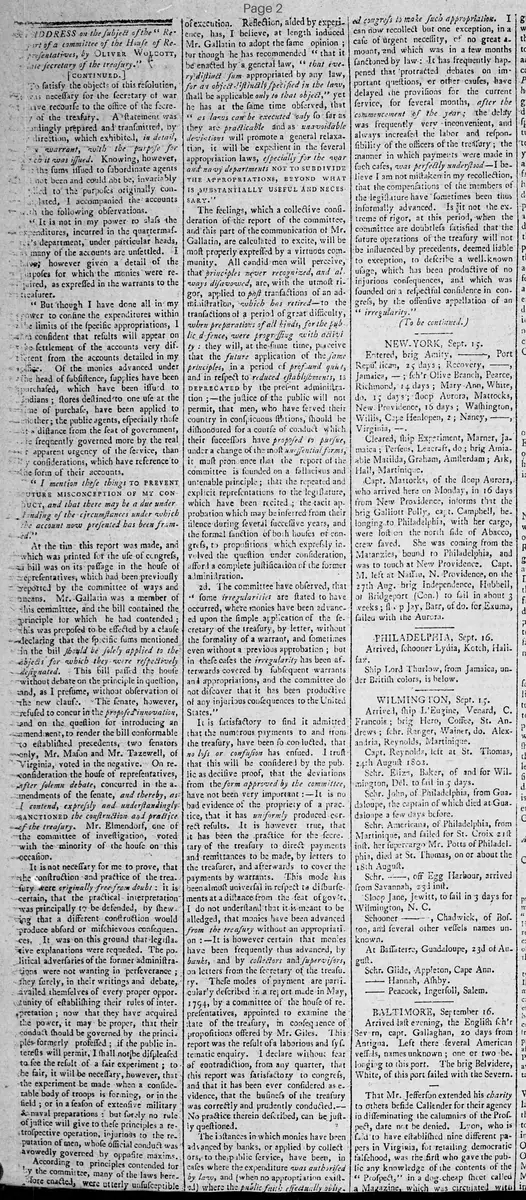
ADDRESS on the subject of the "Report of a committee of the House of Representatives, by OLIVER WOLCOTT, late secretary of the treasury."
CONTINUED.
To satisfy the objects of this resolution, it was necessary for the secretary of war to have recourse to the office of the secretary of the treasury. A statement was accordingly prepared and transmitted, by direction, which exhibited, in detail, every warrant, with the purpose for which it was issued. Knowing, however, that the sums issued to subordinate agents had not been and could not be invariably applied to the purposes originally contemplated, I accompanied the accounts with the following observations.
"It is not in my power to state the expenditures, incurred in the quartermaster's department, under particular heads, as many of the accounts are unsettled. I have, however, given a detail of the purposes for which the monies were required, as expressed in the warrants to the treasurer.
"But though I have done all in my power to confine the expenditures within the limits of the specific appropriations, I am not confident that results will appear on the settlement of the accounts very different from the accounts detailed in my office. Of the monies advanced under the head of subsistence, supplies have been purchased, which have been issued to Indians; stores destined to one use at the time of purchase, have been applied to another; the public agents, especially those at a distance from the seat of government, have frequently governed more by the real or apparent urgency of the service, than by considerations, which have reference to the form of their accounts.
"I mention these things to PREVENT FUTURE MISCONCEPTION OF MY CONDUCT, and that there may be a due understanding of the circumstances under which the account now presented has been framed."
At the time this report was made, and which was printed for the use of Congress, a bill was on its passage in the house of representatives, which had been previously reported by the committee of ways and means. Mr. Gallatin was a member of this committee, and the bill contained the principle for which he had contended. This was proposed to be effected by a clause declaring that the specific sums mentioned in the bill should be solely applied to the objects for which they were respectively designated. This bill passed the house without debate on the principle in question, and, as I presume, without observation of the new clause. The senate, however, refused to concur in the proposed innovation, and on the question for introducing an amendment, to render the bill conformable to established precedents, two senators only, Mr. Mason and Mr. Tazewell, of Virginia, voted in the negative. On reconsideration the house of representatives, after solemn debate, concurred in the amendments of the senate, and thereby, as I contend, expressly and understandingly SANCTIONED the construction and practice of the treasury. Mr. Elmendorf, one of the committee of investigation, voted with the minority of the house on this occasion.
It is not necessary for me to prove, that the construction and practice of the treasury were originally free from doubt; it is certain, that the practical interpretation was principally to be defended, by showing that a different construction would produce absurd or mischievous consequences. It was on this ground that legislative explanations were requested. The political adversaries of the former administrations were not wanting in perseverance; they surely, in their writings and debates, availed themselves of every proper opportunity of establishing their rules of interpretation; now that they have acquired the power, it may be proper, that their conduct should be governed by the principles formerly professed; if the public interests will permit, I shall not be displeased to see the result of a fair experiment; to be fair, it will be necessary, however, that the experiment be made when a considerable body of troops is forming, or in the field; or in a season of extensive military and naval preparations: but surely no rule of justice will give to these principles a retrospective operation, injurious to the reputation of men, whose official conduct was avowedly governed by opposite maxims.
According to principles contended for by the committee, many of the laws heretofore enacted, were utterly susceptible of execution. Reflection, aided by experience, has, I believe, at length induced Mr. Gallatin to adopt the same opinion; for though he has recommended "that it be enacted by a general law," that every distinct sum appropriated by any law, for an object distinctly specified in the law, shall be applicable only to that object," yet he has at the same time observed, that "as laws can be executed only so far as they are practicable and as unavoidable deviations will promote a general relaxation, it will be expedient in the several appropriation laws, especially for the war and navy departments NOT TO SUBDIVIDE THE APPROPRIATIONS, BEYOND WHAT IS SUBSTANTIALLY USEFUL AND NECESSARY."
The feelings, which a collective consideration of the report of the committee, and this part of the communication of Mr. Gallatin, are calculated to excite, will be most properly expressed by a virtuous community. All candid men will perceive, that principles never recognized, and always disfavored, are, with the utmost rigor, applied to past transactions of an administration, which has retired to the transactions of a period of great difficulty, when preparations of all kinds, for the public defence, were progressing with activity: they will, at the same time, perceive that the future application of the same principles, in a period of profound quiet and in respect to reduced establishments, is DEPRECATED by the present administration; the justice of the public will not permit, that men, who have served their country in conspicuous stations, should be dishonoured for a course of conduct which their successors have proposed to pursue, under a change of the most unessential forms, it must pronounce that the report of the committee is founded on a fallacious and untenable principle; that the repeated and explicit representations to the legislature, which have been recited; the tacit approbation which may be inferred from their silence during several successive years, and the formal sanction of both houses of Congress, to propositions which expressly involved the question under consideration, afford a complete justification of the former administration.
2d. The committee have observed, that some irregularities are stated to have occurred, where monies have been advanced upon the simple application of the secretary of the treasury, by letter, without the formality of a warrant, and sometimes even without a previous approbation; but in these cases the irregularity has been afterwards covered by subsequent warrants and appropriations, and the committee do not discover that it has been productive of any injurious consequences to the United States.
It is satisfactory to find it admitted that the numerous payments to and from the treasury, have been so conducted, that no loss or confusion has ensued. I trust that this will be considered by the public as decisive proof, that the deviations from the form approved by the committee, have not been very important: It is no bad evidence of the propriety of a practice, that it has uniformly produced correct results. It is however true, that it has been the practice for the secretary of the treasury to direct payments and remittances to be made, by letters to the treasurer, and afterwards to cover the payments by warrants. This mode has been almost universal in respect to disbursements at a distance from the seat of government. I do not understand that it is meant to be alleged, that monies have been advanced from the treasury without an appropriation: It is however certain that monies have been frequently thus advanced, by banks, and by collectors and supervisors, on letters from the secretary of the treasury. These modes of payment are particularly described in a report made in May 1794, by a committee of the house of representatives, appointed to examine the state of the treasury, in consequence of propositions offered by Mr. Giles. This report was the result of a laborious and systematic enquiry. I declare without fear of contradiction, from any quarter, that this report was satisfactory to Congress, and that it has been ever considered as evidence, that the business of the treasury was correctly and prudently conducted. No practice therein described, can be justly questioned.
The instances in which monies have been advanced by banks, or applied by collectors, to the public service, have been, in cases where the expenditure was authorised by law, and (when no appropriation existed) where the public faith effectually obliged Congress to make such appropriation. I can now recollect but one exception, in a case of urgent necessity, of no great amount, and which was in a few months sanctioned by law. It has frequently happened that protracted debates on important questions, or other causes, have delayed the provisions for the current service, for several months, after the commencement of the year; the delay was frequently very inconvenient, and always increased the labor and responsibility of the officers of the treasury: the manner in which payments were made in such cases, was perfectly understood. I believe I am not mistaken in my recollection, that the compensations of the members of the legislature have sometimes been thus informally advanced. Is it not the extreme of rigor, at this period, when the committee are doubtless satisfied that the future operations of the treasury will not be influenced by precedents, deemed liable to exception, to describe a well-known usage, which has been productive of no injurious consequences, and which was founded on a respectful confidence in Congress, by the offensive appellation of an "irregularity."
(To be continued.)
CONTINUED.
To satisfy the objects of this resolution, it was necessary for the secretary of war to have recourse to the office of the secretary of the treasury. A statement was accordingly prepared and transmitted, by direction, which exhibited, in detail, every warrant, with the purpose for which it was issued. Knowing, however, that the sums issued to subordinate agents had not been and could not be invariably applied to the purposes originally contemplated, I accompanied the accounts with the following observations.
"It is not in my power to state the expenditures, incurred in the quartermaster's department, under particular heads, as many of the accounts are unsettled. I have, however, given a detail of the purposes for which the monies were required, as expressed in the warrants to the treasurer.
"But though I have done all in my power to confine the expenditures within the limits of the specific appropriations, I am not confident that results will appear on the settlement of the accounts very different from the accounts detailed in my office. Of the monies advanced under the head of subsistence, supplies have been purchased, which have been issued to Indians; stores destined to one use at the time of purchase, have been applied to another; the public agents, especially those at a distance from the seat of government, have frequently governed more by the real or apparent urgency of the service, than by considerations, which have reference to the form of their accounts.
"I mention these things to PREVENT FUTURE MISCONCEPTION OF MY CONDUCT, and that there may be a due understanding of the circumstances under which the account now presented has been framed."
At the time this report was made, and which was printed for the use of Congress, a bill was on its passage in the house of representatives, which had been previously reported by the committee of ways and means. Mr. Gallatin was a member of this committee, and the bill contained the principle for which he had contended. This was proposed to be effected by a clause declaring that the specific sums mentioned in the bill should be solely applied to the objects for which they were respectively designated. This bill passed the house without debate on the principle in question, and, as I presume, without observation of the new clause. The senate, however, refused to concur in the proposed innovation, and on the question for introducing an amendment, to render the bill conformable to established precedents, two senators only, Mr. Mason and Mr. Tazewell, of Virginia, voted in the negative. On reconsideration the house of representatives, after solemn debate, concurred in the amendments of the senate, and thereby, as I contend, expressly and understandingly SANCTIONED the construction and practice of the treasury. Mr. Elmendorf, one of the committee of investigation, voted with the minority of the house on this occasion.
It is not necessary for me to prove, that the construction and practice of the treasury were originally free from doubt; it is certain, that the practical interpretation was principally to be defended, by showing that a different construction would produce absurd or mischievous consequences. It was on this ground that legislative explanations were requested. The political adversaries of the former administrations were not wanting in perseverance; they surely, in their writings and debates, availed themselves of every proper opportunity of establishing their rules of interpretation; now that they have acquired the power, it may be proper, that their conduct should be governed by the principles formerly professed; if the public interests will permit, I shall not be displeased to see the result of a fair experiment; to be fair, it will be necessary, however, that the experiment be made when a considerable body of troops is forming, or in the field; or in a season of extensive military and naval preparations: but surely no rule of justice will give to these principles a retrospective operation, injurious to the reputation of men, whose official conduct was avowedly governed by opposite maxims.
According to principles contended for by the committee, many of the laws heretofore enacted, were utterly susceptible of execution. Reflection, aided by experience, has, I believe, at length induced Mr. Gallatin to adopt the same opinion; for though he has recommended "that it be enacted by a general law," that every distinct sum appropriated by any law, for an object distinctly specified in the law, shall be applicable only to that object," yet he has at the same time observed, that "as laws can be executed only so far as they are practicable and as unavoidable deviations will promote a general relaxation, it will be expedient in the several appropriation laws, especially for the war and navy departments NOT TO SUBDIVIDE THE APPROPRIATIONS, BEYOND WHAT IS SUBSTANTIALLY USEFUL AND NECESSARY."
The feelings, which a collective consideration of the report of the committee, and this part of the communication of Mr. Gallatin, are calculated to excite, will be most properly expressed by a virtuous community. All candid men will perceive, that principles never recognized, and always disfavored, are, with the utmost rigor, applied to past transactions of an administration, which has retired to the transactions of a period of great difficulty, when preparations of all kinds, for the public defence, were progressing with activity: they will, at the same time, perceive that the future application of the same principles, in a period of profound quiet and in respect to reduced establishments, is DEPRECATED by the present administration; the justice of the public will not permit, that men, who have served their country in conspicuous stations, should be dishonoured for a course of conduct which their successors have proposed to pursue, under a change of the most unessential forms, it must pronounce that the report of the committee is founded on a fallacious and untenable principle; that the repeated and explicit representations to the legislature, which have been recited; the tacit approbation which may be inferred from their silence during several successive years, and the formal sanction of both houses of Congress, to propositions which expressly involved the question under consideration, afford a complete justification of the former administration.
2d. The committee have observed, that some irregularities are stated to have occurred, where monies have been advanced upon the simple application of the secretary of the treasury, by letter, without the formality of a warrant, and sometimes even without a previous approbation; but in these cases the irregularity has been afterwards covered by subsequent warrants and appropriations, and the committee do not discover that it has been productive of any injurious consequences to the United States.
It is satisfactory to find it admitted that the numerous payments to and from the treasury, have been so conducted, that no loss or confusion has ensued. I trust that this will be considered by the public as decisive proof, that the deviations from the form approved by the committee, have not been very important: It is no bad evidence of the propriety of a practice, that it has uniformly produced correct results. It is however true, that it has been the practice for the secretary of the treasury to direct payments and remittances to be made, by letters to the treasurer, and afterwards to cover the payments by warrants. This mode has been almost universal in respect to disbursements at a distance from the seat of government. I do not understand that it is meant to be alleged, that monies have been advanced from the treasury without an appropriation: It is however certain that monies have been frequently thus advanced, by banks, and by collectors and supervisors, on letters from the secretary of the treasury. These modes of payment are particularly described in a report made in May 1794, by a committee of the house of representatives, appointed to examine the state of the treasury, in consequence of propositions offered by Mr. Giles. This report was the result of a laborious and systematic enquiry. I declare without fear of contradiction, from any quarter, that this report was satisfactory to Congress, and that it has been ever considered as evidence, that the business of the treasury was correctly and prudently conducted. No practice therein described, can be justly questioned.
The instances in which monies have been advanced by banks, or applied by collectors, to the public service, have been, in cases where the expenditure was authorised by law, and (when no appropriation existed) where the public faith effectually obliged Congress to make such appropriation. I can now recollect but one exception, in a case of urgent necessity, of no great amount, and which was in a few months sanctioned by law. It has frequently happened that protracted debates on important questions, or other causes, have delayed the provisions for the current service, for several months, after the commencement of the year; the delay was frequently very inconvenient, and always increased the labor and responsibility of the officers of the treasury: the manner in which payments were made in such cases, was perfectly understood. I believe I am not mistaken in my recollection, that the compensations of the members of the legislature have sometimes been thus informally advanced. Is it not the extreme of rigor, at this period, when the committee are doubtless satisfied that the future operations of the treasury will not be influenced by precedents, deemed liable to exception, to describe a well-known usage, which has been productive of no injurious consequences, and which was founded on a respectful confidence in Congress, by the offensive appellation of an "irregularity."
(To be continued.)
What sub-type of article is it?
Economic Policy
Partisan Politics
Legal Reform
What keywords are associated?
Treasury Practices
Appropriations
Fiscal Policy
Congressional Sanction
Gallatin
Wolcott
Irregularities
What entities or persons were involved?
Oliver Wolcott
Mr. Gallatin
House Of Representatives Committee
Mr. Mason
Mr. Tazewell
Mr. Elmendorf
Mr. Giles
Editorial Details
Primary Topic
Defense Of Treasury Appropriation Practices Against Committee Report
Stance / Tone
Defensive Justification Of Former Administration's Fiscal Conduct
Key Figures
Oliver Wolcott
Mr. Gallatin
House Of Representatives Committee
Mr. Mason
Mr. Tazewell
Mr. Elmendorf
Mr. Giles
Key Arguments
Expenditures Were Confined Within Appropriations Despite Practical Deviations For Urgency
Congress Sanctioned Treasury Practices Through Bill Amendments
Strict Interpretation Would Lead To Absurd Consequences, Especially In Wartime
Past Irregularities Produced No Loss And Were Covered By Subsequent Warrants
Gallatin Now Advises Against Excessive Subdivision Of Appropriations
Committee's Principles Are Fallacious And Not Retrospectively Applicable