Thank you for visiting SNEWPapers!
Sign up free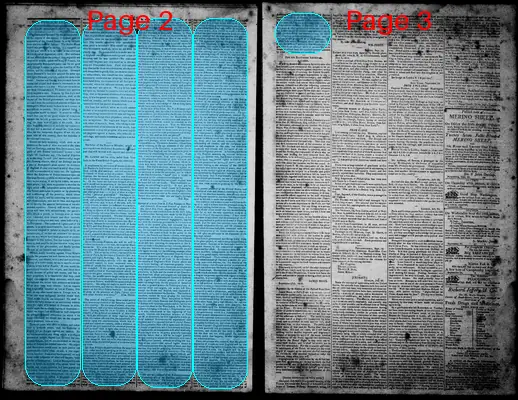
Norfolk Gazette And Publick Ledger
Norfolk, Virginia
What is this article about?
Editorial from Sept. 24, 1810, denounces Napoleon's Continental System excluding US trade from Europe, criticizes US government's passive submission to France versus potential anger at Britain, links Embargo to Napoleon's plans, and quotes Dutch minister Van Polenan's letter on US administration's weakness and sacrificed interests for power retention.
Merged-components note: Continuation of the editorial across pages 2 and 3; the text flows seamlessly, with the end of page 2 component leading directly into the start of page 3 component, discussing American commerce and political relations in the context of European powers.
Clippings
1 of 2
OCR Quality
Full Text
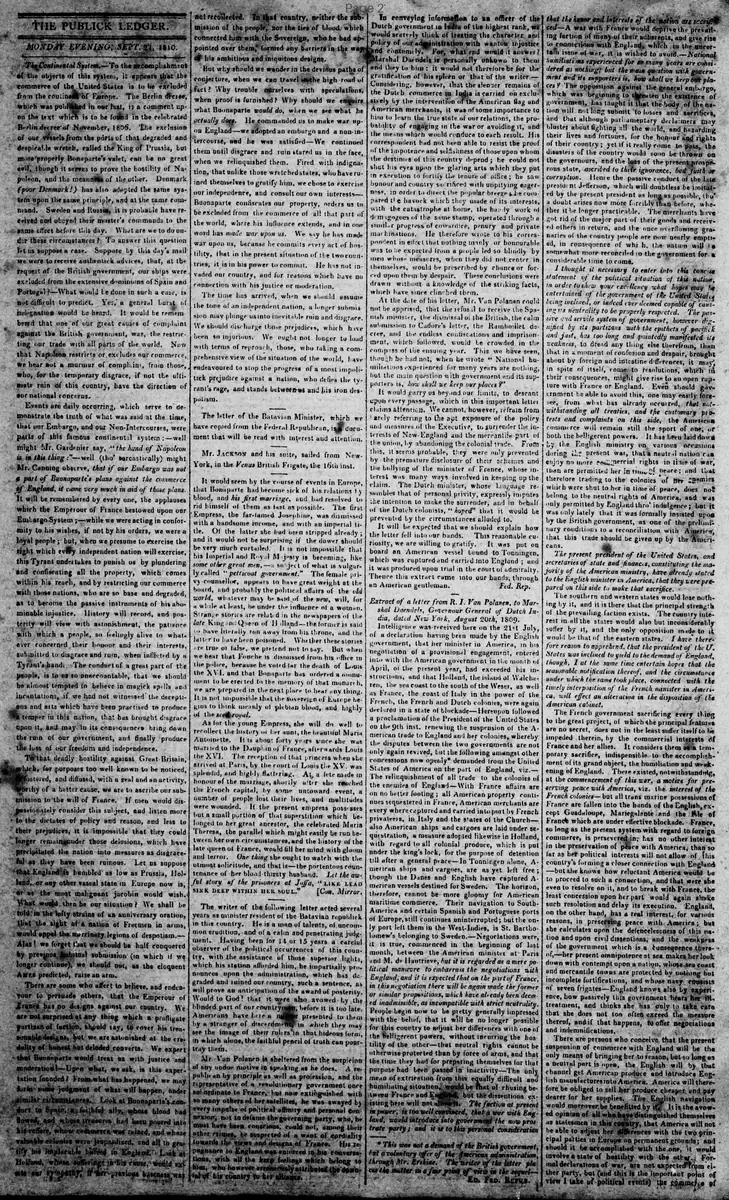
MONDAY EVENING, SEPT. 24, 1810.
The Continental System. To the accomplishment of the objects of this system, it appears that the commerce of the United States is to be excluded from the continent of Europe. The Berlin decree, which was published in our last, is a comment upon the text which is to be found in the celebrated Berlin decree of November, 1806. The exclusion of our vessels from the ports of that degraded and despicable wretch, called the King of Prussia, but more properly Bonaparte's valet, can be no great evil, though it serves to prove the hostility of Napoleon, and the meanness of the other. Denmark (poor Denmark!) has also adopted the same system upon the same principle, and at the same command. Sweden and Russia, it is probable have received and obeyed their master's commands to the same effect before this day. What are we to do under these circumstances? To answer this question, let us suppose a case. Suppose by this day's mail we were to receive authentic advices, that, at the request of the British government, our ships were excluded from the extensive dominions of Spain and Portugal? What would be done in such a case, is not difficult to predict. Yes, a general burst of indignation would be heard. It would be remembered that one of our great causes of complaint against the British government, was, the restricting our trade with all parts of the world. Now that Napoleon restricts or excludes our commerce, we hear not a murmur of complaint, from those, who, for the temporary disgrace, if not the ultimate ruin of this country, have the direction of our national concerns.
Events are daily occurring, which serve to demonstrate the truth of what was said at the time, that our Embargo, and our Non-Intercourses, were parts of this famous continental system: well might Mr. Gardenier say, "the hand of Napoleon is in this thing:"--well (tho sarcastically) might Mr. Canning observe, that if our Embargo was not part of Buonaparte's plans against the commerce of England, it came very much in aid of those plans. It will be remembered by every one, the applauses which the Emperor of France bestowed upon our Embargo System;--while we were acting in conformity to his wishes, if not by his orders, we were a loyal people; but, when we presume to exercise the right which every independent nation will exercise, this Tyrant undertakes to punish us by plundering and confiscating all the property, which comes within his reach, and by restricting our commerce with those nations, who are so base and degraded, as to become the passive instruments of his abominable injustice. History will record, and posterity will view with astonishment, the patience with which a people, so seemingly alive to whatever concerned their honour and their interests, submitted to disgrace and ruin, when inflicted by a Tyrant's hand. The conduct of a great part of the people, is to us so unaccountable, that we should be almost tempted to believe in magick spells and incantations, if we had not witnessed the deceptions and arts which have been practised to produce temper in this nation, that has brought disgrace upon it, and may in its consequences bring down the ruin of our government, and finally produce the loss of our freedom and independence.
To that deadly hostility against Great Britain, which, for purposes too well known to be noticed, fostered, and diffused, with a zeal and an activity, worthy of a better cause, we are to ascribe our submission to the will of France. If men would dispassionately consider this subject, and listen more to the dictates of policy and reason, and less to their prejudices, it is impossible that they could longer remain under those delusions, which have precipitated the nation into measures as disgraceful as they have been ruinous. Let us suppose that England is humbled as low as Prussia, Holland, or any other vassal state in Europe now is, or as the most malignant jacobin would wish. What would then be our situation? We shall be told in the lofty strains of an anniversary oration, that the sight of a nation of Freemen in arms, would appal the mercenary legions of despotism. Alas! we forget that we should be half conquered by previous habitual submission (in which if we longer continue), we should not, as the eloquent Ames predicted, raise an arm.
There are some who affect to believe, and endeavour to persuade others, that the Emperor of France has no designs against our country. We are not surprised at any thing which a profligate artisan of faction, should say, to cover his treasonable designs; but we are astonished at the credulity of honest but deluded converts. We expect that Buonaparte would treat us with justice and moderation. Upon what, we ask, is this expectation founded? --From what has happened, we may form some judgment of what will happen, under similar circumstances. Look at Buonaparte's conduct to Spain, his faithful ally whose blood had flowed, and whose treasures had been poured into his coffers whose commerce was ruined, and whose valuable colonies were jeopardized, and all this gratitude his implacable hatred to England. Look at Holland, whose suffering in his cause, would excuse opprobrium, if not previous base
not recollected. In that country, neither the submission of the people nor the ties of blood which connected him with the Sovereign, who he had appointed over them formed any barrier in the way, of his ambitious and iniquitous designs. But why should we wander in the devious paths of conjecture, when we can travel in the high-road of fact? Why trouble ourselves with speculations, when proof is furnished? Why should we enquire what Buonaparte would do, when we see what he actually does. He commanded us to make war upon England--we adopted an embargo and a non-intercourse, and he was satisfied--We continued them until disgrace and ruin stared us in the face, when we relinquished them. Fired with indignation, that unlike those wretched states, who have ruined themselves to gratify him, we chose to exercise our independence, and consult our own interests--Buonaparte confiscates our property, orders us to be excluded from the commerce of all that part of the world, where his influence extends, and in one word has made war upon us. We say he has made war upon us, because he commits every act of hostility, that in the present situation of the two countries, it is in his power to commit. He has not invaded our country, and for reasons which have no connection with his justice or moderation.
The time has arrived, when we should assume the tone of an independent nation, a longer submission may plunge us into inevitable ruin and disgrace. We should discharge those prejudices, which have been so injurious. We ought not longer to load with terms of reproach, those, who taking a comprehensive view of the situation of the world, have endeavoured to stop the progress of a most impolitic prejudice against a nation, who defies the tyrant's rage, and stands between us and his iron despotism.
The letter of the Batavian Minister, which we have copied from the Federal Republican, is a document that will be read with interest and attention. Mr. Jackson and his suite, sailed from New-York, in the Venus British Frigate, the 16th inst. It would seem by the course of events in Europe, that Bonaparte had become sick of his relations by blood, and his first marriage, and had resolved to rid himself of them as fast as possible. The first Empress, the far-famed Josephine, was dismissed with a handsome income, and with an imperial title. Of the latter she had been stripped already; and it would not be surprising if the dower should be very much curtailed. It is not impossible that his Imperial and Royal Majesty is becoming, like some other great men,--a subject of what is vulgarly called "petticoat government." The female privy-counsellor, appears to have great weight at the board, and probably the political affairs of the old world, whatever may be said of the new, will, for a while at least, be under the influence of a woman. Strange stories are related in the newspapers of the late King and Queen of Holland--the former is said to have literally run away from his throne, and the latter to have been poisoned. Whether these stories are true or false, we pretend not to say. But when we hear that Fouche is dismissed from his office in the police, because he voted for the death of Louis the XVI. and that Bonaparte has ordered a monument to be erected to the memory of that monarch, we are prepared in the next place to hear any thing. It is not impossible that the sovereign of Europe begins to think meanly of plebeian blood, and highly of the seed royal.
As for the young Empress, she will do well to recollect the history of her aunt, the beautiful Maria Antoinette. It is about forty years since she was married to the Dauphin of France, afterwards Louis the XVI. The reception of that princess when she arrived at Paris, by the court of Louis the XV. was splendid, and highly flattering. At a fete made in honour of the marriage, shortly after she reached the French capital, by some untoward event, a number of people lost their lives, and multitudes were wounded. If the present empress possesses but a small portion of that superstition which belonged to her great ancestor, the celebrated Maria Theresa, the parallel which might easily be run between her own circumstances, and the history of the late queen of France, would fill her mind with gloom and terror. One thing she ought to watch with the utmost solicitude, and that is--the portentous countenance of her blood-thirsty husband. Let the awful story of the prisoners at Jaffa, "Like lead sink deep within her soul."
[Con. Mirror.]
The writer of the following letter acted several years as minister resident of the Batavian republic in this country. He is a man of talents, of uncommon erudition, and of a calm and penetrating judgment. Having been for 14 or 15 years a careful observer of the political occurrences of this country, with the assistance of those superior lights, which his station afforded him, he impartially pronounces upon the administration, which has degraded and ruined our country, such a sentence, as will prove an anticipation of the award of posterity. Would to God! that it were also avowed by the blinded part of our countrymen, before it is too late. Americans have here a mirror presented to them by a stranger of discernment in which they may see the image of their rulers in that hideous form, in which alone, the faithful pencil of truth can portray them. Mr. Van Polanen is sheltered from the suspicion of any undue motive in speaking as he does. A republican by principle as well as profession, and the representative of a revolutionary government once subordinate to France, but now extinguished with so many others of her satellites, he was swayed by every impulse of political affinity and personal connexion, not to declaim the governing party, who, he must have been conscious, could not, among their other crimes, be suspected of a want of cordiality towards the views and designs of France. His repugnance to England was enforced in his conversations, with all the deep feeling which belong to him, who however erroneously attributed the downfall of his country to her dire asperity.
In conveying information to an officer of the Dutch government in India of the highest rank, we would scarcely think of treating the character and policy of our administration with wanton injustice and contumely. For what end would it answer? Marshal Daendels is personally unknown to them and they to him: it would not therefore be for the gratification of his spleen or that of the writer.--Considering, however, that the slender remains of the Dutch commerce in India is carried on exclusively by the intervention of the American flag and American merchants, it was of some importance to him to learn the true state of our relations, the probability of engaging in the war or avoiding it, and the means which would conduce to each result. His correspondent had not been able to resist the proof of the impotence and selfishness of those upon whom the destinies of this country depend; he could not shut his eyes upon the glaring arts which they put in execution to fortify the tenure of office; he saw honour and country sacrificed with unpitiful eagerness, in order to direct the popular breeze he compared the havock which they made of its interests, with the catastrophe at home, the hardy work of demagogues of the same stamp, operated through a similar progress of cowardice, penury and private machinations. He therefore wrote to his correspondent in effect that nothing manly or honourable was to be expected from a people led so blindly by men whose measures, when they did not center in themselves, would be prescribed by chance or forced upon them by despair. These conclusions were drawn without a knowledge of the striking facts, which have since clinched them.
At the date of his letter, Mr. Van Polanen could not be apprised, that the refusal to receive the Spanish minister, the dismissal of the British, the calm submission to Cadore's letter, the Rambouillet decree, and the endless confiscations and imprisonment, which followed, would be crowded in the compass of the ensuing year. This we have seen, though he had not, when he wrote "National humiliations experienced for many years are nothing, but the main question with government and its supporters is, how shall we keep our places?"
It would carry us beyond our limits, to descant upon every passage, which in this important letter claims attention. We cannot, however, refrain from barely referring to the last exposure of the policy and measures of the Executive, so surrender the interests of New-England and the mercantile part of the union, by abandoning the colonial trade. From this, it seems probable, they were only prevented by the premature disclosure of their schemes and the bullying of the minister of France, whose interest was many ways involved in keeping up the claim. The Dutch minister, whose language resembles that of personal privity, expressly imputes the intention to make the surrender, and in behalf of the Dutch colonists, "hoped" that it would be prevented by the circumstances alluded to.
It will be expected that we should explain how the letter fell into our hands. This reasonable curiosity, we are willing to gratify. It was put on board an American vessel bound to Tonningen, which was captured and carried into England; and it was produced upon trial in the court of admiralty. Thence this extract came into our hands, through an American gentleman.
Fed. Rep.
Extract of a letter from R.I. Van Polanen, to Marshal Daendels, Governor General of Dutch India, dated New York, August 20th, 1809.
Intelligence was received here on the 21st July, of a declaration having been made by the English government, that her minister in America, in his negotiation of a provisional engagement, entered into with the American government in the month of April, of the present year, had exceeded his instructions, and that Holland, the island of Walcheren, the sea coast to the south of the Weser, as well as France, the coast of Italy in the power of the French, the French and Dutch colonies, were again declared in a state of blockade--Hereupon followed a proclamation of the President of the United States on the 9th inst. renewing the suspension of the American trade to England and her colonies, whereby the disputes between the two governments are not only again revived, but the following amongst other concessions now openly* demanded from the United States of America on the part of England, viz.--
The relinquishment of all trade to the colonies of the enemies of England--With France affairs are on no better footing; all American property continues sequestered in France, American merchants are every where captured and carried into port by French privateers, in Italy and the states of the Church-- also American ships and cargoes are laid under sequestration, a measure adopted likewise in Holland, with regard to all colonial produce, which is put under the king's lock, for the purpose of detention till after a general peace--In Tonningen alone, American ships and cargoes, are as yet let free; though the Danes and English have captured American vessels destined for Sweden. The horizon, therefore, cannot be more gloomy for American maritime commerce. Their navigation to South-America and certain Spanish and Portuguese ports of Europe, still continues uninterrupted; but the only port left them in the West-Indies, is St. Bartholomew's belonging to Sweden. --Negotiations were, it is true, commenced in the beginning of last month, between the American minister at Paris and M. de Hautrieve, but it is regarded as a mere political manoeuvre to embarrass the negotiations with England; and it is expected that on the part of France, in this negotiation there will be again made the former or similar propositions, which have already been deemed inadmissible, as incompatible with strict neutrality.
People begin now to be pretty generally impressed with the belief, that it will be no longer possible for this country to adjust her differences with one of the belligerent powers, without incurring the hostility of the other--that neutral rights cannot be otherwise protected than by force of arms, and that the time they had for preparing themselves for that purpose had been passed in inactivity--The only mean of extrication from this equally difficult and humiliating situation, would be that of chusing between France and England but the dissentions existing here will not allow The faction at present in power, is too well convinced, that a war with England, would introduce into government the now prostrate party ; and it is to this personal consideration
* This was not a demand of the British government but a voluntary offer of the American administration through Mr Erskine. The writer of the letter places the matter in a fair point of view in the sequel--ED. FED. REPUB.
that the honor and interests of the nation are sacrificed--A war with France would deprive the prevailing faction of many of their adherents, and give rise to connections with England which in the uncertain issue of war, it is wished to avoid. National humiliations experienced for so many years are considered as nothing, but the main question with government and its supporters is, how shall we keep our places? The opposition against the general embargo, which was beginning to threaten the existence of government, has taught it that the body of the nation will not long submit to losses and sacrifices, and that although parliamentary declaimers may bluster about fighting all the world, and hazarding their lives and fortunes, or the honour and rights of their country; yet if it really come to pass. the disasters of the country would soon be thrown on the governors, and the loss of the present prosperous state, ascribed to their ignorance, bad faith or corruption. Hence the passive conduct of the late president Jefferson, which will doubtless be imitated by the present president as long as possible, tho a doubt arises now more forcibly than before, whether it be longer practicable. The merchants have got rid of the major part of their goods and received others in return, and the once overflowing granaries of the country people are now nearly emptied, in consequence of which, the nation will be somewhat more reconciled to the government for a considerable time to come.
I thought it necessary to enter into this concise statement of the political situation of this nation in order to shew your excellency what hopes may be entertained of the government of the United States being inclined, or indeed ever deemed capable of causing us neutrality to be properly respected. The passive and servile system of government, however dignified by its partizans with the epithets of pacifick and just, has too long and pointedly manifested its weakness, to dread any thing else therefrom, than that in a moment of confusion and despair, brought about by foreign and intestine differences, it may, in spite of itself, come to resolutions, which in their consequences, might give rise to an open rupture with France or England. Even should government be able to avoid this, one may easily foresee, from what has already occurred, that notwithstanding all treaties, and the customary protests and complaints on this side, the American commerce will remain still the sport of one; or both the belligerent powers. It has been laid down by the English ministry on various occasions during the present war, that a neutral nation can enjoy no more commercial rights in time of war, than are permitted her in time of peace; and that therefore trading to the colonies of her enemies which were shut to her in time of peace, does not belong to the neutral rights of America, and was only permitted by England thro' indulgence; but it was only lately that it was formally insisted upon by the British government, as one of the preliminary conditions to a reconciliation with America that this trade should be given up by the Americans.
The present president of the United States, and secretaries of state and finances, constituting the majority of the American ministry, have already stated to the English minister in America, that they were prepared on this side to make that sacrifice. The southern and western states would lose nothing by it, and it is there that the principal strength of the prevailing faction exists. The country interest in all the states would also but inconsiderably suffer by it, and the only opposition made to it would be that of the eastern states. I have therefore reason to apprehend. that the president of the U. States was inclined to yield to the demand of England, though, I at the same time entertain hopes that the seasonable notification thereof, and the circumstance under which the same took place, connected with the timely interposition of the French minister in America, will effect an alteration in the disposition of the American cabinet.
The French government sacrificing every thing to the great project, of which the principal features are no secret, does not in the least suffer itself to be impeded therein, by the commercial interests of France and her allies. It considers them as a temporary sacrifice, indispensable to the accomplishment of its grand object, the humiliation and weakening of England. There existed, notwithstanding, at the commencement of this war, a motive for preserving peace with America, viz. the interest of the French colonies-- but all trans marine possessions of France are fallen into the hands of the English, except Guadaloupe, Mariegalante and the Isle of France which are under effective blockade. France, so long as the present system with regard to foreign commerce, is persevered in, has no other interest in the preservation of peace with America, than so far as her political interests will not allow of this country's forming a closer connection with England --but she knows how reluctant America would be to proceed to such a connection, and that were she even to resolve on it, and to break with France, the least concession upon her part would again shake such resolution and delay its execution. England, on the other hand, has a real interest, for various reasons, in preserving peace with America; but she calculates upon the defencelessness of this nation and upon civil dissentions, and the weakness of the government which is a consequence thereof, --her present omnipotence at sea makes her look down with contempt upon a nation, whose sea coast and mercantile towns are protected by nothing but incomplete fortifications, and whose navy consists of seven frigates--England knows also by experience, how passively this government bears her ill. treatment, and thinks she has only to take care that she does not too often exceed the measure thereof, and if that happens, to offer negociations and indemnifications.
There are persons who conceive that the present suspension of commerce with England will be the only means of bringing her to reason, but so long as a neutral port is open, the English will by that channel get American produce and introduce English manufactures into America. America will therefore be obliged to sell her produce cheaper and pay dearer for her supplies. The English navigation would moreover be benefitted by it It is the avowed opinion of all who have distinguished themselves as statesmen in this country that America will not be able to adjust her differences with the two principal parties in Europe on permanent grounds; and should it be accomplished-- with the one, it would involve a state of hostility with the other. Formal declarations of war, are not expected from either party, but (and this is the important point of view I take of political events the prominence of
America will continue to be the object of the violence and rapacity of the one or the other side. Their extensive commerce will in future be narrowly-circumscribed by the prohibitory laws and regulations on the continent of Europe; by the uncertain state of their political relations and the violated authorities of all national engagements, blockades proclamations and sequestrations, to which the belligerent powers occasionally resort; and by distrust of the good faith of a single nation. The violent hate which increases more and more between the principal parties in this devastating war, gives rise to an infuriate spirit of animosity and revenge, to which both the national interests and every other consideration are sacrificed.
What sub-type of article is it?
What keywords are associated?
What entities or persons were involved?
Editorial Details
Primary Topic
Critique Of Us Submission To Napoleon's Continental System And Government Policy
Stance / Tone
Strongly Anti Napoleonic, Critical Of Us Administration's Pro French Bias And Weakness
Key Figures
Key Arguments