Thank you for visiting SNEWPapers!
Sign up free
The New Hampshire Gazette And General Advertiser
Portsmouth, Rockingham County, New Hampshire
What is this article about?
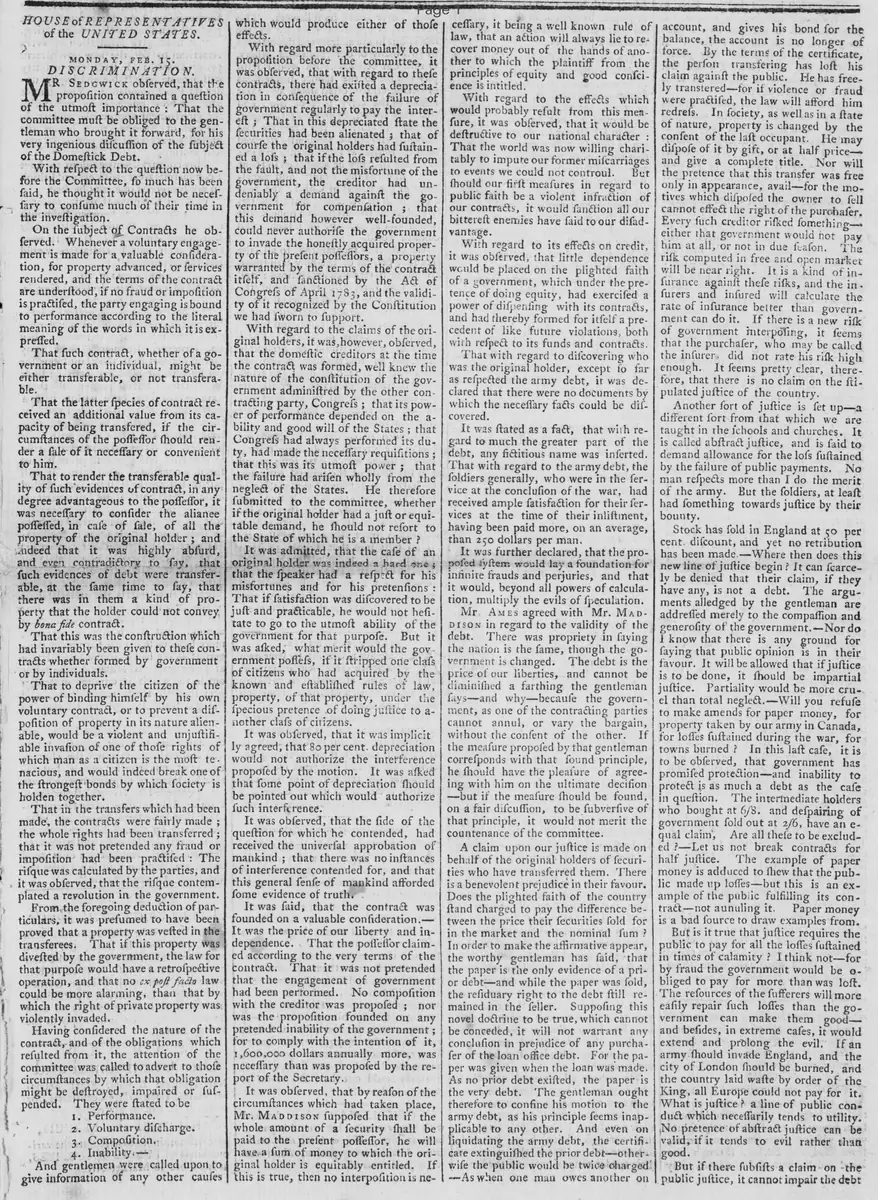
In the US House of Representatives on February 15, Mr. Sedgwick argues against discriminating against transferees of depreciated domestic debt securities, stressing the sanctity of contracts and property rights. Mr. Ames supports the debt's validity but opposes the proposal, arguing it violates justice and public faith.
Merged-components note: Continuous report of the House of Representatives debate on discrimination in public debt payments; the second component directly continues the text from the first, changing label from editorial to story for the overall narrative article.
Clippings
1 of 2
OCR Quality
Full Text
of the UNITED STATES.
TUESDAY, FEB. 15.
MR. SEDGWICK
DISCRIMINATION.
of the utmost importance: That the committee must be obliged to the gentleman who brought it forward, for his very ingenious discussion of the subject of the Domestic Debt.
With respect to the question now before the Committee, so much has been said, he thought it would not be necessary to consume much of their time in the investigation.
On the subject of Contracts he observed, Whenever a voluntary engagement is made for a valuable consideration, for property advanced, or services rendered, and the terms of the contract are understood, if no fraud or imposition is practised, the party engaging is bound to performance according to the literal meaning of the words in which it is expressed.
That such contracts, whether of a government or an individual, might be either transferable, or not transferable.
That the latter species of contract received an additional value from its capacity of being transferred, if the circumstances of the possessor should render a sale of it necessary or convenient to him.
That to render the transferable quality of such evidences of contract, in any degree advantageous to the possessor, it was necessary to consider the alliance possessed, in case of sale, of all the property of the original holder: and indeed that it was highly absurd, and even contradictory to say, that such evidences of debt were transferable, at the same time to say, that there was in them a kind of property that the holder could not convey by bona fide contract.
That this was the construction which had invariably been given to these contracts whether formed by government or by individuals.
That to deprive the citizen of the power of binding himself by his own voluntary contract, or to prevent a disposition of property in its nature alienable, would be a violent and unjustifiable invasion of one of those rights of which man as a citizen is the most tenacious, and would indeed break one of the strongest bonds by which society is holden together.
That in the transfers which had been made, the contracts were fairly made; the whole rights had been transferred; that it was not pretended any fraud or imposition had been practised: The risque was calculated by the parties, and it was observed, that the risque contemplated a revolution in the government.
From the foregoing deduction of particulars, it was presumed to have been proved that a property was vested in the transferees. That if this property was divested by the government, the law for that purpose would have a retrospective operation, and that no ex post facto law could be more alarming, than that by which the right of private property was violently invaded.
Having considered the nature of the contract, and of the obligations which resulted from it, the attention of the committee was called to advert to those circumstances by which that obligation might be destroyed, impaired or suspended. They were stated to be
1. Performance.
2. Voluntary discharge.
3. Composition.
4. Inability.
And gentlemen were called upon to give information of any other causes which would produce either of those effects.
With regard more particularly to the proposition before the committee, it was observed, that with regard to these contracts, there had existed a depreciation in consequence of the failure of government regularly to pay the interest: That in this depreciated state the securities had been alienated; that of course the original holders had sustained a loss; that if the loss resulted from the fault, and not the misfortune of the government, the creditor had undeniably a demand against the government for compensation; that this demand however well-founded, could never authorize the government to invade the honestly acquired property of the present possessors, a property warranted by the terms of the contract itself, and sanctioned by the Act of Congress of April 1783, and the validity of it recognized by the Constitution we had sworn to support.
With regard to the claims of the original holders, it was, however, observed, that the domestic creditors at the time the contract was formed, well knew the nature of the constitution of the government administered by the other contracting party, Congress; that its power of performance depended on the ability and good will of the States; that Congress had always performed its duty, had made the necessary requisitions; that this was its utmost power; that the failure had arisen wholly from the neglect of the States. He therefore submitted to the committee, whether if the original holder had a just or equitable demand, he should not resort to the State of which he is a member?
It was admitted, that the case of an original holder was indeed a hard one; that the speaker had a respect for his misfortunes and for his pretensions: That if satisfaction was discovered to be just and practicable, he would not hesitate to go to the utmost ability of the government for that purpose. But it was asked; what merit would the government possess, if it stripped one class of citizens who had acquired by the known and established rules of law, property, of that property, under the specious pretence of doing justice to another class of citizens.
It was observed, that it was implicitly agreed, that 80 per cent. depreciation would not authorize the interference proposed by the motion. It was asked that some point of depreciation should be pointed out which would authorize such interference.
It was observed, that the side of the question for which he contended, had received the universal approbation of mankind: that there was no instances of interference contended for, and that this general sense of mankind afforded some evidence of truth.
It was said, that the contract was founded on a valuable consideration. It was the price of our liberty and independence. That the possessor claimed according to the very terms of the contract. That it was not pretended that the engagement of government had been performed. No composition with the creditor was proposed; nor was the proposition founded on any pretended inability of the government; for to comply with the intention of it, 1,600,000 dollars annually more, was necessary than was proposed by the report of the Secretary.
It was observed, that by reason of the circumstances which had taken place, Mr. Madison supposed that if the whole amount of a security shall be paid to the present possessor, he will have a sum of money to which the original holder is equitably entitled. If this is true, then no interposition is necessary, it being a well known rule of law, that an action will always lie to recover money out of the hands of another to which the plaintiff from the principles of equity and good conscience is entitled.
With regard to the effects which would probably result from this measure, it was observed, that it would be destructive to our national character: That the world was now willing charitably to impute our former miscarriages to events we could not controul. But should our first measures in regard to public faith be a violent infraction of our contracts, it would sanction all our bitterest enemies have said to our disadvantage.
With regard to its effects on credit, it was observed, that little dependence would be placed on the plighted faith of a government, which under the pretence of doing equity, had exercised a power of dispensing with its contracts, and had thereby formed for itself a precedent of like future violations, both with respect to its funds and contracts.
That with regard to discovering who was the original holder, except so far as respected the army debt, it was declared that there were no documents by which the necessary facts could be discovered.
It was stated as a fact, that with regard to much the greater part of the debt, any fictitious name was inserted. That with regard to the army debt, the soldiers generally, who were in the service at the conclusion of the war, had received ample satisfaction for their services at the time of their enlistment, having been paid more, on an average, than 250 dollars per man.
It was further declared, that the proposed system would lay a foundation for infinite frauds and perjuries, and that it would, beyond all powers of calculation, multiply the evils of speculation.
Mr. Ames agreed with Mr. Madison in regard to the validity of the debt. There was propriety in saying the nation is the same, though the government is changed. The debt is the price of our liberties, and cannot be diminished a farthing the gentleman says—and why—because the government, as one of the contracting parties cannot annul, or vary the bargain, without the consent of the other. If the measure proposed by that gentleman corresponds with that sound principle, he should have the pleasure of agreeing with him on the ultimate decision—but if the measure should be found, on a fair discussion, to be subversive of that principle, it would not merit the countenance of the committee.
A claim upon our justice is made on behalf of the original holders of securities who have transferred them. There is a benevolent prejudice in their favour. Does the plighted faith of the country stand charged to pay the difference between the price their securities sold for in the market and the nominal sum?
In order to make the affirmative appear, the worthy gentleman has said, that the paper is the only evidence of a prior debt and while the paper was sold, the residuary right to the debt still remained in the seller. Supposing this novel doctrine to be true, which cannot be conceded, it will not warrant any conclusion in prejudice of any purchaser of the loan office debt. For the paper was given when the loan was made. As no prior debt existed, the paper is the very debt. The gentleman ought therefore to confine his motion to the army debt, as his principle seems inapplicable to any other. And even on liquidating the army debt, the certificate extinguished the prior debt—otherwise the public would be twice charged!
—As when one man owes another on account, and gives his bond for the balance, the account is no longer of force. By the terms of the certificate, the person transferring has lost his claim against the public. He has freely transferred—for if violence or fraud were practised, the law will afford him redress. In society, as well as in a state of nature, property is changed by the consent of the last occupant. He may dispose of it by gift, or at half price—and give a complete title. Nor will the pretence that this transfer was free only in appearance, avail—for the motives which disposed the owner to sell cannot affect the right of the purchaser.
Every such creditor risked something— a either that government would not pay him at all, or not in due season. The risk computed in free and open market will be near right. It is a kind of insurance against these risks, and the insurers and insured will calculate the rate of insurance better than government can do it. If there is a new risk of government interposing, it seems that the purchaser, who may be called the insurer, did not rate his risk high enough. It seems pretty clear, therefore, that there is no claim on the stipulated justice of the country.
Another sort of justice is set up—a different sort from that which we are taught in the schools and churches. It is called abstract justice, and is said to demand allowance for the loss sustained by the failure of public payments. No man respects more than I do the merit of the army. But the soldiers, at least had something towards justice by their bounty.
Stock has sold in England at 50 per cent. discount, and yet no retribution has been made.—Where then does this new line of justice begin? It can scarcely be denied that their claim, if they have any, is not a debt. The arguments alledged by the gentleman are addressed merely to the compassion and generosity of the government.—Nor do I know that there is any ground for saying that public opinion is in their favour. It will be allowed that if justice is to be done, it should be impartial justice. Partiality would be more cruel than total neglect.—Will you refuse to make amends for paper money, for property taken by our army in Canada, for losses sustained during the war, for towns burned? In this last case, it is to be observed, that government has promised protection—and inability to protect is as much a debt as the case in question. The intermediate holders who bought at 6/8. and despairing of government sold out at 2/6, have an equal claim, Are all these to be excluded?—Let us not break contracts for half justice. The example of paper money is adduced to shew that the public made up losses—but this is an example of the public fulfilling its contract—not annulling it. Paper money is a bad source to draw examples from.
But is it true that justice requires the public to pay for all the losses sustained in times of calamity? I think not—for by fraud the government would be obliged to pay for more than was lost. The resources of the sufferers will more easily repair such losses than the government can make them good—and besides, in extreme cases, it would extend and prolong the evil. If an army should invade England, and the city of London should be burned, and the country laid waste by order of the King, all Europe could not pay for it.
What is justice? a line of public conduct which necessarily tends to utility. No pretence of abstract justice can be valid, if it tends to evil rather than good.
But if there exists a claim on the public justice, it cannot impair the debt
in the hands of the present holder, for which the public faith is pledged. It is alleged that the seller, who sold for a trifle, will be taxed to pay the purchaser.—He certainly ought to fare as other citizens do. But taxes are in proportion to property. If he has property then the plea of necessity is destroyed. If he has none then his taxes will be a mere trifle.
The project is not justice, even to those whom it pretends to relieve. If you allow less to the purchasers than they gave, it is downright robbery. If you allow more, it is half way justice to those who have sold. I would not risk every thing to do justice, as it is called, and then not do it.
But this fragment of justice cannot be given to some, without wronging others. You impair the property in the hands of the present original holders. It is not supposed that the alienated property is near equal to that which is still in the hands of the first holders. Be that as it may, I believe with confidence that it would be cheaper for the present holders to pay the market price of the paper proposed to be given to the former holders, than to suffer the shock which this measure would give to the credit of their paper.
I will not enter now into the merits of the Secretary's plan, but I think it not difficult to show that he proposes better justice to the present original holders than is contained in the motion, and that the debt funded on his plan would sell for more in the market. Great sums have been lent to the public by trustees who acted for others, and only lent their names. Many original creditors were not first holders—supplies were furnished to contractors for the army, who got credit, and afterwards paid in paper, as they received it of the public. Many towns hired soldiers for a gross sum, and agreed to take the wages.—Private debts have been paid at par.—A man in embarrassed circumstances, instead of compounding with his creditors for ten or a dozen years forbearance, paid them at par, or near it, in public paper, which in that period was supposed to be as likely to be paid as his private note.
No less a sum than 214,000 dollars were paid in this way to one mercantile house, at about 10s. in the pound. Compare the gross injustice of these cases with the pretended justice of the motion—consider that it pretends to pay the purchaser. But loan-office certificates have sold from 15s. and 18s. in the pound to 5s. Foreign purchasers gave more than our market price. Before they bought they got certificates of the nature of the debt, that it was not liable to any deduction, and that the transfer would be valid. People in the first offices in this country and abroad signed them. 500,000 dollars were bought for one Dutch house, and registered, and the partners in the sum have divided the certificates by giving their own bonds. What will be the effect? Justice or injustice? In these cases, the gentleman will admit, that the rights of these people are perfect.
The debt, he says himself, cannot be diminished a farthing.—Property is sacred. The right to a single dollar cannot be violated. Let the gentleman then acknowledge that he must give up his project, or his principles.
I have endeavoured to show what sort of abstract justice this is. But if it should be allowed that there is a claim of justice, what then? Let them claim justice of those who have done them injustice, not of the fair purchaser.
(To be continued.)
What sub-type of article is it?
What themes does it cover?
What keywords are associated?
What entities or persons were involved?
Where did it happen?
Story Details
Key Persons
Location
House Of Representatives Of The United States
Event Date
Tuesday, Feb. 15.
Story Details
Mr. Sedgwick defends the rights of current holders of transferred government debt securities against discrimination favoring original holders, arguing that contracts are binding and interference would violate property rights and public faith. Mr. Ames concurs on debt validity but opposes the proposal as unjust and harmful to credit.