Thank you for visiting SNEWPapers!
Sign up free
The New Hampshire Gazette
Portsmouth, Rockingham County, New Hampshire
What is this article about?
In April 1809, US Secretary of State Robert Smith and British Minister David M. Erskine exchanged notes in Washington resolving the 1807 Chesapeake frigate attack with British disavowal, officer recall, return of impressed sailors, and provisions for victims. Britain agrees to withdraw 1807 Orders in Council by June 10, prompting US trade renewal proclamation by President Madison.
Clipping
OCR Quality
Full Text
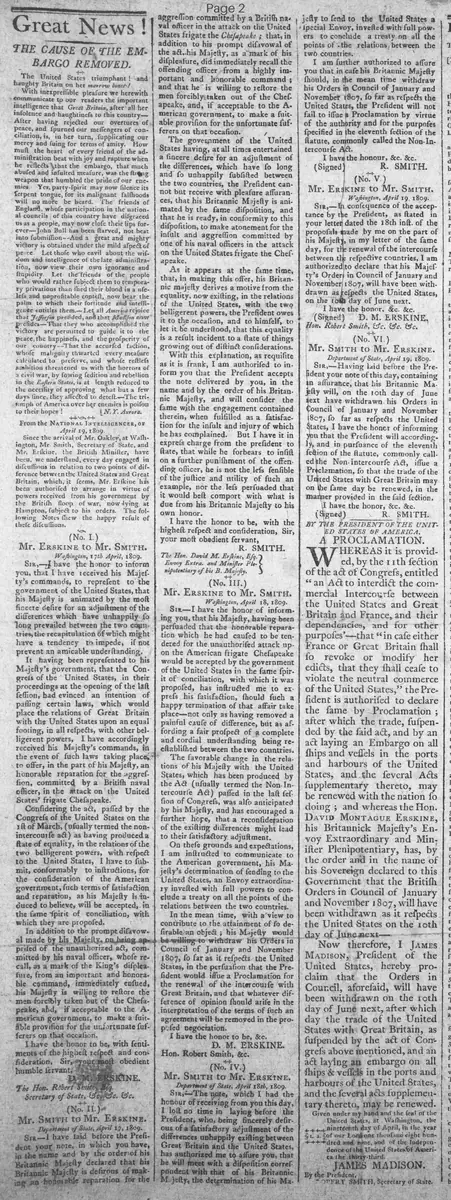
Since the arrival of Mr. Oakley, at Washington, Mr. Smith, Secretary of State, and Mr. Erskine, the British Minister, have been, we understand, every day engaged in discussions in relation to two points of difference between the United States and Great Britain, which, it seems, Mr. Erskine has been authorized to arrange in virtue of powers received from his government by the British sloop of war, now lying at Hampton, subject to his orders. The following Notes show the happy result of these discussions.
(No. I.)
Mr. Erskine to Mr. Smith.
Washington, 17th April, 1809.
SIR,—I have the honor to inform you, that I have received his Majesty's commands, to represent to the government of the United States, that his Majesty is animated by the most sincere desire for an adjustment of the differences which have unhappily so long prevailed between the two countries, the recapitulation of which might have a tendency to impede, if not prevent an amicable understanding.
It having been represented to his Majesty's government, that the Congress of the United States, in their proceedings at the opening of the last session, had evinced an intention of passing certain laws, which would place the relations of Great Britain with the United States upon an equal footing, in all respects, with other belligerent powers, I have accordingly received his Majesty's commands, in the event of such laws taking place, to offer, on the part of his Majesty, an honorable reparation for the aggression, committed by a British naval officer, in the attack on the United States' frigate Chesapeake.
Considering the act, passed by the Congress of the United States on the 1st of March, (usually termed the non-intercourse act) as having produced a state of equality, in the relations of the two belligerent powers, with respect to the United States, I have to submit, conformably to instructions, for the consideration of the American government, such terms of satisfaction and reparation, as his Majesty is induced to believe, will be accepted, in the same spirit of conciliation, with which they are proposed.
In addition to the prompt disavowal made by his Majesty, on being apprised of the unauthorized act, committed by his naval officer, whose recall, as a mark of the King's displeasure, from an important and honorable command, immediately ensued.
his Majesty is willing to restore the men forcibly taken out of the Chesapeake, and, if acceptable to the American government, to make a suitable provision for the unfortunate sufferers on that occasion.
I have the honor to be, with sentiments of the highest respect and consideration, Sir, your most obedient humble servant,
D. M. ERSKINE.
The Hon. Robert Smith, Esq. Secretary of State, &c. &c.
(No. II.)
Mr. Smith to Mr. Erskine.
Department of State, April 17, 1809.
Sir—I have laid before the President your note, in which you have, in the name and by the order of his Britannic Majesty declared that his Britannic Majesty is desirous of making an honorable reparation for the aggression committed by a British naval officer in the attack on the United States frigate the Chesapeake: that, in addition to his prompt disavowal of the act, his Majesty, as a mark of his displeasure, did immediately recall the offending officer from a highly important and honorable command; and that he is willing to restore the men forcibly taken out of the Chesapeake, and, if acceptable to the American government, to make a suitable provision for the unfortunate sufferers on that occasion.
The government of the United States having, at all times entertained a sincere desire for an adjustment of the differences, which have so long and so unhappily subsisted between the two countries, the President cannot but receive with pleasure assurances, that his Britannic Majesty is animated by the same disposition, and that he is ready, in conformity to this disposition, to make atonement for the insult and aggression committed by one of his naval officers in the attack on the United States frigate the Chesapeake.
As it appears at the same time, that, in making this offer, his Britannic majesty derives a motive from the equality, now existing, in the relations of the United States, with the two belligerent powers, the President owes it to the occasion, and to himself, to let it be understood, that this equality is a result incident to a state of things growing out of distinct considerations.
With this explanation, as requisite as it is frank. I am authorized to inform you that the President accepts the note delivered by you, in the name and by the order of his Britannic Majesty, and will consider the same with the engagement contained therein, when fulfilled as a satisfaction for the insult and injury of which he has complained. But I have it in express charge from the president to state, that while he forbears to insist on a further punishment of the offending officer, he is not the less sensible of the justice and utility of such an example, nor the less persuaded that it would best comport with what is due from his Britannic Majesty to his own honor.
I have the honor to be, with the highest respect and consideration, Sir, your most obedient servant,
R. SMITH.
The Hon. David M. Erskine, Esq. Envoy Extra. and Minister Plenipotentiary of his B. Majesty.
(No. III.)
Mr. Erskine to Mr. Smith.
Washington, April 18, 1809.
Sir—I have the honor of informing you, that his Majesty, having been persuaded that the honorable reparation which he had caused to be tendered for the unauthorized attack upon the American frigate Chesapeake would be accepted by the government of the United States in the same spirit of conciliation, with which it was proposed, has instructed me to express his satisfaction, should such a happy termination of that affair take place—not only as having removed a painful cause of difference, but as affording a fair prospect of a complete and cordial understanding being re-established between the two countries.
The favorable change in the relations of his Majesty with the United States, which has been produced by the Act (usually termed the Non-Intercourse Act) passed in the last session of Congress, was also anticipated by his Majesty, and has encouraged a further hope, that a reconsideration of the existing differences might lead to their satisfactory adjustment.
On these grounds and expectations, I am instructed to communicate to the American government, his Majesty's determination of sending to the United States, an Envoy extraordinary invested with full powers to conclude a treaty on all the points of the relations between the two countries.
In the mean time, with a view to contribute to the attainment of so desirable an object; his Majesty would be willing to withdraw his Orders in Council of January and November 1807, so far as it respects the United States, in the persuasion that the President would issue a Proclamation for the renewal of the intercourse with Great Britain, and that whatever difference of opinion should arise in the interpretation of the terms of such an agreement will be removed in the proposed negociation.
I have the honor to be, &c.
D. M. ERSKINE.
Hon. Robert Smith, &c.
(No. IV.)
Mr. Smith to Mr. Erskine.
Department of State, April 18th, 1809.
Sir,—The note, which I had the honour of receiving from you this day, I lost no time in laying before the President, who, being sincerely desirous of a satisfactory adjustment of the differences unhappily existing between Great Britain and the United States, has authorized me to assure you, that he will meet with a disposition correspondent with that of his Britannic Majesty, the determination of his Majesty to send to the United States a special Envoy, invested with full powers to conclude a treaty on all the points of the relations, between the two countries.
I am further authorized to assure you that in case his Britannic Majesty should, in the mean time withdraw his Orders in Council of January and November 1807, so far as respects the United States, the President will not fail to issue a Proclamation by virtue of the authority and for the purposes specified in the eleventh section of the statute, commonly called the Non-Intercourse Act.
I have the honour, &c. &c.
(Signed)
R. SMITH.
(No. V.)
Mr. Erskine to Mr. Smith.
Washington, April 19, 1809.
Sir, In consequence of the acceptance by the President, as stated in your letter dated the 18th inst. of the proposals made by me on the part of his Majesty, in my letter of the same day, for the renewal of the intercourse between the respective countries, I am authorized to declare that his Majesty's Order in Council of January and November 1807, will have been withdrawn as respects the United States, on the 10th day of June next.
I have the honor, &c. &c.
(Signed) D. M. ERSKINE.
Hon. Robert Smith, &c. &c.
(No. VI.)
Mr. Smith to Mr. Erskine.
Department of State, April 19, 1809.
Sir,—Having laid before the President your note of this day, containing an assurance, that his Britannic Majesty will, on the 10th day of June next have withdrawn his Orders in Council of January and November 1807, so far as respects the United States, I have the honor of informing you that the President will accordingly, and in pursuance of the eleventh section of the statute, commonly called the Non-Intercourse Act, issue a Proclamation, so that the trade of the United States with Great Britain may on the same day be renewed, in the manner provided in the said section.
I have the honor, &c. &c.
(Signed)
R. SMITH.
BY THE PRESIDENT OF THE UNITED STATES OF AMERICA,
A PROCLAMATION.
WHEREAS it is provided, by the 11th section of the act of Congress, entitled "an Act to interdict the commercial Intercourse between the United States and Great Britain and France, and their dependencies, and for other purposes'—that "in case either France or Great Britain shall so revoke or modify her edicts, that they shall cease to violate the neutral commerce of the United States," the President is authorized to declare the same by Proclamation; after which the trade, suspended by the said act, and by an act laying an Embargo on all ships and vessels in the ports and harbours of the United States, and the several Acts supplementary thereto, may be renewed with the nation so doing; and whereas the Hon. David Montague Erskine, his Britannic Majesty's Envoy Extraordinary and Minister Plenipotentiary, has, by the order and in the name of his Sovereign declared to this Government that the British Orders in Council of January and November 1807, will have been withdrawn as it respects the United States on the 10th day of June next—
Now therefore, I James Madison, President of the United States, hereby proclaim that the Orders in Council, aforesaid, will have been withdrawn on the 10th day of June next, after which day the trade of the United States with Great Britain, as suspended by the act of Congress above mentioned, and an act laying an embargo on all ships & vessels in the ports and harbours of the United States, and the several acts supplementary thereto, may be renewed.
Given under my hand and the seal of the United States, at Washington, the nineteenth day of April, in the year of our Lord one thousand eight hundred and nine, and of the Independence of the United States of America the thirty-third.
JAMES MADISON.
By the President,
ROBT. SMITH, Secretary of State.
What sub-type of article is it?
What keywords are associated?
What entities or persons were involved?
Where did it happen?
Foreign News Details
Primary Location
Washington
Event Date
April 17 19, 1809
Key Persons
Outcome
british disavowal and recall of offending officer; return of impressed men from chesapeake; suitable provisions for sufferers; withdrawal of 1807 orders in council effective june 10, 1809; us proclamation for trade renewal with great britain.
Event Details
Exchange of diplomatic notes between British Minister Erskine and US Secretary Smith resolves Chesapeake attack with reparation offers accepted by President Madison; Britain to send envoy for full treaty; conditional withdrawal of Orders in Council in response to US Non-Intercourse Act, leading to trade resumption.