Thank you for visiting SNEWPapers!
Sign up free
Editorial
July 19, 1937
Henderson Daily Dispatch
Henderson, Vance County, North Carolina
What is this article about?
Recounts July 1787 Constitutional Convention debates on independence of legislative, executive, and judicial branches; methods for selecting judges and president; and ratifying the Constitution by popular assemblies, emphasizing power reserved to the people.
Clipping
OCR Quality
98%
Excellent
Full Text
JUDICIAL AND OTHER POWERS
During late July of 1787, members of the Convention that wrote the Federal Constitution stated two principles which, for a century and a half, have remained fundamental characteristics of our National government.
They were: (1) that the three branches of government—Legislative, Executive and Judicial—must remain independent of each other; and (2) that power not specifically allocated in the Constitution should remain with the people.
The statements were made during discussions on methods of establishing judicial and other powers in the new nation, and of choosing the Chief Executive.
"If it be a fundamental principle of free government that the Legislative, Executive and Judiciary power should be separately exercised," said James Madison, of Virginia, "it is equally so that they be independently exercised. There is the same and perhaps greater reason why the Executive should be independent of the Legislature than why the Judiciary should."
To which Rufus King, of Massachusetts, added that he wished the Convention to remember "the primitive axiom that the three great departments of government should be separate and independent; that the Executive and Judiciary should be so, as well as the Legislative; that the Executive should be so, equally with the Judiciary."
In support of that principle James Wilson, of Pennsylvania, explained: "The separation of the departments does not require that they should have separate objects, but that they should act separately though on the same objects."
In contrast to the long and often bitter debate which had marked consideration of the Legislative branch of government, discussion of the Judicial branch was comparatively brief.
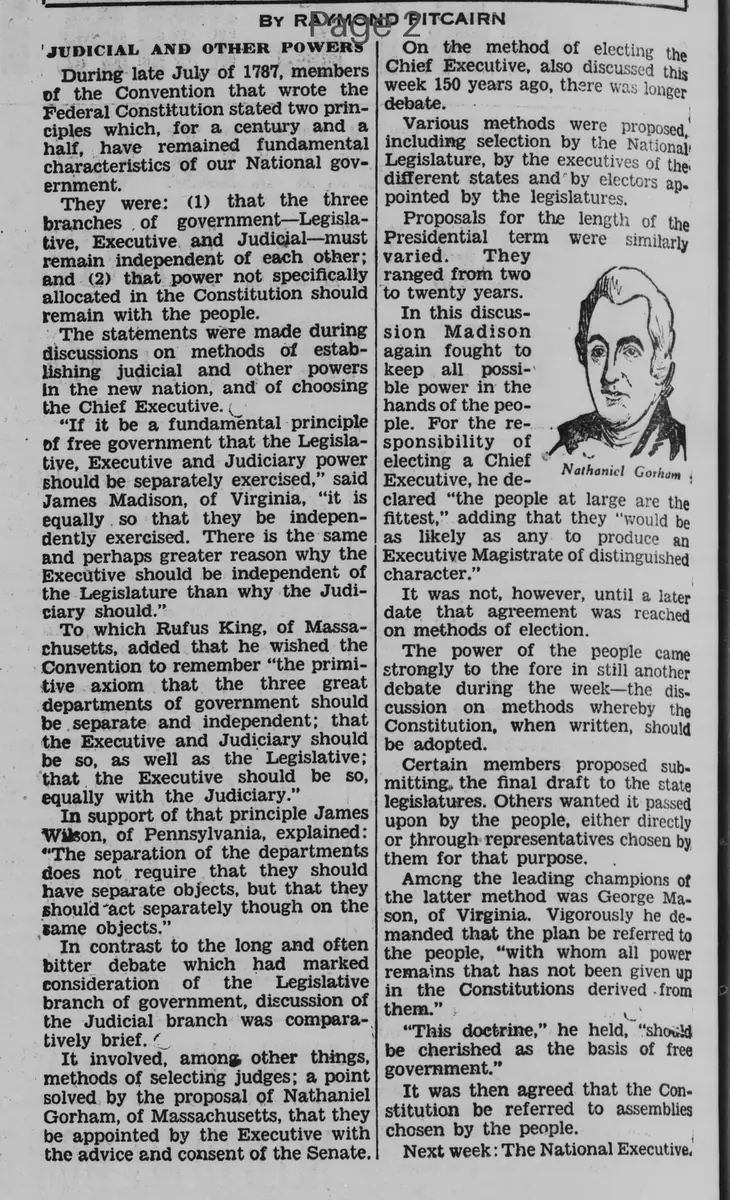
It involved, among other things, methods of selecting judges; a point solved by the proposal of Nathaniel Gorham, of Massachusetts, that they be appointed by the Executive with the advice and consent of the Senate.
On the method of electing the Chief Executive, also discussed this week 150 years ago, there was longer debate.
Various methods were proposed, including selection by the National Legislature, by the executives of the different states and by electors appointed by the legislatures.
Proposals for the length of the Presidential term were similarly varied.
They ranged from two to twenty years.
In this discussion Madison again fought to keep all possible power in the hands of the people. For the responsibility of electing a Chief Executive, he declared "the people at large are the fittest," adding that they "would be as likely as any to produce an Executive Magistrate of distinguished character."
It was not, however, until a later date that agreement was reached on methods of election.
The power of the people came strongly to the fore in still another debate during the week—the discussion on methods whereby the Constitution, when written, should be adopted.
Certain members proposed submitting the final draft to the state legislatures. Others wanted it passed upon by the people, either directly or through representatives chosen by them for that purpose.
Among the leading champions of the latter method was George Mason, of Virginia. Vigorously he demanded that the plan be referred to the people, "with whom all power remains that has not been given up in the Constitutions derived from them."
"This doctrine," he held, "should be cherished as the basis of free government."
It was then agreed that the Constitution be referred to assemblies chosen by the people.
Next week: The National Executive.
During late July of 1787, members of the Convention that wrote the Federal Constitution stated two principles which, for a century and a half, have remained fundamental characteristics of our National government.
They were: (1) that the three branches of government—Legislative, Executive and Judicial—must remain independent of each other; and (2) that power not specifically allocated in the Constitution should remain with the people.
The statements were made during discussions on methods of establishing judicial and other powers in the new nation, and of choosing the Chief Executive.
"If it be a fundamental principle of free government that the Legislative, Executive and Judiciary power should be separately exercised," said James Madison, of Virginia, "it is equally so that they be independently exercised. There is the same and perhaps greater reason why the Executive should be independent of the Legislature than why the Judiciary should."
To which Rufus King, of Massachusetts, added that he wished the Convention to remember "the primitive axiom that the three great departments of government should be separate and independent; that the Executive and Judiciary should be so, as well as the Legislative; that the Executive should be so, equally with the Judiciary."
In support of that principle James Wilson, of Pennsylvania, explained: "The separation of the departments does not require that they should have separate objects, but that they should act separately though on the same objects."
In contrast to the long and often bitter debate which had marked consideration of the Legislative branch of government, discussion of the Judicial branch was comparatively brief.
It involved, among other things, methods of selecting judges; a point solved by the proposal of Nathaniel Gorham, of Massachusetts, that they be appointed by the Executive with the advice and consent of the Senate.
On the method of electing the Chief Executive, also discussed this week 150 years ago, there was longer debate.
Various methods were proposed, including selection by the National Legislature, by the executives of the different states and by electors appointed by the legislatures.
Proposals for the length of the Presidential term were similarly varied.
They ranged from two to twenty years.
In this discussion Madison again fought to keep all possible power in the hands of the people. For the responsibility of electing a Chief Executive, he declared "the people at large are the fittest," adding that they "would be as likely as any to produce an Executive Magistrate of distinguished character."
It was not, however, until a later date that agreement was reached on methods of election.
The power of the people came strongly to the fore in still another debate during the week—the discussion on methods whereby the Constitution, when written, should be adopted.
Certain members proposed submitting the final draft to the state legislatures. Others wanted it passed upon by the people, either directly or through representatives chosen by them for that purpose.
Among the leading champions of the latter method was George Mason, of Virginia. Vigorously he demanded that the plan be referred to the people, "with whom all power remains that has not been given up in the Constitutions derived from them."
"This doctrine," he held, "should be cherished as the basis of free government."
It was then agreed that the Constitution be referred to assemblies chosen by the people.
Next week: The National Executive.
What sub-type of article is it?
Constitutional
What keywords are associated?
Constitutional Convention
Separation Of Powers
Judicial Branch
Executive Election
Federal Constitution
Power Of The People
What entities or persons were involved?
James Madison
Rufus King
James Wilson
Nathaniel Gorham
George Mason
Constitutional Convention
Editorial Details
Primary Topic
Discussions On Separation Of Powers And Judicial/Executive Branches At The 1787 Constitutional Convention
Stance / Tone
Informative Historical Recounting
Key Figures
James Madison
Rufus King
James Wilson
Nathaniel Gorham
George Mason
Constitutional Convention
Key Arguments
Three Branches Of Government Must Remain Independent
Power Not Allocated In Constitution Remains With The People
Judges Appointed By Executive With Senate Consent
People Fittest To Elect Chief Executive
Constitution To Be Ratified By People Chosen Assemblies