Thank you for visiting SNEWPapers!
Sign up free
Gazette Of The United States
Philadelphia, Philadelphia County, Pennsylvania
What is this article about?
On February 26, the U.S. House of Representatives addressed memorials challenging Joseph B. Varnum's election due to unqualified voters; debated and recommitted a bill authorizing a loan for Washington, D.C., focusing on property security; received a report on impressment of American seamen; and approved a motion to inquire into the state and expenses of public buildings in the federal city.
Merged-components note: These components form a continuous report on congressional proceedings regarding the loan for the city of Washington, spanning pages 2 and 3. The second component's label changed from 'story' to 'domestic_news' to better reflect national political news.
Clippings
1 of 2
OCR Quality
Full Text
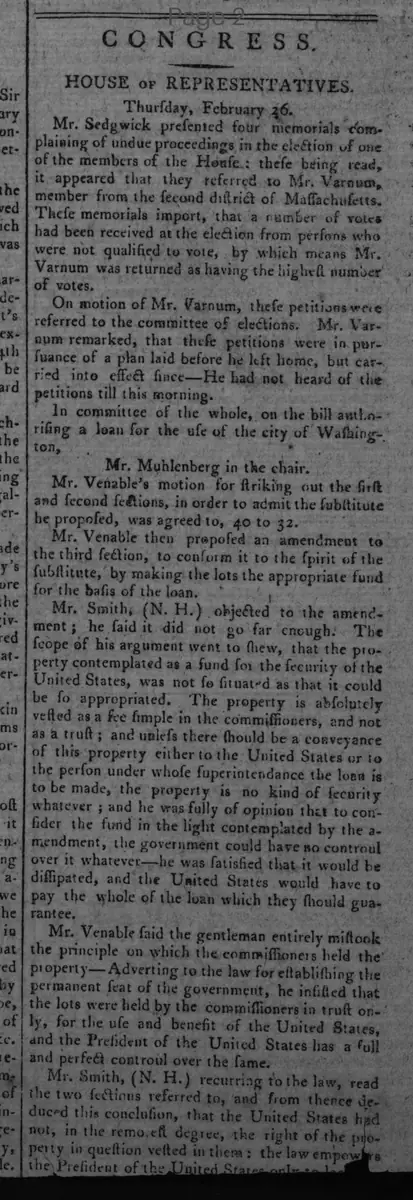
HOUSE OF REPRESENTATIVES.
Thursday, February 26.
Mr. Sedgwick presented four memorials complaining of undue proceedings in the election of one of the members of the House: these being read, it appeared that they referred to Mr. Varnum, member from the second district of Massachusetts. These memorials import, that a number of votes had been received at the election from persons who were not qualified to vote, by which means Mr. Varnum was returned as having the highest number of votes.
On motion of Mr. Varnum, these petitions were referred to the committee of elections. Mr. Varnum remarked, that these petitions were in pursuance of a plan laid before he left home, but carried into effect since—He had not heard of the petitions till this morning.
In committee of the whole, on the bill authorizing a loan for the use of the city of Washington,
Mr. Muhlenberg in the chair.
Mr. Venable's motion for striking out the first and second sections, in order to admit the substitute he proposed, was agreed to, 40 to 32.
Mr. Venable then proposed an amendment to the third section, to conform it to the spirit of the substitute, by making the lots the appropriate fund for the basis of the loan.
Mr. Smith, (N. H.) objected to the amendment; he said it did not go far enough. The scope of his argument went to shew, that the property contemplated as a fund for the security of the United States, was not so situated as that it could be so appropriated. The property is absolutely vested as a fee simple in the commissioners, and not as a trust; and unless there should be a conveyance of this property either to the United States or to the person under whose superintendence the loan is to be made, the property is no kind of security whatever; and he was fully of opinion that to consider the fund in the light contemplated by the amendment, the government could have no controul over it whatever—he was satisfied that it would be dissipated, and the United States would have to pay the whole of the loan which they should guarantee.
Mr. Venable said the gentleman entirely mistook the principle on which the commissioners held the property—Adverting to the law for establishing the permanent seat of the government, he insisted that the lots were held by the commissioners in trust only, for the use and benefit of the United States, and the President of the United States has a full and perfect controul over the same.
Mr. Smith, (N. H.) recurring to the law, read the two sections referred to, and from thence deduced this conclusion, that the United States had not, in the remotest degree, the right of the property in question vested in them: the law empowers the President of the United States and. Authorized by the law to accept any grants of land, but only grants of money.
Mr. D. Foster called for the reading of the deed of trust or conveyance which had been repeatedly referred to. This was accordingly read.
Mr. Giles said he was satisfied with the bill as it stood. The only difference between the substitute and the bill is this, that the bill provided for the conveyance of the property to the United States, whereas the substitute contemplates leaving the property as it is, under the direction of the commissioners. He agreed with the gentleman from New Hampshire, that a good and legal conveyance could be made by the commissioners; but as the substitute had been agreed to, he saw no material difference in the actual operation of the thing; he did not think that there would be any hesitation on the part of purchasers, whether the sales were made by the commissioners, by themselves, or by direction from the President of the United States. He wished the discussion to proceed;—if the committee should think the objection of importance, the bill might be re-committed.
Mr. Nicholas, adverting to the act of conveyance, recited a passage from which he said it was apparent the property stands precisely in the situation which gentlemen would wish it.
Mr. Havens said he did not perfectly comprehend the subject, but it appeared to him that there was an essential variation in the title of the deed of conveyance from that of the law for establishing the permanent seat of government.
Mr. Dayton said that from what had fallen from the gentleman from N. H. it appears that the commissioners were vested with the fee simple of the lots, if so, it was a total uncertainty whether the United States had or could have the least control over the property. If this was the case, he never would give his assent to the bill. The commissioners may refuse to sell or convey. The title to the property ought to be better understood. He considered the business as being highly important, and that the House ought to proceed with great caution and deliberation, and not decide without more information than they were at present in possession of.
Mr. Hillhouse proposed an amendment, the object of which was to place the subject on a footing that could not be misconstrued.
Mr. Brent, recurred to the law, and read the clauses, relative to the grants of land, and of money. With respect to the first, the law vests a discretionary power in the President to dispose of the property in such a way as to answer the several objects of the law, in the best manner. The deed of conveyance goes no further than this: Adverting to the deed, he said it expressly provides for the disposition of the net produce of the sales, as the President of the United States may direct; and the commissioners cannot make any use of it for any purpose that they are not authorized to by the President. Hence he concluded that there was no force in the objection drawn from the deed of trust, no any ground for fear on this point.
Mr. Swift observed, that there appeared to be such a diversity of opinion relative to the nature of the deed of conveyance, that he conceived it was almost impossible for gentlemen to determine what was the actual state of the security, on which the loan is to be raised.— He moved therefore that the committee should rise.
Mr. Brent opposed the motion: he was rather disposed to attribute this desire of procrastination to a settled determination on the part of some gentlemen not to give their assent to the bill in any shape whatever.
Mr. Crabb said he admired the attention of the gentleman from Connecticut, in his watchful care over the treasury of the United States, but to what purpose is this delay? What is asked, it is simply to guarantee a loan, that is all. To what purpose then the flowers of rhetoric, and declamation. If gentlemen mean something more than they express, let them come forward and kick the bill out of the House. If they intend this, let them say so, and we shall then know on what ground we stand; we shall then be able to meet them on the ground of argument, but to what purpose are the amendments on amendments brought forward, but to perplex and deceive? Mr. Crabb then alluded to what had fallen from Mr. Williams, relative to the grants made to the federal city. Mr. Williams had insinuated, he said, that these grants were so far from a gift that they were a benefit to the donors. Mr. Crabb asked if the gentleman had never heard of the grants made by the states of Maryland and Virginia, seventy thousand dollars by the former, and 120,000 dollars by the latter? The gentleman said that he blushed as a republican at the grandeur of the federal edifices. I believe said he, that we shall look a good while before we see the gentleman blush.
The committee rose, and the bill was re-committed—On motion four members were added to the committee.
Mr. Livingston brought in a report relative to the impressment of American seamen, which was twice read, and committed to the committee of the whole House on Monday next: Ordered to be printed.
Mr. Dearborn moved that the committee on the loan bill, be instructed to this purport, that they enquire, whether any, and what alterations would be proper to be made in the plan adopted for the public buildings in the city of Washington, and to report.
Mr. Murray said he hoped the motion would not be agreed to. He conceived it was useless—No alteration could now take place without great waste and loss. · The gentleman does not propose that the buildings should be pulled down. They are now raised and progressed to a considerable extent. They have not cost the United States any thing. They have progressed thus far, thro the generous donations of two particular states, and he submitted it to the consideration of the gentleman whether it would be perfectly delicate to interfere in the plan, which had been adopted by those states.
Mr. Dearborn said if the committee, on enquiry, should not find any alterations advisable or practicable they would report accordingly. He thought there was no impropriety in the enquiry. With the propriety of a full investigation into the subject became proper, and he did not conceive that in this situation of the business,, it could not be considered as indicative, it was no more than adopting a proper mode to obtain information.
Mr. Crabb objected to the motion. He thought the proposed enquiry very improper. The law said he, has appointed the President of the United States to manage this business. Suppose the enquiry were to take place, and the buildings are found on too large a scale, shall they be pulled down, and smaller ones erected? If gentlemen were indulged, where would their enquiries end? He read the message of the President to the House on the subject, wherein he says the sale of the lots will be equal to the expense of the buildings. It would be well, he said, if gentlemen would gain a little more information on subjects, before they brought them forward. If this had been the case, he thought much of the debate which had occupied the House for several days might have been saved.
Mr. Dearborn acknowledged he lacked information, but that he had attended, without effect, to gain it from his accuser.
Mr. Bourne supported the motion. He conceived that it was strictly proper ; the information may be of essential use in governing the decisions of the House in the future division of the bill. It is apparent that the supposed extravagance in erecting the public buildings has influenced in clogging the progress of the bill. Perhaps the suggestions which have been started are unfounded, if they are it will appear so. If not they may propose practicable retrenchments, in either case useful information will be obtained.
Mr. Murray hoped that the motion for this instruction to the Committee would not succeed.— The mover had wished for information upon the present state of the public buildings and to know their dimensions, to this he had nothing to oppose but the remark that if the information which was then on the clerk's table could not satisfy him, the time to obtain more from the city would be too long in all reason. On the table he could find the elevation of the Congress House and its dimensions, and he believed of the house for the executive also. Were the object of the motion to obtain this sort of knowledge through the committee, and that the only object, he should have considered it as merely unnecessary and opposed it as it would uselessly accumulate business for the committee and prove a source of delay ; but he opposed this motion because it did not demand information merely, but the opinion of the committee whether any, and what alteration was necessary in those buildings. - This being the motion he considered it as embarking the house in a principle new and dangerous to the city of Washington. It was the assumption of a power of controlling and of departing from a plan warranted by law, and to the implicit execution of which the faith of the government, through the President acting by his commissioners was completely and solemnly plighted. If you have a right to dictate alterations in any part of that city, then have those who have embarked their whole fortunes under the faith of the act of Congress from whose construction a discretionary power in the President upon this subject was deduced, been in a state of delusion· But he denied the power of the house to act in this way consistently with good faith. The President had the city laid off, he had power to do so. Men of state, architects of ability and engineers were he presumed consulted as to the plan; sites were determined on for the public buildings; squares, streets and avenues were laid off, each object bore its relation to the other, so as to raise the value of the whole. . Individuals have bought property whose value must result from the completion of the place upon which they speculated. Defeat, derange that plan and you do a violence to that faith in which purchasers vested. If the motion seeks mere information it is present. If it asks opinion, it implies a power of alteration and this will vitiate the spirit of the institution. If defects do exist, it is too late to rectify them, and it would be profusion to do it in the way he had heard.
Mr. Thatcher was in favor of general instructions to the committee, and not those of a minute and particular nature. He considered that a minute enquiry involved very extensive consequences, such as he believed were not contemplated by any person whatever.
Mr. Giles proposed a substitute of a more general nature. The motion before the House proposes that the committee should report opinions; his was for a report of acts.
Mr. Dearborn said the motion just read did not go far enough.
Mr. Swanwick was in favor of a minute enquiry into the whole business.
Mr. Gallatin thought that the report should contain not only a state of facts, but also of opinions founded on those facts. Mr. Gallatin said the motion of the gentleman from Virginia did not embrace the object so fully as that moved by the gentleman from Massachusetts. In reply to what had been said relative to the exclusive right to manage the business, on the part of the President, he remarked, that the law had made it the duty of the President to cause the buildings to be erected ; and this he had a right to do without consulting the legislature while the expense was confined to the grants by the states of Maryland and Virginia— But there was one check in the business, and that was in agitating the grant of money on the part of the Union; here the ground was changed, and a right on the part of the government to enquire into the business was the consequence. He was therefore in favor of the first motion, as it went to enquire into facts, but also provided for a declaration of opinions founded on those facts
Mr. Coit hoped the motion would prevail. He recited some of the expenses which had taken place. These were so extravagant as to occasion great part of the opposition to the bill,
Mr. Giles here read his substitute, with some additions extending the compass of it.
Mr. Murray offered some further objections re the motion : The more he heard it discerned. the more he disliked it.~- He did
Mr. Crabb said he saw no use in the enquiry, but to produce endless and unproductive debates.
Mt. Cooper opposed the motion He said that all the government had to do in the business was to guarantee the loan, and to secure the eventual reimbursement of it by the lots.
Mr. Sedgwick observed, that contemplating the removal of the government as settled by law, he had thought it but reasonable that the government should guarantee a loan for completing the public buildings necessary for the accommodation of congress on the principles which he had stated., But with respect to the size or elegance of those buildings, erected not at their expense, he very much doubted the propriety of investigating the enquiry proposed. It would, he conceived, have a very singular appearance for the government to say that these buildings are too large, too commodious, or too elegant. He did not care, for his part, how accommodating they were.
Mr. Dearborn's motion was agreed to, 42 to 38.
Mr. Giles's resolution being called for, it was put and carried, to the following effect :
" That the said committee shall be instructed to enquire into the state of the Public Buildings at the permanent seat of Government of the United States, into the expense already incurred in erecting, and the probable expense of completing the same."
What sub-type of article is it?
What keywords are associated?
What entities or persons were involved?
Domestic News Details
Event Date
Thursday, February 26.
Key Persons
Outcome
memorials on varnum's election referred to committee; loan bill recommitted with additions; impressment report committed and printed; dearborn's motion on public buildings approved 42-38; giles's resolution on building expenses carried.
Event Details
House proceedings included presentation of memorials alleging irregularities in Joseph B. Varnum's election from Massachusetts due to unqualified voters, referred to elections committee. In committee of the whole, debate on bill for loan to Washington city focused on property security and commissioners' control, with amendments adopted and bill recommitted. Report on impressment of American seamen read and committed. Motion to inquire into alterations for Washington public buildings debated extensively on propriety, expense, and presidential authority, ultimately approved.