Thank you for visiting SNEWPapers!
Sign up free
The Virginia Gazette
Williamsburg, Virginia
What is this article about?
In December 1773, ten men from the cutter of the Adventure ship, sent to gather greens in Grass Cove, New Zealand, were surprised, killed, and eaten by local savages. Search party found human remains and engaged the attackers, destroying canoes before departing.
Clipping
OCR Quality
Full Text
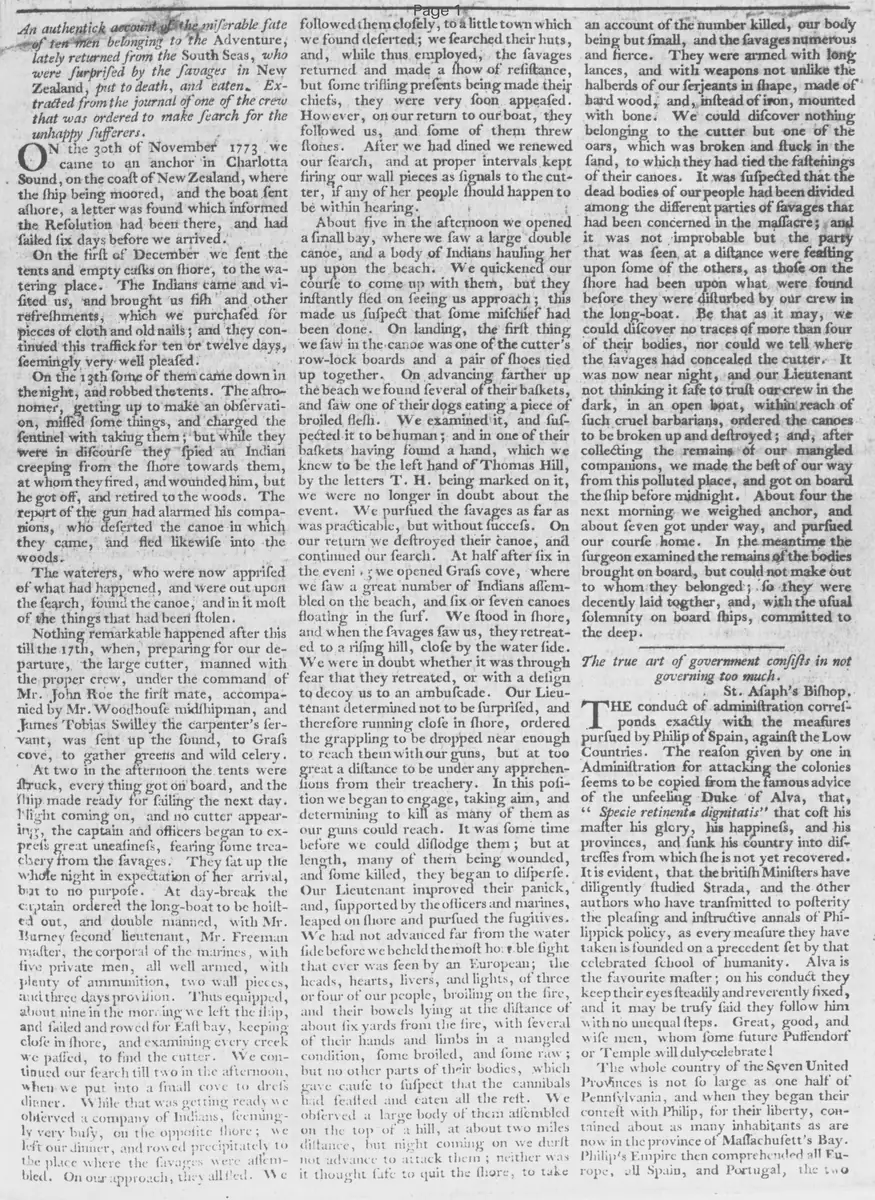
Extracted from the journal of one of the crew that was ordered to make search for the unhappy sufferers.
On the 30th of November 1773 we came to an anchor in Charlotte Sound, on the coast of New Zealand, where the ship being moored, and the boat sent on shore, a letter was found which informed the Resolution had been there, and had sailed six days before we arrived.
On the first of December we sent the tents and empty casks on shore, to the watering place. The Indians came and visited us, and brought us fish and other refreshments, which we purchased for pieces of cloth and old nails; and they continued this traffic for ten or twelve days, seemingly very well pleased.
On the 13th some of them came down in the night, and robbed the tents. The astronomer, getting up to make an observation, missed some things, and charged the Sentinel with taking them; but while they were in discourse they spied an Indian creeping from the shore towards them, at whom they fired, and wounded him, but he got off, and retired to the woods. The report of the gun had alarmed his companions, who deserted the canoe in which they came, and fled likewise into the woods.
The waterers, who were now apprised of what had happened, and were out upon the search, found the canoe, and in it most of the things that had been stolen.
Nothing remarkable happened after this till the 17th, when, preparing for our departure, the large cutter, manned with the proper crew, under the command of Mr. John Rowe the first mate, accompanied by Mr. Woodhouse midshipman, and James Tobias Swilley the carpenter's servant, was sent up the sound, to Grass Cove, to gather greens and wild celery.
At two in the afternoon the tents were struck, every thing got on board, and the ship made ready for sailing the next day. Night coming on, and no cutter appearing, the captain and officers began to express great uneasiness, fearing some treachery from the savages. They sat up the whole night in expectation of her arrival, but to no purpose. At day-break the captain ordered the long-boat to be hoisted out, and double manned, with Mr. Burney second lieutenant, Mr. Freeman master, the corporal of the marines, with five private men, all well armed, with plenty of ammunition, two wall pieces, and three days provision. Thus equipped, about nine in the morning we left the ship, and sailed and rowed for East bay, keeping close in shore, and examining every creek we passed, to find the cutter. We continued our search till two in the afternoon, when we put into a small cove to dress dinner. While that was getting ready we observed a company of Indians, seemingly very busy, on the opposite shore; we left our dinner, and rowed precipitately to the place where the savages were assembled. On our approach, they all fled. We followed them closely, to a little town which we found deserted; we searched their huts, and, while thus employed, the savages returned and made a show of resistance, but some trifling presents being made their chiefs, they were very soon appeased.
However, on our return to our boat, they followed us, and some of them threw stones. After we had dined we renewed our search, and at proper intervals kept firing our wall pieces as signals to the cutter, if any of her people should happen to be within hearing.
About five in the afternoon we opened a small bay, where we saw a large double canoe, and a body of Indians hauling her up upon the beach. We quickened our course to come up with them, but they instantly fled on seeing us approach; this made us suspect that some mischief had been done. On landing, the first thing we saw in the canoe was one of the cutter's row-lock boards and a pair of shoes tied up together. On advancing farther up the beach we found several of their baskets, and saw one of their dogs eating a piece of broiled flesh. We examined it, and suspected it to be human; and in one of their baskets having found a hand, which we knew to be the left hand of Thomas Hill, by the letters T. H. being marked on it, we were no longer in doubt about the event. We pursued the savages as far as was practicable, but without success. On our return we destroyed their canoe, and continued our search. At half after six in the evening we opened Grass Cove, where we saw a great number of Indians assembled on the beach, and six or seven canoes floating in the surf. We stood in shore, and when the savages saw us, they retreated to a rising hill, close by the water side. We were in doubt whether it was through fear that they retreated, or with a design to decoy us to an ambuscade. Our Lieutenant determined not to be surprised, and therefore running close in shore, ordered the grappling to be dropped near enough to reach them with our guns, but at too great a distance to be under any apprehensions from their treachery. In this position we began to engage, taking aim, and determining to kill as many of them as our guns could reach. It was some time before we could dislodge them: but at length, many of them being wounded, and some killed, they began to disperse. Our Lieutenant improved their panic, and, supported by the officers and marines, leaped on shore and pursued the fugitives. We had not advanced far from the water side before we beheld the most horrible sight that ever was seen by an European; the heads, hearts, livers, and lights, of three or four of our people, broiling on the fire, and their bowels lying at the distance of about six yards from the fire, with several of their hands and limbs in a mangled condition, some broiled, and some raw: but no other parts of their bodies, which gave cause to suspect that the cannibals had feasted and eaten all the rest. We observed a large body of them assembled on the top of a hill, at about two miles distance, but night coming on we durst not advance to attack them; neither was it thought safe to quit the shore, to take an account of the number killed, our body being but small, and the savages numerous and fierce. They were armed with long lances, and with weapons not unlike the halberds of our sergeants in shape, made of hard wood, and, instead of iron, mounted with bone. We could discover nothing belonging to the cutter but one of the oars, which was broken and stuck in the sand, to which they had tied the fastenings of their canoes. It was suspected that the dead bodies of our people had been divided among the different parties of savages that had been concerned in the massacre; and it was not improbable but the party that was seen, at a distance were feasting upon some of the others, as those on the shore had been upon what were found before they were disturbed by our crew in the long-boat. Be that as it may, we could discover no traces of more than four of their bodies, nor could we tell where the savages had concealed the cutter. It was now near night, and our Lieutenant not thinking it safe to trust our crew in the dark, in an open boat, within reach of such cruel barbarians, ordered the canoes to be broken up and destroyed: and, after collecting the remains of our mangled companions, we made the best of our way from this polluted place, and got on board the ship before midnight. About four the next morning we weighed anchor, and about seven got under way, and pursued our course home. In the meantime the surgeon examined the remains of the bodies brought on board, but could not make out to whom they belonged; so they were decently laid together, and, with the usual solemnity on board ships, committed to the deep.
What sub-type of article is it?
What keywords are associated?
What entities or persons were involved?
Where did it happen?
Foreign News Details
Primary Location
New Zealand
Event Date
17th December 1773
Key Persons
Outcome
ten men from the cutter killed and eaten by savages; search party wounded and killed several indians, destroyed canoes, recovered some remains which were buried at sea; cutter not found.
Event Details
The Adventure anchored in Charlotte Sound on 30 November 1773. After initial friendly trade with locals, a theft on 13 December led to a shooting. On 17 December, the cutter with ten men under Mr. Rowe was sent to Grass Cove and did not return. Search party in long-boat found evidence of massacre including human remains and engaged savages, killing some before withdrawing at night.