Thank you for visiting SNEWPapers!
Sign up free
Story
February 18, 1889
Weekly Courier Journal
Louisville, Jefferson County, Kentucky
What is this article about?
This article explores changes in etiquette for widows' second marriages, rejecting somber gray for white silk gowns, orange blossoms, and veils, with examples from recent weddings and international customs. (187 characters)
Merged-components note: Image overlaps with the literary text on 'Her Second Marriage'; acts as relevant illustration for the article.
Clipping
OCR Quality
70%
Good
Full Text
HER SECOND MARRIAGE.
What Fickle Fashion Now Prescribes For a Widow's Bridal Gown.
A Revolution In Etiquette Which Permits White Silk and Orange Blossoms To a Woman Who Makes a Second Voyage On the Matrimonial Sea,
The First Husband's Wedding Ring Can Be Worn Or Left Off At Pleasure.
AS TO PROPER NAMES.
(Written for the Courier-Journal.)
CHANGE comes o'er the spirit of our dreams. There is nothing short of a revolution in progress in the etiquette of second marriage. The color gray. It is against its deadly zinc tones that the arms of the rebels' are directed. Powerful has it been to avenge the spinster on the pretty widow who dared to lead a fresh captive in chains. I'd wager three yards of pearl-gray silk that more than one bridegroom has felt the love glamor fading into the common light of every day before the subdued tones, the decorous, reminiscent festivities of a second marriage. The funeral baked meats did coldly furnish forth the wedding feast. I'd wager three yards again that Hamlet's mother stood up with the wicked uncle in a pearl-gray gown, and that, bad as he was, he repented the murder when he looked on her. She had no bridesmaids, of course. There were no orange blossoms, and she hid her blushes under no maiden vail. She still wore the ring of her first marriage, and when they came to the proper point in the second ceremony his fingers touched it, reminding him of ghosts as he slipped another just like it to be its mate on the same finger. She wore a bonnet, probably, and thoroughly correct cuffs and collar. It's possible that she avoided comparisons with the gayeties of her first wedding by eschewing distinctly bridal robes altogether, and gowning herself from head to foot in a traveling costume. Unless she had the genius to seek this refuge, she was all in half tones, not sorrowful, but as if, having emerged from grief, she was yet unable to again taste joy. All very well for Hamlet's mother, but harder on younger and more exemplary widows. In these days of Chicago divorce such a dress conspiracy against remarriage—suggesting the tacit alliance of Dame Fashion, the manners book and the un mated damsel to serve the last-named first in case the men would not go round—could not be expected to hold. The pretty widow has rallied her forces. She seizes boldly on white, the accepted marriage color, and she carries the day. White velvet was her first venture. She got that far last spring. The earth did not open and swallow her, and one after another she conquers white brocade, white satin and white silk this winter. She goes farther. If she be young enough and pretty enough she claims as her privilege the crown of bridal blossoms, the train of maidens and—yes, something not unlike the wedding vail. It is by delicate gradations, by subtleties only, that you would know the altar had seen her in front of it before. As regards the orange blooms, she is not without some show of precedent in her favor. In England, the bride who is a bride for the second time may not wear the myrtle or the orange. But we are not so English as we were. In most parts of Germany it is the virgin only who twists them in her hair. But there are many German and Swiss districts where a widow, if not too old a one, though she would not deck herself with either flower separately, weaves a wreath of the two of them and puts it on with a smile. French widows never allow themselves on a second occasion the long trail of orange blossoms falling on the shoulder and catching up the vail, but society concedes them just a wee tuft of the flowers, modest in size and unassuming, but enough to assert the right to assume the marriage emblem. It is the French rule which is beginning to find followers here. A woman marrying a second or a third or a fourth husband, if she wears flowers at all is likely to content herself with a knot of white roses. But if she choose to tuck a spray of orange flowers into the tangle of her fluffy curls, there may be those who will call it a trifle audacious, but there can be none who will not admit she has had abundant precedent in three or four of the prettiest weddings of the season. Lilies of the valley, the other wedding flower, have been seen on at least one occasion.
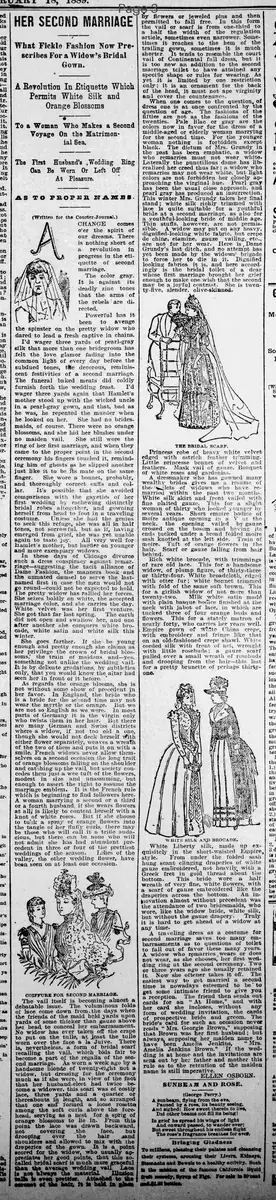
COIFFURE FOR SECOND MARRIAGE.
The vail itself is becoming almost a debatable issue. The voluminous folds of lace come down from the days when the friends of the maid held yards upon yards of some thicker than gauze above her head to conceal her embarrassment. No widow has ever taken off the crape to put on the tulle, at least the tulle worn over the face a la Juive. There is, nevertheless, a form of bridal scarf recalling the vail, which bids fair to become a part of the regalia of the second marriage. As worn a week ago by a handsome blonde of twenty-eight not a widow, but dressing for the ceremony much as if she were, in view of the fact that her husband-elect had twice become a widower, this scarf was of costly lace, three yards and a quarter or thereabouts in length, and so arranged that one end formed a loose rosette among the soft curls above the forehead, serving as a nest for a sprig of orange blossoms to lie in. From this point the lace was drawn backward, not covering the face, but drooping over the hair and shoulders and allowed to mix with the draperies of the gown. It is a point scored for the widow, who usually appreciates her good points, that this so-called bridal scarf is much more graceful than the average wedding vail. Lace is not always the material. Tulle is even prettier. Attached to the coronet of the hair, it is held in by flowers or jeweled pins and then permitted to fall free. In this form the vail or scarf is from one-third to a half the width of the regulation article. Sometimes even narrower. Sometimes it reaches to the hem of the trailing gown, sometimes it is much shorter. It tends to resemble the court vail of Continental full dress, but it is too new an addition to the second marriage toilet to have attained any specific shape or rules for wearing. As yet it is limited by one restriction only; it is an ornament for the back of the head, it must not ape virginity and cover the countenance.
When one comes to the question of dress one is at once confronted by the question of age. The fashions of the fifties are not as the fashions of the twenties. Pale lilac or gray are the colors now in favor for the dress of a middle-aged or elderly woman marrying for the second time. For the younger woman nothing is forbidden except black. The dictum of Mrs. Grundy in the past has been emphatic, a widow who remarries must not wear white. Latterly the punctilious dame has liberalized her creed thus far; a widow who remarries may not wear white, but light colors are not forbidden her closely approaching the virginal hue. Pearl gray has been the usual close approach, and pearl gray has produced an insurrection. This winter Mrs. Grundy takes her final stand: white silk richly trimmed with lace is quite suitable for a youthful bride at a second marriage, as also for a youthful-looking bride of middle age. Thin stuffs, however, are not permissible. A widow may put on any heavy, dignified-looking white fabric, but crepe de chine, etamine, gauze veiling, etc., are not for her wear. Here is Dame Grundy's last ditch, and no attempt has yet been made by the widows' brigade to force her to die in it. Dignified looking fabrics it is, and here accordingly is the bridal toilet of a dear whose first marriage brought her grief enough to make one wish that the second may be a joyful contrast. She is twenty-five, slender, olive-skinned. Princess robe of heavy white velvet edged with ostrich feather trimming. Little princesse bonnet of velvet and feathers. Mask vail of gauze. Bouquet of white roses and gardenias.
A dressmaker who has gowned many wealthy brides gives me a resume of the toilets of widows who have remarried within the past two months. White silk skirt and front veiled with fine plaited gauze. This for a slight woman of thirty who looked younger by several years. Short empire bodice of moire antique opening in a V at the neck, the opening veiled by gauze crossed on the bosom and having its ends tucked under a broad folded moire sash knotted at the left side. Train of moire. Tuft of orange flowers in the hair. Scarf of gauze falling from hair behind. Rich white brocade, with trimmings of rare old lace. This for a handsome widow, of plump figure, of thirty-three or thirty-four. White broadcloth, edged with otter fur; white bonnet trimmed with fold of the same soft brown. This for a girlish widow of not more than twenty-two. Milk white satin made with plain basque bodice finished at the neck with jabot of lace, in which are tucked three or four orange buds and flowers. This for a stately matron of nearly forty, who carries her years well. Empire gown of white China crepe, with embroidery and fringe like that on an old-fashioned crepe shawl. White corded silk with front of net, wrought with little rosebuds; a gauze scarf pulled over a small wreath of rosebuds and drooping from the hair—this last for a pretty brunette of perhaps thirty-one.
WHITE SILK AND BROCADE.
White Liberty silk, made up exquisitely in the short-waisted Empire style. From under the folded sash hung scant clinging draperies of white gauze embroidered, not heavily with a Greek fret in gold thread about the bottom. This bride wore a half wreath of very fine, white flowers, with a scarf of gauze embroidered like the draperies across the bottom. An innovation almost without precedent was the attendance of two bridesmaids, who wore, like the widow bride, white silk, but without the gauze drapery. Truly it is hard to get ahead of a widow at any time.
A traveling dress as a costume for second marriage saves too many embarrassments as to questions of toilet to fall out of favor these many years. A widow who remarries wears or does not wear, as she chooses, her first wedding ring at the second ceremony. Two or three years ago she usually retained it. Now she oftener takes it off. The easiest way to get married a second time is nowadays esteemed to be to get some intimate friend to give you a reception. The friend then sends out cards for an "At Home," and with her card she incloses, without any form of wedding invitation, the cards of prospective bride and groom. The bride's card for such an occasion never reads "Mrs. Georgie Brown," supposing that Brown was her first husband; but always, supposing her maiden name to have been Amelia Jenkins, "Mrs. Amelia Jenkins Brown." If the wedding is at home and the invitations are sent out by her father and mother this rule as to the retention of the maiden name is still imperative.
ELLEN OSBORN.
What Fickle Fashion Now Prescribes For a Widow's Bridal Gown.
A Revolution In Etiquette Which Permits White Silk and Orange Blossoms To a Woman Who Makes a Second Voyage On the Matrimonial Sea,
The First Husband's Wedding Ring Can Be Worn Or Left Off At Pleasure.
AS TO PROPER NAMES.
(Written for the Courier-Journal.)
CHANGE comes o'er the spirit of our dreams. There is nothing short of a revolution in progress in the etiquette of second marriage. The color gray. It is against its deadly zinc tones that the arms of the rebels' are directed. Powerful has it been to avenge the spinster on the pretty widow who dared to lead a fresh captive in chains. I'd wager three yards of pearl-gray silk that more than one bridegroom has felt the love glamor fading into the common light of every day before the subdued tones, the decorous, reminiscent festivities of a second marriage. The funeral baked meats did coldly furnish forth the wedding feast. I'd wager three yards again that Hamlet's mother stood up with the wicked uncle in a pearl-gray gown, and that, bad as he was, he repented the murder when he looked on her. She had no bridesmaids, of course. There were no orange blossoms, and she hid her blushes under no maiden vail. She still wore the ring of her first marriage, and when they came to the proper point in the second ceremony his fingers touched it, reminding him of ghosts as he slipped another just like it to be its mate on the same finger. She wore a bonnet, probably, and thoroughly correct cuffs and collar. It's possible that she avoided comparisons with the gayeties of her first wedding by eschewing distinctly bridal robes altogether, and gowning herself from head to foot in a traveling costume. Unless she had the genius to seek this refuge, she was all in half tones, not sorrowful, but as if, having emerged from grief, she was yet unable to again taste joy. All very well for Hamlet's mother, but harder on younger and more exemplary widows. In these days of Chicago divorce such a dress conspiracy against remarriage—suggesting the tacit alliance of Dame Fashion, the manners book and the un mated damsel to serve the last-named first in case the men would not go round—could not be expected to hold. The pretty widow has rallied her forces. She seizes boldly on white, the accepted marriage color, and she carries the day. White velvet was her first venture. She got that far last spring. The earth did not open and swallow her, and one after another she conquers white brocade, white satin and white silk this winter. She goes farther. If she be young enough and pretty enough she claims as her privilege the crown of bridal blossoms, the train of maidens and—yes, something not unlike the wedding vail. It is by delicate gradations, by subtleties only, that you would know the altar had seen her in front of it before. As regards the orange blooms, she is not without some show of precedent in her favor. In England, the bride who is a bride for the second time may not wear the myrtle or the orange. But we are not so English as we were. In most parts of Germany it is the virgin only who twists them in her hair. But there are many German and Swiss districts where a widow, if not too old a one, though she would not deck herself with either flower separately, weaves a wreath of the two of them and puts it on with a smile. French widows never allow themselves on a second occasion the long trail of orange blossoms falling on the shoulder and catching up the vail, but society concedes them just a wee tuft of the flowers, modest in size and unassuming, but enough to assert the right to assume the marriage emblem. It is the French rule which is beginning to find followers here. A woman marrying a second or a third or a fourth husband, if she wears flowers at all is likely to content herself with a knot of white roses. But if she choose to tuck a spray of orange flowers into the tangle of her fluffy curls, there may be those who will call it a trifle audacious, but there can be none who will not admit she has had abundant precedent in three or four of the prettiest weddings of the season. Lilies of the valley, the other wedding flower, have been seen on at least one occasion.
COIFFURE FOR SECOND MARRIAGE.
The vail itself is becoming almost a debatable issue. The voluminous folds of lace come down from the days when the friends of the maid held yards upon yards of some thicker than gauze above her head to conceal her embarrassment. No widow has ever taken off the crape to put on the tulle, at least the tulle worn over the face a la Juive. There is, nevertheless, a form of bridal scarf recalling the vail, which bids fair to become a part of the regalia of the second marriage. As worn a week ago by a handsome blonde of twenty-eight not a widow, but dressing for the ceremony much as if she were, in view of the fact that her husband-elect had twice become a widower, this scarf was of costly lace, three yards and a quarter or thereabouts in length, and so arranged that one end formed a loose rosette among the soft curls above the forehead, serving as a nest for a sprig of orange blossoms to lie in. From this point the lace was drawn backward, not covering the face, but drooping over the hair and shoulders and allowed to mix with the draperies of the gown. It is a point scored for the widow, who usually appreciates her good points, that this so-called bridal scarf is much more graceful than the average wedding vail. Lace is not always the material. Tulle is even prettier. Attached to the coronet of the hair, it is held in by flowers or jeweled pins and then permitted to fall free. In this form the vail or scarf is from one-third to a half the width of the regulation article. Sometimes even narrower. Sometimes it reaches to the hem of the trailing gown, sometimes it is much shorter. It tends to resemble the court vail of Continental full dress, but it is too new an addition to the second marriage toilet to have attained any specific shape or rules for wearing. As yet it is limited by one restriction only; it is an ornament for the back of the head, it must not ape virginity and cover the countenance.
When one comes to the question of dress one is at once confronted by the question of age. The fashions of the fifties are not as the fashions of the twenties. Pale lilac or gray are the colors now in favor for the dress of a middle-aged or elderly woman marrying for the second time. For the younger woman nothing is forbidden except black. The dictum of Mrs. Grundy in the past has been emphatic, a widow who remarries must not wear white. Latterly the punctilious dame has liberalized her creed thus far; a widow who remarries may not wear white, but light colors are not forbidden her closely approaching the virginal hue. Pearl gray has been the usual close approach, and pearl gray has produced an insurrection. This winter Mrs. Grundy takes her final stand: white silk richly trimmed with lace is quite suitable for a youthful bride at a second marriage, as also for a youthful-looking bride of middle age. Thin stuffs, however, are not permissible. A widow may put on any heavy, dignified-looking white fabric, but crepe de chine, etamine, gauze veiling, etc., are not for her wear. Here is Dame Grundy's last ditch, and no attempt has yet been made by the widows' brigade to force her to die in it. Dignified looking fabrics it is, and here accordingly is the bridal toilet of a dear whose first marriage brought her grief enough to make one wish that the second may be a joyful contrast. She is twenty-five, slender, olive-skinned. Princess robe of heavy white velvet edged with ostrich feather trimming. Little princesse bonnet of velvet and feathers. Mask vail of gauze. Bouquet of white roses and gardenias.
A dressmaker who has gowned many wealthy brides gives me a resume of the toilets of widows who have remarried within the past two months. White silk skirt and front veiled with fine plaited gauze. This for a slight woman of thirty who looked younger by several years. Short empire bodice of moire antique opening in a V at the neck, the opening veiled by gauze crossed on the bosom and having its ends tucked under a broad folded moire sash knotted at the left side. Train of moire. Tuft of orange flowers in the hair. Scarf of gauze falling from hair behind. Rich white brocade, with trimmings of rare old lace. This for a handsome widow, of plump figure, of thirty-three or thirty-four. White broadcloth, edged with otter fur; white bonnet trimmed with fold of the same soft brown. This for a girlish widow of not more than twenty-two. Milk white satin made with plain basque bodice finished at the neck with jabot of lace, in which are tucked three or four orange buds and flowers. This for a stately matron of nearly forty, who carries her years well. Empire gown of white China crepe, with embroidery and fringe like that on an old-fashioned crepe shawl. White corded silk with front of net, wrought with little rosebuds; a gauze scarf pulled over a small wreath of rosebuds and drooping from the hair—this last for a pretty brunette of perhaps thirty-one.
WHITE SILK AND BROCADE.
White Liberty silk, made up exquisitely in the short-waisted Empire style. From under the folded sash hung scant clinging draperies of white gauze embroidered, not heavily with a Greek fret in gold thread about the bottom. This bride wore a half wreath of very fine, white flowers, with a scarf of gauze embroidered like the draperies across the bottom. An innovation almost without precedent was the attendance of two bridesmaids, who wore, like the widow bride, white silk, but without the gauze drapery. Truly it is hard to get ahead of a widow at any time.
A traveling dress as a costume for second marriage saves too many embarrassments as to questions of toilet to fall out of favor these many years. A widow who remarries wears or does not wear, as she chooses, her first wedding ring at the second ceremony. Two or three years ago she usually retained it. Now she oftener takes it off. The easiest way to get married a second time is nowadays esteemed to be to get some intimate friend to give you a reception. The friend then sends out cards for an "At Home," and with her card she incloses, without any form of wedding invitation, the cards of prospective bride and groom. The bride's card for such an occasion never reads "Mrs. Georgie Brown," supposing that Brown was her first husband; but always, supposing her maiden name to have been Amelia Jenkins, "Mrs. Amelia Jenkins Brown." If the wedding is at home and the invitations are sent out by her father and mother this rule as to the retention of the maiden name is still imperative.
ELLEN OSBORN.
What sub-type of article is it?
Curiosity
What themes does it cover?
Social Manners
What keywords are associated?
Second Marriage
Widow Etiquette
Bridal Gown
Orange Blossoms
Fashion Revolution
Story Details
Story Details
Article discusses the revolution in etiquette for second marriages, allowing widows to wear white silk, orange blossoms, and bridal veils, moving away from gray tones; includes examples of gowns and customs from various countries and recent weddings.