Thank you for visiting SNEWPapers!
Sign up free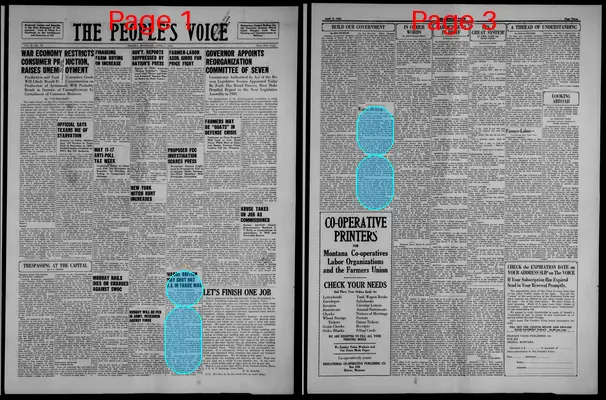
The People's Voice
Helena, Lewis And Clark County, Montana
What is this article about?
Review of Carleton Beals' 'Pan America' warns that Britain's totalitarian economic shift challenges U.S. trade dominance in Latin America amid global rivalries for raw materials like rubber and oil, urging U.S. to adapt or lose out.
Merged-components note: Continuation of Scott Nearing's article on British trade policies; relabeled from 'review' to 'foreign_news' as it fits international reports.
Clippings
1 of 2
OCR Quality
Full Text
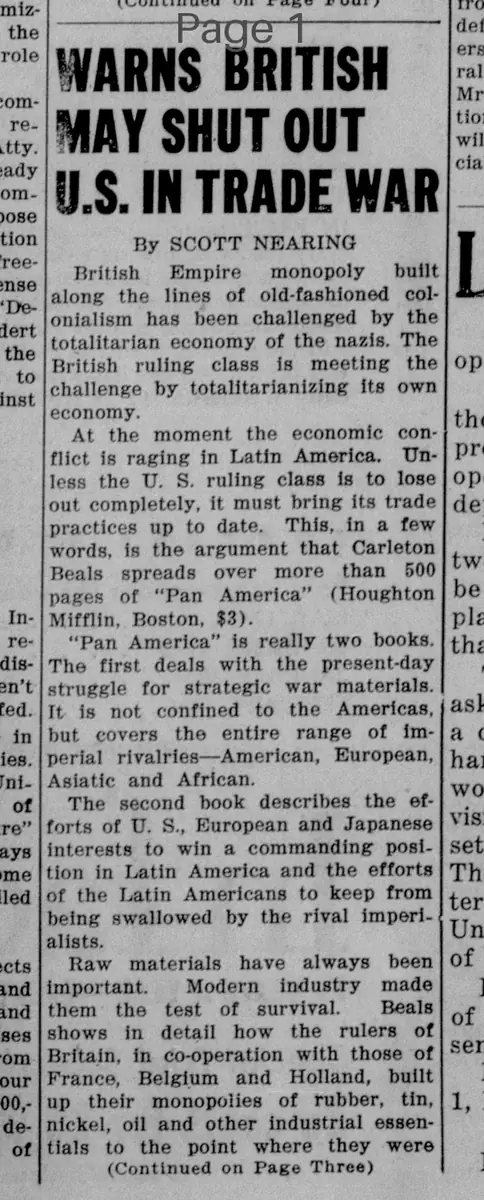
By SCOTT NEARING
British Empire monopoly built along the lines of old-fashioned colonialism has been challenged by the totalitarian economy of the nazis. The British ruling class is meeting the challenge by totalitarianizing its own economy.
At the moment the economic conflict is raging in Latin America. Unless the U. S. ruling class is to lose out completely, it must bring its trade practices up to date. This, in a few words, is the argument that Carleton Beals spreads over more than 500 pages of "Pan America" (Houghton Mifflin, Boston, $3).
"Pan America" is really two books. The first deals with the present-day struggle for strategic war materials. It is not confined to the Americas, but covers the entire range of imperial rivalries--American, European, Asiatic and African.
The second book describes the efforts of U. S., European and Japanese interests to win a commanding position in Latin America and the efforts of the Latin Americans to keep from being swallowed by the rival imperialists.
Raw materials have always been important. Modern industry made them the test of survival. Beals shows in detail how the rulers of Britain, in co-operation with those of France, Belgium and Holland, built up their monopolies of rubber, tin, nickel, oil and other industrial essentials to the point where they were able to collect monopoly profit from the entire western world.
The British stranglehold was both economic and political. Weak nations and peoples were pawns in the game of empire-building. The American ruling class, in its present co-operation with Great Britain, will have the shirt stripped from its back unless it knows what it is about, Beals warns.
He sees the process already operating in several ways. The British have sold the U. S. gold (which is useless) in exchange for oil and planes (which are useful). The British are boycotting U. S. cotton and tobacco, buying instead from Brazil, Egypt and Turkey.
By buying their cotton and other supplies from Latin American countries they provide themselves with markets for their manufactured goods which are excluded from the U. S. by prohibitive tariffs. Like the Axis powers, the British are now bartering for their supplies and using trade methods that make U. S. competition on the old door formula all but impossible.
The author of "Pan America" has collected a vast amount of information. So much, indeed, that he often gets lost in the masses. The book is well worth careful study by anyone interested in world economics or politics. But the reader cannot follow the author to any noteworthy conclusions, because there are none.
"Pan America" does not provide any working formula for the western hemisphere. The author hopes for peace and reciprocal relations among free peoples, but he offers no plan for bringing about such a result.
What sub-type of article is it?
What keywords are associated?
What entities or persons were involved?
Where did it happen?
Foreign News Details
Primary Location
Latin America
Key Persons
Outcome
british monopolies on raw materials like rubber, tin, nickel, oil; british boycotting u.s. cotton and tobacco, buying from brazil, egypt, turkey; bartering for supplies excluding u.s. competition
Event Details
British Empire's colonial monopoly challenged by Nazi totalitarian economy, leading Britain to totalitarize its economy. Economic conflict rages in Latin America. U.S. must update trade practices to avoid loss. 'Pan America' by Carleton Beals details struggles for strategic war materials globally and efforts by U.S., European, Japanese interests to dominate Latin America, countered by Latin Americans. British and allies built monopolies on essentials, collecting profits worldwide. British stranglehold economic and political. U.S. cooperating with Britain risks loss unless cautious. British sold U.S. gold for oil and planes, boycotted U.S. cotton and tobacco. British buy from Latin America to create markets for their goods excluded from U.S. by tariffs. Like Axis, British barter supplies, making U.S. competition difficult. Book collects vast information on world economics and politics but offers no conclusions or plan for peace and reciprocal relations.