Thank you for visiting SNEWPapers!
Sign up free
Editorial
May 19, 1801
The New Hampshire Gazette
Portsmouth, Rockingham County, New Hampshire
What is this article about?
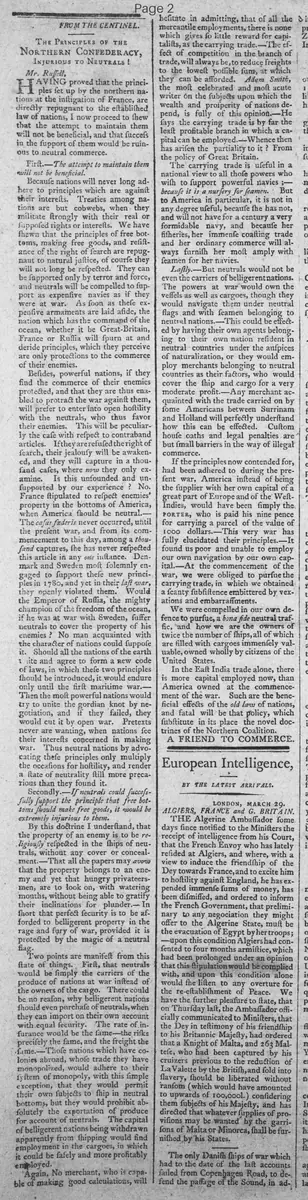
An editorial critiquing the principles of the Northern Confederacy, arguing they violate established international law and would harm neutral commerce by forcing neutrals into costly defenses, reducing profits in carrying trade, and inviting belligerent hostility. Signed 'A FRIEND TO COMMERCE.'
Clipping
OCR Quality
95%
Excellent
Full Text
FROM THE CENTINEL.
The Principles of the Northern Confederacy.
Injurious To Neutrals!
Mr. Russell,
Having proved that the principles set up by the northern nations at the instigation of France, are directly repugnant to the established law of nations, I now proceed to show that the attempt to maintain them will not be beneficial, and that success in the support of them would be ruinous to neutral commerce.
First.--The attempt to maintain them will not be beneficial.
Because nations will never long adhere to principles which are against their interests. Treaties among nations are but cobwebs, when they militate strongly with their real or supposed rights or interests. We have shown that the principles of free bottoms, making free goods, and resistance of the right of search are repugnant to natural justice, of course they will not long be respected. They can be supported only by terror and force, and neutrals will be compelled to support as expensive navies as if they were at war. As soon as these expensive armaments are laid aside, the nation which has the command of the ocean, whether it be Great-Britain, France or Russia will spurn at and deride principles, which they perceive are only protections to the commerce of their enemies.
Besides, powerful nations, if they find the commerce of their enemies protected, and that they are thus enabled to protract the war against them, will prefer to enter into open hostility with the neutrals, who thus favor their enemies. This will be peculiarly the case with respect to contraband articles. If they are refused the right of search, their jealousy will be awakened, and they will capture in a thousand cases, where now they only examine. Is this unfounded and unsupported by our experience? No.
France stipulated to respect enemies' property in the bottoms of America, when America should be neutral.-- The casus foederis never occurred, until the present war, and from its commencement to this day, among a thousand captures, she has never respected this article in any one instance. Denmark and Sweden most solemnly engaged to support these new principles in 1780, and yet in their last war, they openly violated them. Would the Emperor of Russia, the mighty champion of the freedom of the ocean, if he was at war with Sweden, suffer neutrals to cover the property of his enemies? No man acquainted with the character of nations could suppose it. Should all the nations of the earth unite and agree to form a new code of laws, in which these two principles should be introduced, it would endure only until the first maritime war.-- Then the most powerful nations would try to unite the Gordian knot by negotiation, and if they failed, they would cut it by open war. Pretexts never are wanting, when nations see their interests concerned in making war. Thus neutral nations by advocating these principles only multiply the occasions for hostility, and render a state of neutrality still more precarious than they found it.
Secondly.--If neutrals could successfully support the principle that free bottoms should make free goods, it would be extremely injurious to them.
By this doctrine I understand, that the property of an enemy is to be religiously respected in the ships of neutrals, without any cover or concealment. That all the papers may avow that the property belongs to an enemy and yet that hungry privateersmen, are to look on, with watering mouths, without being able to gratify their inclinations for plunder,-- In short that perfect security is to be afforded to belligerent property in the rage and fury of war, provided it is protected by the magic of a neutral flag.
Two points are manifest from this state of things. First, that neutrals would be simply the carriers of the produce of nations at war instead of the owners of the cargo. There could be no reason, why belligerent nations should even purchase of neutrals, when they can import on their own account with equal security. The rate of insurance would be the same--the risks precisely the same, and the freight the same.--Those nations which have colonies abroad, whose trade they have monopolized, would adhere to their system of monopoly, with this simple exception, that they would permit their own subjects to ship in neutral bottoms, but they would prohibit absolutely the exportation of produce for account of neutrals. The capital of belligerent nations being withdrawn apparently from shipping would find employment in the cargoes, in which it could be safely and more profitably employed.
Again, No merchant, who is capable of making good calculations, will hesitate in admitting, that of all the mercantile employments, there is none which gives so little reward for capitalists, as the carrying trade.--The effect of competition in the branch of trade, will always be, to reduce freights to the lowest possible sum, at which they can be afforded. Adam Smith, the most celebrated and most acute writer on the subjects upon which the wealth and prosperity of nations depend, is fully of this opinion.--He says the carrying trade is by far the least profitable branch in which a capital can be employed.--Whence then has arisen the partiality to it? From the policy of Great Britain.
The carrying trade is useful in a national view to all those powers who wish to support powerful navies ;-- because it is a nursery for seamen. But to America in particular, it is not in any degree useful, because she has not, and will not have for a century a very formidable navy, and because her fisheries, her immense coasting trade and her ordinary commerce will always furnish her most amply with seamen for her navies.
Lastly. But neutrals would not be even the carriers of belligerent nations. The powers at war would own the vessels as well as cargoes, though they would navigate them under neutral flags and with seamen belonging to neutral nations.--This could be effected by having their own agents belonging to their own nation resident in neutral countries under the auspices of naturalization, or they would employ merchants belonging to neutral countries as their factors, who would cover the ship and cargo for a very moderate profit.--Any merchant acquainted with the trade carried on by some Americans between Surinam and Holland will perfectly understand how this can be effected. Custom house oaths and legal penalties are but small barriers in the way of illegal commerce.
If the principles now contended for, had been adhered to during the present war, America instead of being the supplier with her own capital of a great part of Europe and of the West-Indies, would have been simply the PORTER, who is paid his nine pence for carrying a parcel of the value of 1000 dollars.—This very war has fully elucidated their principles.--It found us poor and unable to employ our own navigation by our own capital.--At the commencement of the war, we were obliged to pursue the carrying trade, in which we obtained a scanty subsistence embittered by vexations and embarrassments. We were compelled in our own defence to pursue, a bona fide neutral traffic, and now we are the owners of twice the number of ships, all of which are filled with cargoes immensely valuable, owned wholly by citizens of the United States.
In the East India trade alone, there is more capital employed now, than America owned at the commencement of the war. Such are the beneficial effects of the old law of nations, and fatal will be that policy, which substitute in its place the novel doctrines of the Northern Coalition.
A FRIEND TO COMMERCE.
The Principles of the Northern Confederacy.
Injurious To Neutrals!
Mr. Russell,
Having proved that the principles set up by the northern nations at the instigation of France, are directly repugnant to the established law of nations, I now proceed to show that the attempt to maintain them will not be beneficial, and that success in the support of them would be ruinous to neutral commerce.
First.--The attempt to maintain them will not be beneficial.
Because nations will never long adhere to principles which are against their interests. Treaties among nations are but cobwebs, when they militate strongly with their real or supposed rights or interests. We have shown that the principles of free bottoms, making free goods, and resistance of the right of search are repugnant to natural justice, of course they will not long be respected. They can be supported only by terror and force, and neutrals will be compelled to support as expensive navies as if they were at war. As soon as these expensive armaments are laid aside, the nation which has the command of the ocean, whether it be Great-Britain, France or Russia will spurn at and deride principles, which they perceive are only protections to the commerce of their enemies.
Besides, powerful nations, if they find the commerce of their enemies protected, and that they are thus enabled to protract the war against them, will prefer to enter into open hostility with the neutrals, who thus favor their enemies. This will be peculiarly the case with respect to contraband articles. If they are refused the right of search, their jealousy will be awakened, and they will capture in a thousand cases, where now they only examine. Is this unfounded and unsupported by our experience? No.
France stipulated to respect enemies' property in the bottoms of America, when America should be neutral.-- The casus foederis never occurred, until the present war, and from its commencement to this day, among a thousand captures, she has never respected this article in any one instance. Denmark and Sweden most solemnly engaged to support these new principles in 1780, and yet in their last war, they openly violated them. Would the Emperor of Russia, the mighty champion of the freedom of the ocean, if he was at war with Sweden, suffer neutrals to cover the property of his enemies? No man acquainted with the character of nations could suppose it. Should all the nations of the earth unite and agree to form a new code of laws, in which these two principles should be introduced, it would endure only until the first maritime war.-- Then the most powerful nations would try to unite the Gordian knot by negotiation, and if they failed, they would cut it by open war. Pretexts never are wanting, when nations see their interests concerned in making war. Thus neutral nations by advocating these principles only multiply the occasions for hostility, and render a state of neutrality still more precarious than they found it.
Secondly.--If neutrals could successfully support the principle that free bottoms should make free goods, it would be extremely injurious to them.
By this doctrine I understand, that the property of an enemy is to be religiously respected in the ships of neutrals, without any cover or concealment. That all the papers may avow that the property belongs to an enemy and yet that hungry privateersmen, are to look on, with watering mouths, without being able to gratify their inclinations for plunder,-- In short that perfect security is to be afforded to belligerent property in the rage and fury of war, provided it is protected by the magic of a neutral flag.
Two points are manifest from this state of things. First, that neutrals would be simply the carriers of the produce of nations at war instead of the owners of the cargo. There could be no reason, why belligerent nations should even purchase of neutrals, when they can import on their own account with equal security. The rate of insurance would be the same--the risks precisely the same, and the freight the same.--Those nations which have colonies abroad, whose trade they have monopolized, would adhere to their system of monopoly, with this simple exception, that they would permit their own subjects to ship in neutral bottoms, but they would prohibit absolutely the exportation of produce for account of neutrals. The capital of belligerent nations being withdrawn apparently from shipping would find employment in the cargoes, in which it could be safely and more profitably employed.
Again, No merchant, who is capable of making good calculations, will hesitate in admitting, that of all the mercantile employments, there is none which gives so little reward for capitalists, as the carrying trade.--The effect of competition in the branch of trade, will always be, to reduce freights to the lowest possible sum, at which they can be afforded. Adam Smith, the most celebrated and most acute writer on the subjects upon which the wealth and prosperity of nations depend, is fully of this opinion.--He says the carrying trade is by far the least profitable branch in which a capital can be employed.--Whence then has arisen the partiality to it? From the policy of Great Britain.
The carrying trade is useful in a national view to all those powers who wish to support powerful navies ;-- because it is a nursery for seamen. But to America in particular, it is not in any degree useful, because she has not, and will not have for a century a very formidable navy, and because her fisheries, her immense coasting trade and her ordinary commerce will always furnish her most amply with seamen for her navies.
Lastly. But neutrals would not be even the carriers of belligerent nations. The powers at war would own the vessels as well as cargoes, though they would navigate them under neutral flags and with seamen belonging to neutral nations.--This could be effected by having their own agents belonging to their own nation resident in neutral countries under the auspices of naturalization, or they would employ merchants belonging to neutral countries as their factors, who would cover the ship and cargo for a very moderate profit.--Any merchant acquainted with the trade carried on by some Americans between Surinam and Holland will perfectly understand how this can be effected. Custom house oaths and legal penalties are but small barriers in the way of illegal commerce.
If the principles now contended for, had been adhered to during the present war, America instead of being the supplier with her own capital of a great part of Europe and of the West-Indies, would have been simply the PORTER, who is paid his nine pence for carrying a parcel of the value of 1000 dollars.—This very war has fully elucidated their principles.--It found us poor and unable to employ our own navigation by our own capital.--At the commencement of the war, we were obliged to pursue the carrying trade, in which we obtained a scanty subsistence embittered by vexations and embarrassments. We were compelled in our own defence to pursue, a bona fide neutral traffic, and now we are the owners of twice the number of ships, all of which are filled with cargoes immensely valuable, owned wholly by citizens of the United States.
In the East India trade alone, there is more capital employed now, than America owned at the commencement of the war. Such are the beneficial effects of the old law of nations, and fatal will be that policy, which substitute in its place the novel doctrines of the Northern Coalition.
A FRIEND TO COMMERCE.
What sub-type of article is it?
Foreign Affairs
Trade Or Commerce
War Or Peace
What keywords are associated?
Northern Confederacy
Neutral Rights
Free Bottoms
Right Of Search
Carrying Trade
Law Of Nations
Commerce
Neutrality
What entities or persons were involved?
Northern Confederacy
France
Great Britain
Russia
Denmark
Sweden
America
Adam Smith
Editorial Details
Primary Topic
Principles Of The Northern Confederacy Injurious To Neutral Commerce
Stance / Tone
Strongly Opposed To Northern Confederacy Principles Favoring Traditional Law Of Nations
Key Figures
Northern Confederacy
France
Great Britain
Russia
Denmark
Sweden
America
Adam Smith
Key Arguments
Nations Won't Adhere To Principles Against Their Interests, Leading To Costly Navies For Neutrals.
Belligerents Will Attack Neutrals Protecting Enemy Commerce, Especially Contraband.
Historical Examples: France, Denmark, Sweden Violated Similar Treaties.
Free Bottoms Make Free Goods Would Reduce Neutrals To Mere Carriers With Low Profits.
Carrying Trade Is Least Profitable Per Adam Smith, Unbeneficial For America Without Strong Navy Needs.
Belligerents Would Covertly Own Ships Under Neutral Flags, Bypassing Principles.
Current War Shows Benefits Of Old Laws: America Prospered As Owner, Not Carrier.