Thank you for visiting SNEWPapers!
Sign up free
The Nome Nugget
Nome, Nome County, Alaska
What is this article about?
At the Geneva Preparatory Disarmament Conference in November 1920s, nations debated limitation methods for land armaments. The US opposed budgetary restrictions, favoring direct limits, while others supported budgets. On Nov. 15, the conference adopted the budgetary principle, backed by most nations except the US and abstainers.
Clipping
OCR Quality
Full Text
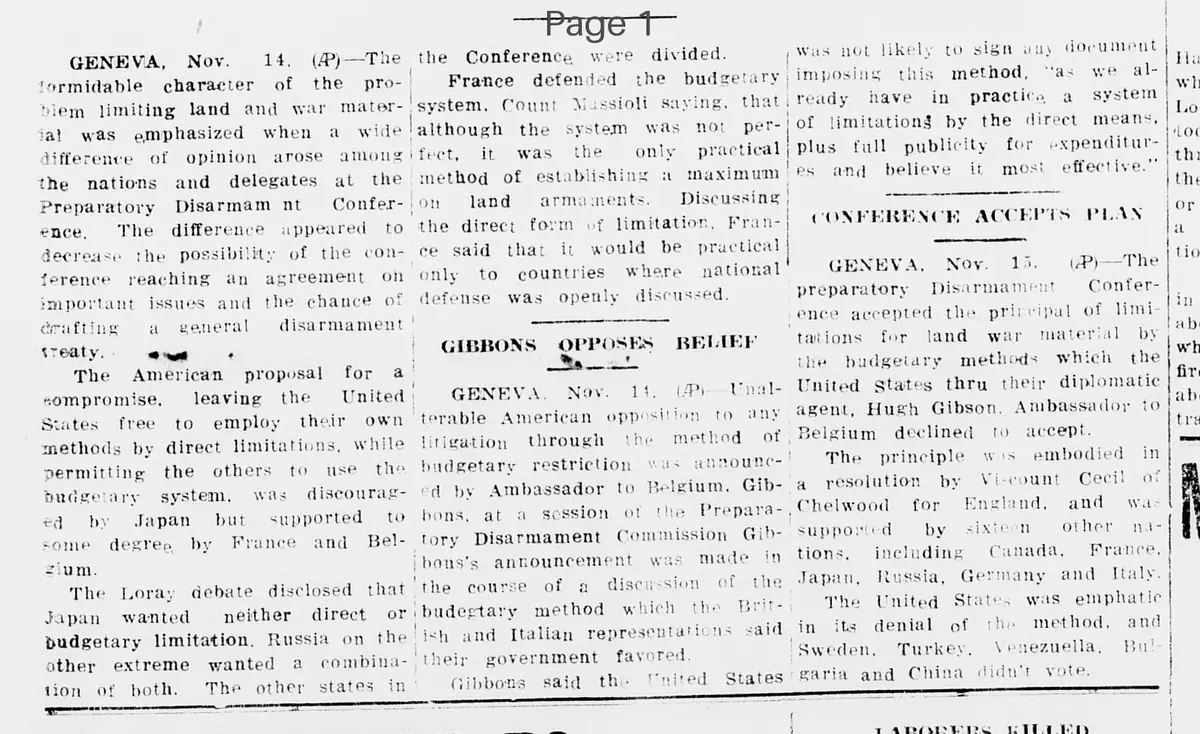
The difference appeared to decrease the possibility of the conference reaching an agreement on important issues and the chance of drafting a general disarmament treaty.
The American proposal for a compromise, leaving the United States free to employ their own methods by direct limitations, while permitting the others to use the budgetary system, was discouraged by Japan but supported to some degree by France and Belgium.
The Loray debate disclosed that Japan wanted neither direct or budgetary limitation. Russia on the other extreme wanted a combination of both.
The other states in the Conference were divided. France defended the budgetary system, Count Missioli saying that although the system was not perfect, it was the only practical method of establishing a maximum on land armaments.
Discussing the direct form of limitation, France said that it would be practical only to countries where national defense was openly discussed.
GENEVA. Nov. 14. (AP)—Unalterable American opposition to any litigation through the method of budgetary restriction was announced by Ambassador to Belgium, Gibbons, at a session of the Preparatory Disarmament Commission. Gibbons's announcement was made in the course of a discussion of the budgetary method which the British and Italian representations said their government favored.
Gibbons said the United States was not likely to sign any document imposing this method, "as we already have in practice a system of limitations by the direct means, plus full publicity for expenditures and believe it most effective."
CONFERENCE ACCEPTS PLAN
GENEVA. NOV. 15. (AP)
The preparatory Disarmament Conference accepted the principal of limitations for land war material by the budgetary methods which the United States thru their diplomatic agent, Hugh Gibson, Ambassador to Belgium declined to accept.
The principle was embodied in a resolution by Viscount Cecil of Chelwood for England, and was supported by sixteen other nations, including Canada, France, Japan, Russia, Germany and Italy.
The United States was emphatic in its denial of the method, and Sweden, Turkey, Venezuela, Bulgaria and China didn't vote.
What sub-type of article is it?
What keywords are associated?
What entities or persons were involved?
Where did it happen?
Foreign News Details
Primary Location
Geneva
Event Date
Nov. 14 15
Key Persons
Outcome
conference accepted budgetary limitation principle for land war material, supported by 17 nations including canada, france, japan, russia, germany, italy; us opposed and did not accept; sweden, turkey, venezuela, bulgaria, china abstained.
Event Details
Nations at the Preparatory Disarmament Conference debated methods to limit land and war materials, with differences between direct limitations (favored by US) and budgetary systems (supported by France, Britain, Italy). US proposed compromise but Japan opposed; Russia wanted combination. France argued budgetary method was practical. US Ambassador Gibbons announced firm opposition to budgetary restrictions. On Nov. 15, resolution by Viscount Cecil adopted budgetary principle despite US refusal.