Thank you for visiting SNEWPapers!
Sign up free
Editorial
July 27, 1852
The Daily Union
Washington, District Of Columbia
What is this article about?
The editorial critiques the Whig Party's nomination of General Scott, highlighting Daniel Webster's opposition due to its betrayal of sectional peace principles from the Compromise of 1850. It quotes the Boston Courier, noting Webster's refusal to support Scott and the party's ingratitude toward him, amid southern Whig disaffection.
Clipping
OCR Quality
95%
Excellent
Full Text
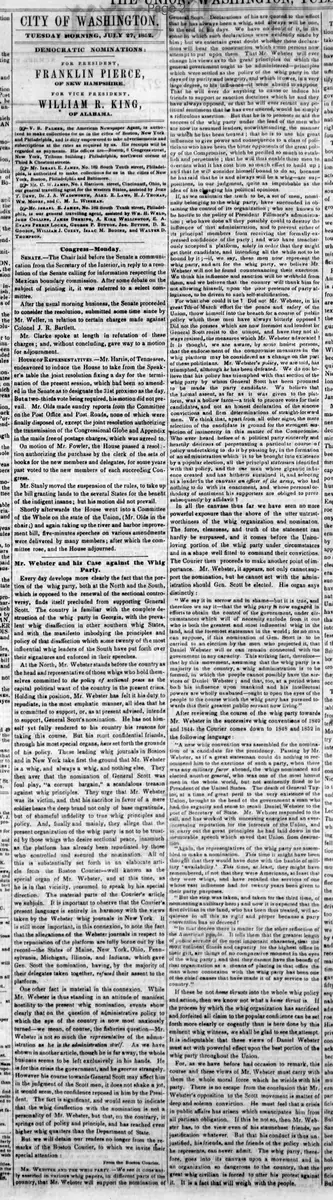
Mr. Webster and his Case against the Whig Party.
Every day develops more clearly the fact that the portion of the whig party, both at the North and the South, which is opposed to the renewal of the sectional controversy, finds itself precluded from supporting General Scott. The country is familiar with the complete destruction of the whig party in Georgia, with the prevalent whig disaffection in other southern whig States, and with the manifesto embodying the principles and policy of that disaffection which some twenty of the most influential whig leaders of the South have put forth over their signatures and enforced in their speeches.
At the North. Mr. Webster stands before the country as the head and representative of those whigs who hold themselves committed to the policy of sectional peace as the capital political want of the country in the present crisis.
Holding this position, Mr. Webster has felt it his duty to repudiate, in the most emphatic manner, all idea that he is committed to support, or, as at present advised, intends to support, General Scott's nomination. He has not himself yet fully rendered to his country his reasons for taking this course. But his most confidential friends, through his most special organs, have set forth the grounds of his policy. These leading whig journals in Boston and in New York take first the ground that Mr. Webster is a whig, and always a whig, and nothing else. They then aver that the nomination of General Scott was foul play, 'a corrupt bargain,' a scandalous treason against whig principles. They urge that Mr. Webster was its victim, and that his sacrifice in favor of a mere soldier bears the deep brand not only of base ingratitude, but of shameful infidelity to true whig principles and policy. And, finally and mainly, they allege that the present organization of the whig party is not to be trusted by those whigs who desire sectional peace, inasmuch as the platform has already been repudiated by those who controlled and secured the nomination. All of this is substantially set forth in an elaborate article from the Boston Courier-well known as the special organ of Mr. Webster, and at this time, as he is in that vicinity, presumed to speak by his special direction. The material parts of the Courier's article we subjoin. It is important to observe that the Courier's present language is entirely in harmony with the views taken by the Webster whig journals in New York. It is still more important, in this connexion, to note the fact that the allegations of the Webster journals in respect to the repudiation of the platform are fully borne out by the record-the States of Maine, New York, Ohio, Pennsylvania, Michigan, Illinois, and Indiana, which gave Gen. Scott the nomination, having, by the majority of their delegates taken together, refused their assent to the platform.
One other fact is material in this connexion. While Mr. Webster is thus standing in an attitude of manifest hostility to the present whig nomination, events show clearly that on the question of administrative policy to which the eye of the country is now most anxiously turned-we mean, of course, the fisheries question—Mr. Webster is not so much the representative of the administration as he is the administration itself. As we have shown in another article, though he is far away, the whole business seems to be left exclusively in his hands. He is for this crisis the government, and he governs strangely.
However his course towards General Scott may affect him in the judgment of the Scott men, it does not shake a jot, it would seem, the confidence reposed in him by the President. The fact is significant, and would seem to indicate that the whig disaffection with the nomination is not a personality of Mr. Webster, but that, on the contrary, it springs out of policy and principle, and has reached even higher whig quarters than the Department of State.
But we will detain our readers no longer from the remarks of the Boston Courier, to which we invite their special attention :
From the Boston Courier.
Mr. WEBSTER AND THE WHIG PARTY. -We see it constantly asserted in various whig papers, in different parts of the country, that Mr. Webster will support the nomination of General Scott. Declarations of his are quoted to the effect that he has always been a whig, and always will be one, to the end of his days. We have no doubt of it, in the sense in which such declarations were evidently made by him; but we entertain great doubt whether those declarations will bear the construction which some persons now attempt to put upon them. That Mr. Webster will ever change his views as to the great principles on which the general government ought to be administered-principles which were settled as the policy of the whig party in the days of its purity and integrity, and which it owes, in a very large degree, to his influence-it were absurd to suppose That he will ever do anything to cause or induce his friends to support or sanction doctrines which he and they have always opposed, or that he will ever retract any political sentiment that he has ever uttered, would be simply a ridiculous assertion. But that he is to promote or aid the success of the whig party under the lead of the men who are now its assumed leaders, notwithstanding the manner in which he has been treated ; that he is to use his great influence to give power and consequence to a class of politicians who have been the bitter opponents of the great policy of the Compromise, which he perilled so much to establish and perpetuate ; that he will thus enable these men to overturn what it has cost him so much effort to build up; and that he will consider himself bound to do so, because he has said that he is and always will be a whig-are suppositions, in our judgment, quite as improbable as the idea of his changing his political opinions.
If, as we maintain the truth to be, a set of men, nominally belonging to the whig party, have succeeded in obtaining the control of its organization ; who are known to be hostile to the policy of President Fillmore's administration; who have done all they possibly could to destroy the influence of that administration, and to prevent either of its principal members from receiving the formally-expressed confidence of the party; and who have treacherously accepted a platform, solely in order that they might get their candidate, and intending all the while not to be bound by it ;-if, we say, these men now represent the whig party, and act for the whig party, we believe Mr. Webster will not be found countenancing their exertions.
We think his influence and sanction will be withheld from them, and we believe that the country will thank him for not allowing himself, upon the poor pretence of party allegiance, to be driven to such self-stultification.
For what else could it be ? Did not Mr. Webster, in his great 7th-of March effort for the peace and safety of the Union. throw himself into the breach for a course of public policy which these men have always bitterly opposed?
Did not the presses which are now foremost and loudest for General Scott resist to the utmost, and have they not always resisted, the measures which Mr. Webster advocated ?
It is thought, we are aware, by some honest persons, that the endorsement of the compromise measures in the whig platform may be considered as a change on the part of these politicians. Mr. Webster's policy, we are told, has triumphed, although he has been defeated. We do not believe that his policy has triumphed with that section of the whig party by whom General Scott has been procured to be made the party candidate. We believe that the formal assent, as far as it was given to the platform, was a hollow farce-a trick to procure votes for their candidates, and not an honest declaration of the sincere convictions and firm determinations of straight-forward men. We think that, apart from all other signs, the mere selection of the candidate is ground for the strongest suspicion of insincerity in this matter of the Compromise.
Who ever heard before of a political party sincerely and heartily desirous of perpetuating a particular course of policy undertaking to do it by passing by, in the formation of an administration which is to be brought into existence by a popular election, all the principal statesmen identified with that policy, and the one man whose gigantic influence created and has hitherto sustained it, and selecting as a leader in the canvass an officer of the army, who had nothing to do with its enactment, and whose personal orthodoxy of sentiment his supporters are obliged to prove subsequently by affidavit?
In all the canvass thus far we have seen no more powerful exposure than the above of the utter untrustworthiness of the whig organization and nomination The force, clearness, and truth of the statement can hardly be surpassed, and it comes before the Union-loving portion of the whig party under circumstances and in a shape well fitted to command their convictions.
The Courier then proceeds to make another point of importance. Mr. Webster, it appears, not only cannot support the nomination, but he cannot act with the administration should Gen. Scott be elected. His organ says distinctly:
' We say it in sorrow and in shame-but it is true, and therefore we say it-that the whig party is now engaged in efforts to obtain the control of the government, under circumstances which will of necessity exclude from it one who is both the greatest and most influential whig in the land, and the foremost statesman in the world; for no man can suppose, if this nomination of Gen. Scott is to be carried to an election by the men who projected it, that Daniel Webster will or can remain connected with the government in any capacity. This striking fact, therefore-that by this movement, assuming that the whig party is a majority in the country, a whig administration is to be formed, in which the people cannot possibly have the services of Daniel Webster ; and that, too, at a period when both his influence upon mankind and his intellectual powers are wholly unabated-ought to open the eyes of the people to the course which the whig party has pursued towards this their greatest public servant now living.'
After reviewing the course of the whig party towards Mr. Webster in the successive whig conventions of 1840 and 1844, the Courier comes down to 1848 and 1852 in the following language:
'A new whig convention was assembled for the nomination of a candidate for the presidency. Passing by Mr. Webster, as if a great statesman could do nothing to recommend him to the exertions of such a party, when there was any military furor abroad, the whigs nominated and elected another general, who was one of the most honest men in the whole world, but not eminently fitted to be President of the United States. The death of General Taylor, at a time of great peril to the very existence of the Union, brought to the head of the government a man who had the sagacity and sense to recall Daniel Webster to the post of Secretary of State. Mr. Webster responded to the call, and has worked with unceasing energies and an ever-increasing reputation for the interests of the Union, and to carry out the great principles he had laid down in the memorable speech which saved that Union from destruction
'Again, the representatives of the whig party are assembled to make a nomination. This time it might have been thought that they would have done with the bauble of military 'availability.' This time, at least, they might have remembered, if not that they were Americans, at least that they were whigs, and have recalled the services of one whose vast influence had for twenty years been given to their party purposes.
'But the step was taken, and taken for the third time, of nominating a military hero and now it is expected that the first civilian in the land, who has been thus treated, will acquiesce in all this as right and proper because a party convention has so decreed
'In that decree there is matter for the sober reflection of the American people. It tells them that the greatest length of public service of the most important character, that the most eminent fitness and capacity for the highest office in their gift, are things of no comparative moment in the eyes of the whig party ; and that they cannot have the benefit of that organization as a means of placing in that office the man whose connexion with the whig party has been one of the chief causes that have made it of any service to the country.'
If these be not home thrusts into the whole whig policy and action, then we know not what a home thrust is. If the process by which the whig organization has sacrificed and forfeited all claim to the popular confidence can be set forth more clearly or cogently than is here done by this eminent whig witness, we shall be glad to see the attempt.
It is indisputable that these views of Daniel Webster must act with powerful effect upon the best portion of the whig party throughout the Union.
For, as we have before had occasion to remark, this course and these views of Mr. Webster must carry with them the whole moral force which he wields with his party. There is no escape from the conclusion that Mr. Webster's opposition to the Scott movement is matter of deep and solemn conviction. He must feel that a crisis in public affairs has arisen which emancipates him from all partisan obligation. If this be not so, then Mr. Webster has, to the view even of his staunchest friends, no justification whatever. But that his conduct is thus unjustified, his friends, and the friends of the policy which he represents, can never admit. The whig party, therefore, goes into its canvass upon a movement and in an organization so dangerous to the country, that the great chief civilian in the land denounces it in the strongest terms.
'It is a fact that will weigh with the people, in deciding upon the claims of the whig party to their confidence.
Every day develops more clearly the fact that the portion of the whig party, both at the North and the South, which is opposed to the renewal of the sectional controversy, finds itself precluded from supporting General Scott. The country is familiar with the complete destruction of the whig party in Georgia, with the prevalent whig disaffection in other southern whig States, and with the manifesto embodying the principles and policy of that disaffection which some twenty of the most influential whig leaders of the South have put forth over their signatures and enforced in their speeches.
At the North. Mr. Webster stands before the country as the head and representative of those whigs who hold themselves committed to the policy of sectional peace as the capital political want of the country in the present crisis.
Holding this position, Mr. Webster has felt it his duty to repudiate, in the most emphatic manner, all idea that he is committed to support, or, as at present advised, intends to support, General Scott's nomination. He has not himself yet fully rendered to his country his reasons for taking this course. But his most confidential friends, through his most special organs, have set forth the grounds of his policy. These leading whig journals in Boston and in New York take first the ground that Mr. Webster is a whig, and always a whig, and nothing else. They then aver that the nomination of General Scott was foul play, 'a corrupt bargain,' a scandalous treason against whig principles. They urge that Mr. Webster was its victim, and that his sacrifice in favor of a mere soldier bears the deep brand not only of base ingratitude, but of shameful infidelity to true whig principles and policy. And, finally and mainly, they allege that the present organization of the whig party is not to be trusted by those whigs who desire sectional peace, inasmuch as the platform has already been repudiated by those who controlled and secured the nomination. All of this is substantially set forth in an elaborate article from the Boston Courier-well known as the special organ of Mr. Webster, and at this time, as he is in that vicinity, presumed to speak by his special direction. The material parts of the Courier's article we subjoin. It is important to observe that the Courier's present language is entirely in harmony with the views taken by the Webster whig journals in New York. It is still more important, in this connexion, to note the fact that the allegations of the Webster journals in respect to the repudiation of the platform are fully borne out by the record-the States of Maine, New York, Ohio, Pennsylvania, Michigan, Illinois, and Indiana, which gave Gen. Scott the nomination, having, by the majority of their delegates taken together, refused their assent to the platform.
One other fact is material in this connexion. While Mr. Webster is thus standing in an attitude of manifest hostility to the present whig nomination, events show clearly that on the question of administrative policy to which the eye of the country is now most anxiously turned-we mean, of course, the fisheries question—Mr. Webster is not so much the representative of the administration as he is the administration itself. As we have shown in another article, though he is far away, the whole business seems to be left exclusively in his hands. He is for this crisis the government, and he governs strangely.
However his course towards General Scott may affect him in the judgment of the Scott men, it does not shake a jot, it would seem, the confidence reposed in him by the President. The fact is significant, and would seem to indicate that the whig disaffection with the nomination is not a personality of Mr. Webster, but that, on the contrary, it springs out of policy and principle, and has reached even higher whig quarters than the Department of State.
But we will detain our readers no longer from the remarks of the Boston Courier, to which we invite their special attention :
From the Boston Courier.
Mr. WEBSTER AND THE WHIG PARTY. -We see it constantly asserted in various whig papers, in different parts of the country, that Mr. Webster will support the nomination of General Scott. Declarations of his are quoted to the effect that he has always been a whig, and always will be one, to the end of his days. We have no doubt of it, in the sense in which such declarations were evidently made by him; but we entertain great doubt whether those declarations will bear the construction which some persons now attempt to put upon them. That Mr. Webster will ever change his views as to the great principles on which the general government ought to be administered-principles which were settled as the policy of the whig party in the days of its purity and integrity, and which it owes, in a very large degree, to his influence-it were absurd to suppose That he will ever do anything to cause or induce his friends to support or sanction doctrines which he and they have always opposed, or that he will ever retract any political sentiment that he has ever uttered, would be simply a ridiculous assertion. But that he is to promote or aid the success of the whig party under the lead of the men who are now its assumed leaders, notwithstanding the manner in which he has been treated ; that he is to use his great influence to give power and consequence to a class of politicians who have been the bitter opponents of the great policy of the Compromise, which he perilled so much to establish and perpetuate ; that he will thus enable these men to overturn what it has cost him so much effort to build up; and that he will consider himself bound to do so, because he has said that he is and always will be a whig-are suppositions, in our judgment, quite as improbable as the idea of his changing his political opinions.
If, as we maintain the truth to be, a set of men, nominally belonging to the whig party, have succeeded in obtaining the control of its organization ; who are known to be hostile to the policy of President Fillmore's administration; who have done all they possibly could to destroy the influence of that administration, and to prevent either of its principal members from receiving the formally-expressed confidence of the party; and who have treacherously accepted a platform, solely in order that they might get their candidate, and intending all the while not to be bound by it ;-if, we say, these men now represent the whig party, and act for the whig party, we believe Mr. Webster will not be found countenancing their exertions.
We think his influence and sanction will be withheld from them, and we believe that the country will thank him for not allowing himself, upon the poor pretence of party allegiance, to be driven to such self-stultification.
For what else could it be ? Did not Mr. Webster, in his great 7th-of March effort for the peace and safety of the Union. throw himself into the breach for a course of public policy which these men have always bitterly opposed?
Did not the presses which are now foremost and loudest for General Scott resist to the utmost, and have they not always resisted, the measures which Mr. Webster advocated ?
It is thought, we are aware, by some honest persons, that the endorsement of the compromise measures in the whig platform may be considered as a change on the part of these politicians. Mr. Webster's policy, we are told, has triumphed, although he has been defeated. We do not believe that his policy has triumphed with that section of the whig party by whom General Scott has been procured to be made the party candidate. We believe that the formal assent, as far as it was given to the platform, was a hollow farce-a trick to procure votes for their candidates, and not an honest declaration of the sincere convictions and firm determinations of straight-forward men. We think that, apart from all other signs, the mere selection of the candidate is ground for the strongest suspicion of insincerity in this matter of the Compromise.
Who ever heard before of a political party sincerely and heartily desirous of perpetuating a particular course of policy undertaking to do it by passing by, in the formation of an administration which is to be brought into existence by a popular election, all the principal statesmen identified with that policy, and the one man whose gigantic influence created and has hitherto sustained it, and selecting as a leader in the canvass an officer of the army, who had nothing to do with its enactment, and whose personal orthodoxy of sentiment his supporters are obliged to prove subsequently by affidavit?
In all the canvass thus far we have seen no more powerful exposure than the above of the utter untrustworthiness of the whig organization and nomination The force, clearness, and truth of the statement can hardly be surpassed, and it comes before the Union-loving portion of the whig party under circumstances and in a shape well fitted to command their convictions.
The Courier then proceeds to make another point of importance. Mr. Webster, it appears, not only cannot support the nomination, but he cannot act with the administration should Gen. Scott be elected. His organ says distinctly:
' We say it in sorrow and in shame-but it is true, and therefore we say it-that the whig party is now engaged in efforts to obtain the control of the government, under circumstances which will of necessity exclude from it one who is both the greatest and most influential whig in the land, and the foremost statesman in the world; for no man can suppose, if this nomination of Gen. Scott is to be carried to an election by the men who projected it, that Daniel Webster will or can remain connected with the government in any capacity. This striking fact, therefore-that by this movement, assuming that the whig party is a majority in the country, a whig administration is to be formed, in which the people cannot possibly have the services of Daniel Webster ; and that, too, at a period when both his influence upon mankind and his intellectual powers are wholly unabated-ought to open the eyes of the people to the course which the whig party has pursued towards this their greatest public servant now living.'
After reviewing the course of the whig party towards Mr. Webster in the successive whig conventions of 1840 and 1844, the Courier comes down to 1848 and 1852 in the following language:
'A new whig convention was assembled for the nomination of a candidate for the presidency. Passing by Mr. Webster, as if a great statesman could do nothing to recommend him to the exertions of such a party, when there was any military furor abroad, the whigs nominated and elected another general, who was one of the most honest men in the whole world, but not eminently fitted to be President of the United States. The death of General Taylor, at a time of great peril to the very existence of the Union, brought to the head of the government a man who had the sagacity and sense to recall Daniel Webster to the post of Secretary of State. Mr. Webster responded to the call, and has worked with unceasing energies and an ever-increasing reputation for the interests of the Union, and to carry out the great principles he had laid down in the memorable speech which saved that Union from destruction
'Again, the representatives of the whig party are assembled to make a nomination. This time it might have been thought that they would have done with the bauble of military 'availability.' This time, at least, they might have remembered, if not that they were Americans, at least that they were whigs, and have recalled the services of one whose vast influence had for twenty years been given to their party purposes.
'But the step was taken, and taken for the third time, of nominating a military hero and now it is expected that the first civilian in the land, who has been thus treated, will acquiesce in all this as right and proper because a party convention has so decreed
'In that decree there is matter for the sober reflection of the American people. It tells them that the greatest length of public service of the most important character, that the most eminent fitness and capacity for the highest office in their gift, are things of no comparative moment in the eyes of the whig party ; and that they cannot have the benefit of that organization as a means of placing in that office the man whose connexion with the whig party has been one of the chief causes that have made it of any service to the country.'
If these be not home thrusts into the whole whig policy and action, then we know not what a home thrust is. If the process by which the whig organization has sacrificed and forfeited all claim to the popular confidence can be set forth more clearly or cogently than is here done by this eminent whig witness, we shall be glad to see the attempt.
It is indisputable that these views of Daniel Webster must act with powerful effect upon the best portion of the whig party throughout the Union.
For, as we have before had occasion to remark, this course and these views of Mr. Webster must carry with them the whole moral force which he wields with his party. There is no escape from the conclusion that Mr. Webster's opposition to the Scott movement is matter of deep and solemn conviction. He must feel that a crisis in public affairs has arisen which emancipates him from all partisan obligation. If this be not so, then Mr. Webster has, to the view even of his staunchest friends, no justification whatever. But that his conduct is thus unjustified, his friends, and the friends of the policy which he represents, can never admit. The whig party, therefore, goes into its canvass upon a movement and in an organization so dangerous to the country, that the great chief civilian in the land denounces it in the strongest terms.
'It is a fact that will weigh with the people, in deciding upon the claims of the whig party to their confidence.
What sub-type of article is it?
Partisan Politics
What keywords are associated?
Whig Party
Daniel Webster
General Scott
Sectional Peace
Compromise Policy
Party Nomination
Boston Courier
What entities or persons were involved?
Mr. Webster
General Scott
Whig Party
President Fillmore
Boston Courier
Editorial Details
Primary Topic
Mr. Webster's Opposition To The Whig Nomination Of General Scott
Stance / Tone
Strongly Critical Of Whig Party's Betrayal Of Sectional Peace Principles
Key Figures
Mr. Webster
General Scott
Whig Party
President Fillmore
Boston Courier
Key Arguments
Nomination Of Scott Is A Corrupt Bargain And Treason Against Whig Principles
Webster Not Committed To Support Scott Due To Party's Infidelity To Compromise Policy
Whig Platform On Sectional Peace Repudiated By Key Northern States
Party's Repeated Preference For Military Heroes Over Statesmen Like Webster Shows Ingratitude
Webster's Influence Withheld From Current Whig Leadership Hostile To Compromise
Election Of Scott Would Exclude Webster From Government Service