Thank you for visiting SNEWPapers!
Sign up free
Daily Press
Newport News, Virginia
What is this article about?
The US Army is acquiring a fleet of giant war balloons for the Signal Corps, led by Brig. Gen. James Allen. The new balloon, the largest in the US, features innovative design for quick deflation and observer training. Details on existing balloons, gas production plans, and recent aerial achievements are included.
Clipping
OCR Quality
Full Text
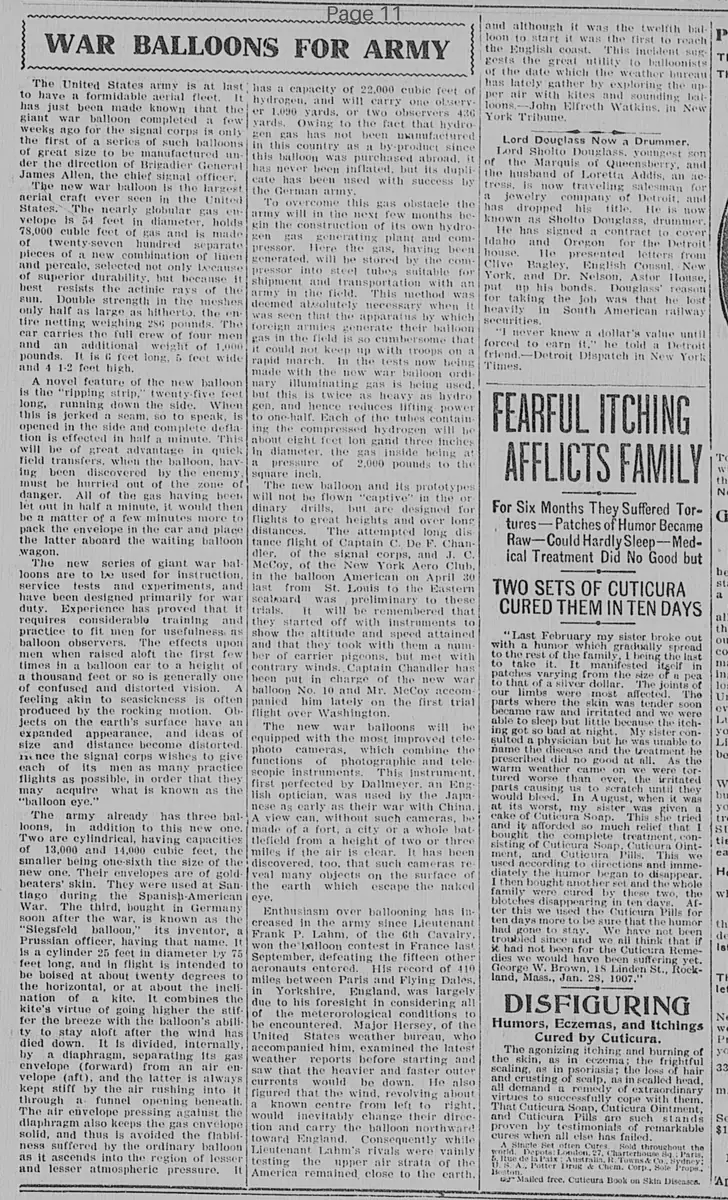
The United States army is at last to have a formidable aerial fleet. It has just been made known that the giant war balloon completed a few weeks ago for the signal corps is only the first of a series of such balloons of great size to be manufactured under the direction of Brigadier General James Allen, the chief signal officer.
The new war balloon is the largest aerial craft ever seen in the United States. The nearly globular gas envelope is 54 feet in diameter, holds 75,000 cubic feet of gas and is made of twenty-seven hundred separate pieces of a new combination of linen and percale, selected not only because of superior durability, but because it best resists the actinic rays of the sun.
Double strength in the meshes only half as large as hitherto, the entire netting weighing 255 pounds. The car carries the full crew of four men and an additional weight of 1,000 pounds. It is 6 feet long, 5 feet wide and 4 1-2 feet high.
A novel feature of the new balloon is the "ripping strip," twenty-five feet long, running down the side. When this is jerked a seam, so to speak, is opened in the side and complete deflation is effected in half a minute. This will be of great advantage in quick field transfers, when the balloon, having been discovered by the enemy, must be hurried out of the zone of danger. All of the gas having been let out in half a minute, it would then be a matter of a few minutes more to pack the envelope in the car and place the latter aboard the waiting balloon wagon.
The new series of giant war balloons are to be used for instruction, service tests and experiments, and have been designed primarily for war duty. Experience has proved that it requires considerable training and practice to fit men for usefulness as balloon observers. The effects upon men when raised aloft the first few times in a balloon car to a height of a thousand feet or so is generally one of confused and distorted vision.
A feeling akin to seasickness is often produced by the rocking motion. Objects on the earth's surface have an expanded appearance, and ideas of size and distance become distorted.
Since the signal corps wishes to give each of its men as many practice flights as possible, in order that they may acquire what is known as the "balloon eye."
The army already has three balloons, in addition to this new one. Two are cylindrical, having capacities of 13,000 and 14,000 cubic feet, the smaller being one-sixth the size of the new one. Their envelopes are of gold beaters' skin. They were used at Santiago during the Spanish-American War. The third, bought in Germany soon after the war, is known as the "Siegsfeld balloon," its inventor, a Prussian officer, having that name. It is a cylinder 25 feet in diameter by 75 feet long, and in flight is intended to be poised at about twenty degrees to the horizontal, or at about the inclination of a kite. It combines the kite's virtue of going higher the stiffer the breeze with the balloon's ability to stay aloft after the wind has died down. It is divided, internally, by a diaphragm, separating its gas envelope (forward) from an air envelope (aft), and the latter is always kept stiff by the air rushing into it through a funnel opening beneath.
The air envelope pressing against the diaphragm also keeps the gas envelope solid, and thus is avoided the flabbiness suffered by the ordinary balloon as it ascends into the region of lesser and lesser atmospheric pressure.
It has a capacity of 22,000 cubic feet of hydrogen, and will carry one observer 1,070 yards, or two observers 436 yards. Owing to the fact that hydrogen gas has not been manufactured in this country as a by-product since this balloon was purchased abroad, it has never been inflated, but its duplicate has been used with success by the German army.
To overcome this gas obstacle the army will in the next few months begin the construction of its own hydrogen gas generating plant and compressor. Here the gas, having been generated, will be stored by the compressor into steel tubes suitable for shipment and transportation with an army in the field. This method was deemed absolutely necessary when it was seen that the apparatus by which foreign armies generate their balloon gas in the field is so cumbersome that it could not keep up with troops on a rapid march. In the tests now being made with the new war balloon ordinary illuminating gas is being used, but this is twice as heavy as hydrogen and hence reduces lifting power to one-half. Each of the tubes containing the compressed hydrogen will be about eight feet long and three inches in diameter, the gas inside being at a pressure of 2,000 pounds to the square inch.
The new balloon and its prototypes will not be flown "captive" in the ordinary drills, but are designed for flights to great heights and over long distances. The attempted long distance flight of Captain C. De F. Chandler, of the signal corps, and J. C. McCoy, of the New York Aero Club, in the balloon America on April 30 last from St. Louis to the Eastern seacoast was preliminary to these trials. It will be remembered that they started off with instruments to show the altitude and speed attained and that they took with them a number of carrier pigeons, but met with contrary winds. Captain Chandler has been put in charge of the new war balloon No. 10 and Mr. McCoy accompanied him lately on the first trial flight over Washington.
The new war balloons will be equipped with the most improved telephoto cameras, which combine the functions of photographic and telescopic instruments. This instrument, first perfected by Dallmeyer, an English optician, was used by the Japanese as early as their war with China.
A view can, without such cameras, be made of a fort, a city or a whole battlefield from a height of two or three miles if the air is clear. It has been discovered, too, that such cameras reveal many objects on the surface of the earth which escape the naked eye.
Enthusiasm over ballooning has increased in the army since Lieutenant Frank P. Lahm, of the 6th Cavalry, won the balloon contest in France last September, defeating the fifteen other aeronauts entered. His record of 410 miles between Paris and Flying Dales, in Yorkshire, England, was largely due to his foresight in considering all of the meteorological conditions to be encountered. Major Hersey, of the United States weather bureau, who accompanied him, examined the latest weather reports before starting and saw that the heavier and faster outer currents would be down. He also figured that the wind, revolving about a known centre from left to right, would inevitably change their direction and carry the balloon northward toward England. Consequently, while Lieutenant Lahm's rivals were vainly testing the upper air strata of the America remained close to the earth, and although it was the twelfth balloon to start it was the first to reach the English coast. This incident suggests the great utility to balloonists of the data which the weather bureau has lately gathered by exploring the upper air with kites and sounding balloons.—John Elfreth Watkins, in New York Tribune.
What sub-type of article is it?
What themes does it cover?
What keywords are associated?
What entities or persons were involved?
Where did it happen?
Story Details
Key Persons
Location
United States
Story Details
The US Army Signal Corps is developing a series of giant war balloons under Brigadier General James Allen, starting with a new 54-foot diameter balloon holding 75,000 cubic feet of gas, featuring a ripping strip for quick deflation. Details on design, training for observers to overcome visual distortions, existing balloons including those from the Spanish-American War and the Siegsfeld balloon, plans for hydrogen gas production, and recent trials and achievements like Lieutenant Lahm's balloon contest win are described.