Thank you for visiting SNEWPapers!
Sign up free
American Watchman And Delaware Advertiser
Wilmington, New Castle County, Delaware
What is this article about?
Proceedings of the court martial for Captain David Porter in Washington City, August 9-13, 1825. The court found him guilty on charges related to unauthorized publication of court proceedings and disrespectful conduct, sentencing him to six months suspension. Approved by President John Quincy Adams.
Clipping
OCR Quality
Full Text
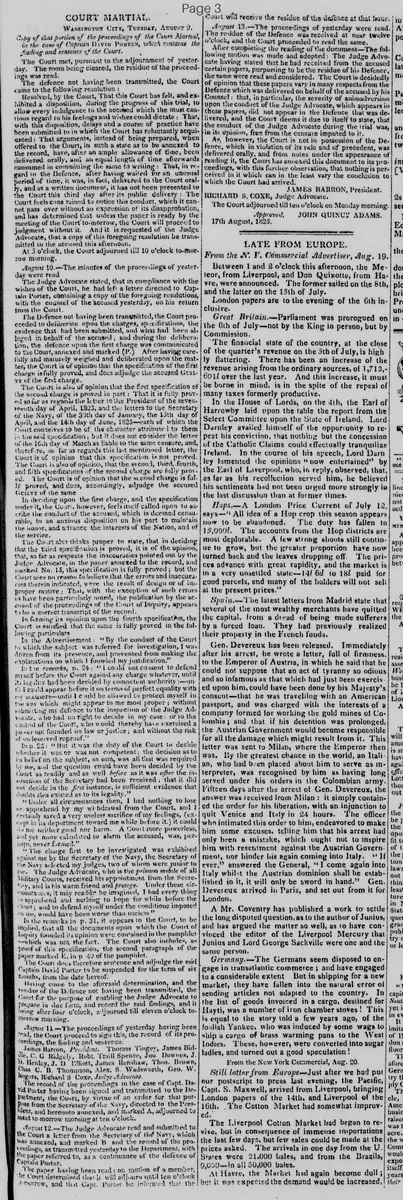
WASHINGTON CITY, Tuesday, August 9.
Copy of that portion of the proceedings of the Court Martial, in the case of Captain David Porter, which contains the finding and sentence of the Court.
The Court met, pursuant to the adjournment of yesterday. The room being cleared, the residue of the proceedings was read.
The defence not having been transmitted, the Court came to the following resolution:
Resolved, by the Court, That this Court has felt, and exhibited a disposition, during the progress of this trial, to allow every indulgence to the accused which the most cautious regard to his feelings and wishes could dictate: That, with this disposition, delays and a course of practice have been submitted to in which the Court has reluctantly acquiesced: That arguments, instead of being prepared, when offered to the Court, in such a state as to be annexed to the record, have, after an ample allowance of time, been delivered orally, and an equal length of time afterwards consumed in committing the same to writing: That, in regard to the Defence, after having waited for an unusual period of time, it was, in fact, delivered to the Court orally, and as a written document, it has not been presented to the Court this third day after its public delivery: The Court feels constrained to notice this conduct, which it cannot pass over without an expression of its disapprobation, and has determined that unless the paper is ready by the meeting of the Court to-morrow, the Court will proceed to judgment without it. And it is requested of the Judge Advocate, that a copy of this foregoing resolution be transmitted to the accused this afternoon.
At 3 o'clock, the Court adjourned till 10 o'clock to-morrow morning.
August 10.--The minutes of the proceedings of yesterday were read.
The Judge Advocate stated, that in compliance with the wishes of the Court, he had left a letter directed to Captain Porter, containing a copy of the foregoing resolutions, with the counsel of the accused yesterday, on his return from the Court.
The Defence not having been transmitted, the Court proceeded to deliberate upon the charges, specifications, the evidence that had been submitted, and what had been alleged in behalf of the accused; and during the deliberation, the defence upon the first charge was communicated to the Court, annexed and marked (P.) After having carefully and maturely weighed and deliberated upon the matter, the Court is of opinion that the specification of the first charge is fully proved, and does adjudge the accused Guilty of the first charge.
The Court is also of opinion that the first specification of the second charge is proved in part: That it is fully proved so far as regards the letter to the President of the seventeenth day of April, 1825, and the letters to the Secretary of the Navy, of the 30th day of January, the 13th day of April, and the 14th day of June, 1825--each of which the Court conceives to be of the character attributed to them in the said specification; but it does not consider the letter of the 16th day of March as liable to the same censure, and therefore, so far as regards this last mentioned letter, the Court is of opinion that this specification is not proved.
The Court is also of opinion, that the second, third, fourth, and fifth specifications of the second charge are fully proved. The Court is of opinion that the second charge is fully proved, and does, accordingly, adjudge the accused Guilty of the same.
In deciding upon the first charge, and the specification under it, the Court, however, feels itself called upon to ascribe the conduct of the accused, which is deemed censurable, to an anxious disposition on his part to maintain the honor, and advance the interests of the Nation, and of the service.
The Court also thinks proper to state, that in deciding that the third specification is proved, it is of the opinion, that, so far as respects the inaccuracies pointed out by the Judge Advocate, in the paper annexed to the record, and marked No. 15, this specification is fully proved; but the Court sees no reason to believe that the errors and inaccuracies therein indicated, were the result of design or of improper motive: That, with the exception of such errors as have been particularly noted, the publication by the accused of the proceedings of the Court of Inquiry, appears to be a correct transcript of the record.
In forming its opinion upon the fourth specification, the Court is satisfied that the same is fully proved in the following particulars:
In the Advertisement: "By the conduct of the Court to which the subject was referred for investigation, I was driven from its presence, and prevented from making the explanations on which I founded my justification."
In the remarks, p. 24: "I could not consent to defend myself before the Court against any charge whatever, until its illegality had been decided by competent authority:--until I could appear before it on terms of perfect equality with my accusers--until I could be allowed to protect myself in the way which might appear to me most proper; without submitting my defence to the inspection of the Judge Advocate, who had no right to decide in my case: or to the control of the Court, who would thereby have exercised a power not founded on law or justice; and without the risk of undeserved reproof."
In p. 25: "But it was the duty of the Court to decide whether it was or was not competent; the decision as to its belief on the subject, on oath, was all that was required by me, and the question could have been decided by the Court as readily and as well before as it was after the instructions of the Secretary had been received: that it did not decide in the first instance, is sufficient evidence that doubts then existed as to its legality."
"Under all circumstances then, I had nothing to lose or apprehend by my withdrawal from the Court, and I certainly saved a very useless sacrifice of my feelings, (except in its deportment toward me while before it.) it could do me neither good nor harm. A Court more powerless, and yet more calculated to alarm the accused, was, perhaps, never formed."
"The charge first to be investigated was exhibited against me by the Secretary of the Navy, the Secretary of the Navy selected my judges, two of whom were junior to me. The Judge Advocate, who is the primum mobile of all Military Courts, received his appointment from the Secretary, and is his warm friend and protege. Under these circumstances, it may readily be imagined, I had every thing to apprehend and nothing to hope for while before the Court; and to defend myself under the conditions imposed on me, would have been worse than useless"
In the remarks in p. 31, it appears to the Court, to be implied, that all the documents upon which the Court of Inquiry founded its opinion were contained in the pamphlet--which was not the fact. The Court also includes, as proof of this specification, the second paragraph of the paper marked E, in p 40 of the pamphlet.
The Court does therefore sentence and adjudge the said Captain David Porter to be suspended for the term of six months, from the date hereof.
Having come to the aforesaid determination, and the residue of the Defence not having been transmitted, the Court for the purpose of enabling the Judge Advocate to prepare in due form, and record the said findings, and it being after four o'clock, adjourned till eleven o'clock to-morrow morning.
August 11--The proceedings of yesterday having been read, the Court proceed to sign this, the record of its proceedings, the finding and sentence.
James Barron, President. Thomas Tingey, James Biddle, C. G. Ridgely, Robt. Traill Spence, Jno. Downes, J. D. Henley, J. D. Elliott, James Renshaw, Thos. Brown, Chas C. B. Thompson, Alex. S. Wadsworth, Geo. W. Rodgers, Richard S Coxe, Judge Advocate.
The record of the proceedings in the case of Capt. David Porter having been signed and transmitted to the Department, the Court, by virtue of an order for that purpose from the Secretary of the Navy, directed to the President, and hereunto annexed, and marked A, adjourned to meet to-morrow morning at ten o'clock.
August 12.--The Judge Advocate read and submitted to the Court a letter from the Secretary of the Navy, which was annexed, and marked B and the record of the proceedings, as transmitted yesterday to the Department, with the paper referred to, as a continuance of the defence of Captain Porter.
The paper having been read: on motion of a member, the Court determined that it will adjourn until ten o'clock to-morrow, and that Capt. Porter be informed that the Court will receive the residue of the defence at that hour.
August 13.--The proceedings of yesterday were read.
The residue of the Defence was received at near twelve o'clock, and the Court proceeded to read the same.
After completing the reading of the document--The following motion was made and adopted: The Judge Advocate having stated that he had received from the accused certain papers, purporting to be the residue of his Defence, the same were read and considered. The Court is decidedly of opinion that these papers vary in many respects from the Defence which was delivered on behalf of the accused by his Counsel: that, in particular, the severity of animadversion upon the conduct of the Judge Advocate, which appears in these papers, did not appear in the Defence that was delivered, and the Court deems it due to itself to state, that the conduct of the Judge Advocate during the trial was, in its opinion, free from the censure imputed to it.
As, however, the Court is not in possession of the Defence, which in violation of its rule and of precedent, was delivered orally, and from notes under the appearance of reading it, the Court has annexed this document to its proceedings, with this further observation, that nothing is perceived in it which can in the least vary the conclusion to which the Court had arrived.
JAMES BARRON, President.
RICHARD S. COXE, Judge Advocate.
The Court adjourned till ten o'clock on Monday morning.
Approved,
JOHN QUINCY ADAMS.
17th August, 1825.
What sub-type of article is it?
What keywords are associated?
What entities or persons were involved?
Where did it happen?
Domestic News Details
Primary Location
Washington City
Event Date
August 9 13, 1825
Key Persons
Outcome
captain david porter sentenced to six months suspension from duty.
Event Details
The court martial found Captain Porter guilty of the first charge (unauthorized publication of court of inquiry proceedings) and the second charge (disrespectful conduct toward superiors via letters and publications). Specific specifications proved in part or fully, with some leniency noted on motives. Proceedings detailed deliberations, defense issues, and signing of the record.