Thank you for visiting SNEWPapers!
Sign up free
The Newport Gazette
Newport, Newport County, Rhode Island
What is this article about?
Lord North's speech in the House of Commons on Feb. 17 defends his American policy, proposes conciliatory bills to end taxation fears, appoints commissioners with broad powers to negotiate peace with Congress and colonies, suspending hostilities and restoring constitutions, without insisting on immediate independence renunciation.
Merged-components note: These components form a continuous extraction of Lord North's speech from a British parliamentary session, discussing American affairs from a foreign (British) perspective.
Clippings
1 of 2
OCR Quality
Full Text
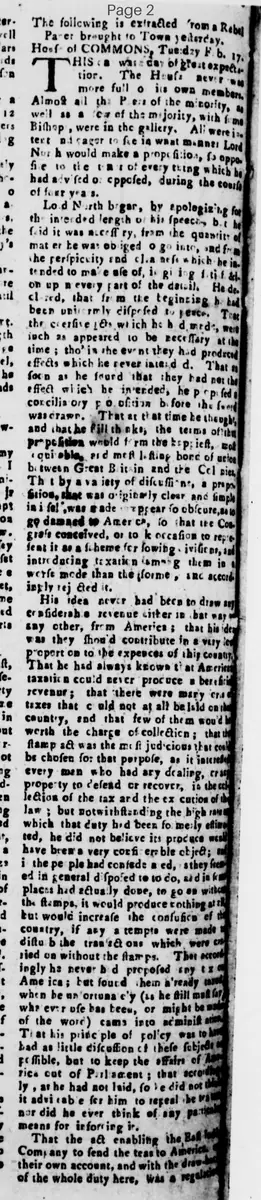
House of COMMONS, Tuesday Feb. 17.
This was a day of great expectation, more full of its own members.
The House never was fuller.
Almost all the Peers of the minority, as well as a chief of the majority, with some Bishops, were in the gallery. All were anxious to hear in what manner Lord North would make a proposition, or apology to the state of every thing which he had advised or opposed, during the course of four years.
Lord North began, by apologizing for the intended length of his speech; but he said it was necessary, from the quantity of matter he was obliged to go into, and from the perspicuity and clearness which he intended to make use of, in giving information on every part of the detail. He declared, that from the beginning he had been uniformly disposed to peace. To the coercive acts which he had made, were such as appeared to be necessary at the time; though in the event they had produced effects which he never intended. That as soon as he found that they had not the effect which he intended, he proposed conciliatory propositions before the sword was drawn. That at that time he thought and that he still thinks; the terms of that proposition would form the basis, most suitable, and most simple bond of union between Great Britain and the Colonies.
That by a variety of discussion, a proposition, that was originally clear and simple in itself was made appear so obscure, and so damaged in America, that the Congress conceived, or took occasion to repeat: Seat it as a scheme for sowing divisions, and introducing taxation among them in its worst form, and accordingly rejected it.
His idea never had been to draw any considerable revenue either in that way or any other, from America; that his idea was they should contribute in a way in proportion to the expenses of this country.
That he had always known that American taxation could never produce beneficial revenue: that there were many good taxes that could not at all be laid on that country, and that few of them would be worth the charges of collection: that the stamp act was the most judicious that could be chosen for that purpose, as it interested every man who had any dealing, trade property to defend or recover, in the collection of the tax and the execution of the law: but notwithstanding the high rate which that duty had been formerly esteemed, he did not believe its produce would have been a very considerable object; unless the people had conformed, as they seemed in general disposed to do, and in some places had actually done, to go on with the stamps, it would produce nothing at all but would increase the discontents of the country, if any attempt were made to disturb the transactions which were carried on without the stamps. That accordingly he never had proposed any tax on America; but found them already started when he unfortunately (as he still makes it) whatever use they have been, or might be of the word) came into administration.
That his principle of policy was to have as little discussion of these objects possible, but to keep the affairs of America out of Parliament: that accordingly, as he had not said, (nor did he think it advisable for him to repeal the tea duty) nor did he ever think of any particular means for enforcing it.
That the act enabling the East India Company to send the teas to America on their own account, and with the drawback of the whole duty here, was regulative.
which he thought it not possible the Americans could complain of, since it was a tea let instead of an oppression; but that the ill-affected there, and persons concerned in contraband trade, endeavoured to represent it as a monopoly: that in some hand bills that were scattered about at Boston, even supposed that he had taken off the American three pence per pound duty, and that even on that supposition, the disaffected excited the people to a tumult, upon a principle totally distinct from all idea of taxation. That, therefore, as he had never meant taxation as his object in the last tea act, no neither did he in his conciliatory proposition, but in the latter considered it only as a means of union and good agreement between the two countries: that therefore, in what he was going to Propose, he was fully armed and consistent.
One of the bills he proposed to move for was, to quiet America upon the subject of taxation, and to remove all fears, real or pretended, of Parliament's ever attempting to tax them again: and to take away all exercise of the right itself in future, so far as regarded revenue: that as to the other particulars in controversy, he observed, that the Americans had desired a repeal of all the acts passed since 1763: that this could not, however, be supposed to mean any more than those acts which had, in some way or other, pressed on them: for that some which had passed in 1766 were beneficial, and such as they themselves would consider in that light, being the granting bounties and premiums, or the relaxation of former statutes that had been grievous to them. That as to the late acts, such as the Massachusetts Charter, the Fishery, and the Prohibitory Bills, as they were the effect of the quarrel, should cease: and that as to Complaints of matters of a various nature, authority should be given to Settle them to the satisfaction of America.
That all these matters, consisting of a great variety would be better left to the discussion of Commissioners, than to be established here by act of Parliament, or by explicit powers given for each specific pretence: for that the Americans in the negotiation would consider every concession made actually here, to be a part of the basis of the treaty, and never to be receded from, and would accumulate new demands upon that, therefore, as every thing of that kind might be variously modified by agreement, he was for leaving the whole to Commissioners.
That the commissioners formerly appointed had very large powers. Indeed he understood those powers. But that another seemed to consider them as more limited than in reality they were, he should take care now to be very explicit, and he would give them full powers to treat; discuss, and conclude upon every point whatever. That as some difficulties had arisen about the power given to the commissioners, of treating with the Congress by name, he would now remove that difficulty, by empowering and enabling the commissioners to treat with the Congress, as if it were a legal body, and would so far give it authenticity as to suppose its acts and conclusions would bind America. That they should have powers to treat with any of the Provincial Assemblies upon their present constitution, and with any individuals in their present civil capacities or military commands: with General Washington, or any other officer, whenever they thought it requisite to order a suspension of arms.
That they should have a power to suspend the operation of all laws. That they should have a power of granting all forms of pardons, amnesties and rewards. That
they should have a power of restoring all the Colonies, or any of them, to the form of its ancient constitution as it stood before the troubles: any of those where the King nominated the Governors, Council, Judges, and other Magistrates, to nominate Such at their discretion, till the King's further pleasure be known.
That as the powers of the former Commissioners had been objected to, o the Congress had raised a difficulty on pretence of their non admission of their title to be Independent States.
That meaning peace sincerely, he was resolved that this difficulty should not stand in the way of a negotiation for that the Commissioners were to admit it upon entering into a treaty. but as a point to be given on its amicable termination. Another Americans might claim their independence as the outlet, he would not insist on their renouncing it till the treaty should receive its final ratification by the King and Parliament of Great Britain.
That the Commissioners should be instructed to negotiate. for some reasonable and moderate contribution towards the common defence of the empire when re- united: but to take away all pretence for not terminating this unhappy difference the contribution was not to be insisted on as a sine qua non of the treaty; but that if the Americans should refuse a reasonable and equitable a proposal, they were not to complain, if hereafter they were not to look or suspect, from that part of the em- pire to whose expense they had refused to contribute; that it might be asked if his sentiments had always been such with re- gard to taxation and peace, and why he had not made this proposition at a more early period? To this he answered, his opinion had ever been that the moment of victory was the proper time for offering terms of concession. That the House might remember, that at the beginning of the Session, he had declared, that such were his sentiments: he at that time thought that the victories obtained by Sir Wil- liam Howe had been more decisive; and that he knew nothing of General Bur- goyne's misfortune: That when the news of that misfortune had arrived, and that the victories obtained by Sir Wm. Howe could not be so improved, to hinder General Washington from appearing with some superiority in the field: and that the King's troops were obliged to retire and fortify themselves in winter quarters, the first thing but occurred to him, as the nation was still strong and vigorous, that they could raise a number of men, and that the resources were far from exhausted, that their strength should be exerted to repair losses, and to pursue the war with vigour to a happy termination; but when he re- flected upon the uncertainty of events, which had hitherto so much disappointed his expectation, and that in case of the utmost success, the terms which he now proposed must be substantially the same as he should propose in the height of vic- tory, he saw no reason to prevent the pro- tracting the war, the effusion of blood, and the immoderate expense, he would offer the same proposition now.
That he was convinced that they would considerably aid the operation of war, as they would themselves be aided by the force in America, which was still very great; that in case nothing farther could be done by force at any rate, they would be offered with more grace than hereafter. That the events of war in America had turned out very differently from his expectations; that great force had been procured to be sent to America; but to little purpose hi- therto.
That he must confess himself extremely disappointed in his expectations of the ef- fect of our military force. He did not mean by that to condemn, or even call into question the conduct of any of the Commanders, but he had been disap- pointed. That Sir William Howe had not only been in the late actions, and in the whole course of the campaign, in goodness of corps, and in all manner of Supplies, but in numbers too, much supe- rior to the American army which opposed him in the field. That General Bur- goyne, who was at length overpowered by numbers, had been in numbers until the affair at Bennington, near twice as strong as the army under General Gates.. That all these things had happened in a manner very contrary to his expectation.
That, for his part, he never had made a promise which he did not perform, or receive an information which he did not communicate. That he only kept back the names of those who had given him in- formation, and which it would be unfaith- ful and inhuman to divulge; that he promised a great army should be sent over, there were 60,000 men, and upwards; that he had promised a great fleet should be employed, and a great fleet has been employed, and is now employed: that they should be provided for with every kind of supply. and that they had been so most amply and liberally, and might be so for years to come; that if the House was deceived, they had deceived themselves.
On the whole, his concessions were from reason and propriety. not from necessity; that we were in condition to carry on the war much longer. We might raise many more men, and had many more-ready to send, for the navy was never in greater strength, the revenue very little sunk. and that he could raise the supplies for the current year, as a little time would show; that he submitted the whole, with regard to the propriety of his past and present conduct,.to the judgment of the House.
What sub-type of article is it?
What keywords are associated?
What entities or persons were involved?
Where did it happen?
Foreign News Details
Primary Location
London
Event Date
Tuesday Feb. 17.
Key Persons
Outcome
proposes bills to end taxation on america, appoints commissioners with powers to negotiate peace, suspend arms, grant pardons, restore constitutions; no insistence on immediate renunciation of independence; seeks moderate contribution to empire defense but not as treaty prerequisite.
Event Details
Lord North delivers a lengthy speech defending his past policies on America, explaining coercive acts and conciliatory propositions, and proposing new bills to quiet taxation fears and repeal contentious acts since 1763. He outlines broad powers for new commissioners to treat with Congress as a legal body, provincial assemblies, and military leaders like Washington to achieve peace, including suspending laws, granting pardons, and restoring colonial constitutions. He expresses disappointment in military outcomes despite superior British forces and promises continued support, offering terms now to avoid further war costs.