Thank you for visiting SNEWPapers!
Sign up free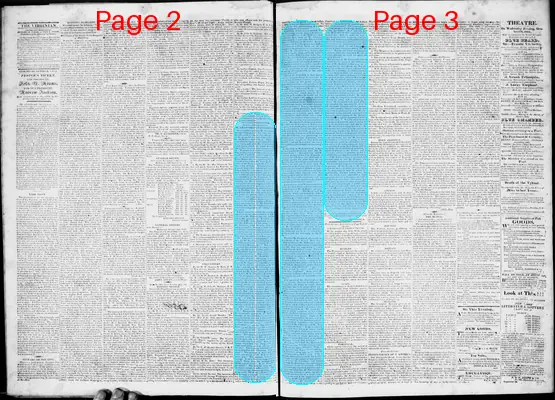
The Virginian
Lynchburg, Virginia
What is this article about?
Editorial from the National Journal attacks William H. Crawford's political consistency, highlighting his opposition to Jefferson and Madison administrations, votes against embargo repeal and bank charter, anti-navy sentiments, and opportunistic shifts for appointments, questioning his presidential fitness.
Merged-components note: These components form a single continuous editorial article on Mr. Crawford's consistency, spanning pages 2 and 3, with sequential reading order and coherent topic flow.
Clippings

1 of 2
OCR Quality
Full Text
MR. CRAWFORD'S CONSISTENCY
Great credit is given to Mr. Crawford by the opposition papers, for what they call his independent vote on the embargo, and on the proposed renewal of the charter of the old United States' Bank. There are some facts, yet undisclosed, connected with these votes, and with Mr. Crawford's political career, which are worth knowing and as these journals have refused to insert the 'Westmoreland Address,' notwithstanding its liberality and forbearance in speaking of Mr. Crawford; and as some of them have violently railed at its reputed author Major Somerville, for suggesting that Mr. Crawford was unfriendly to the gradual increase of the Navy, it is worth while to disclose a few of them. Without pretending to know from what information that gentleman drew his conclusions, it is easy to show that they are correct, and it might not be difficult to prove that he has spoken too indulgently of Mr. Crawford. If any imposition has been practised on the public credulity by Mr. Crawford's friends, in consequence of not having been sufficiently conspicuous 15 or 16 years ago to have had all his opinions distinctly noted and remembered, it is time that the veil should be withdrawn, and the truth made known— The public are already informed, that this 'exclusive and consistent republican' signed, in 1798, an address, declaring his confidence in 'the wisdom, justice, and firmness of the administration of Mr. John Adams' and that after the fall of federalism, he denounced it as regardless of utility in its measures. But the extent to which he carried his opposition to the administration of Jefferson and of Mr. Madison, has not yet been sufficiently pointed out. It will be recollected that Mr John Randolph quarrelled with Mr. Jefferson and his party, (except Mr. Gallatin,) about the year 1806 or, and succeeded in forming a little malcontent faction, which continued to grow, and to oppose the government until the declaration of war, and during the course of it. Who were the members of this opposition to Mr. Jefferson's administration? Were they not Mr. Randolph of Virginia, Mr. D. R. Williams of South Carolina, Mr. W. H. Crawford of Georgia, &c.? Was not Mr. Crawford first elected to the Senate about 1807, and did he not identify himself with the Randolph opposition on the embargo and other questions? Did not the rancorous opposition of Mr. Randolph to Mr. Jefferson's administration cause a violent quarrel in, or about the year 1808, between him and Mr. Eppes, the republican leader in Virginia, and the son-in-law of Mr. Jefferson; and did not Mr. Crawford carry a challenge from Mr. Randolph to Mr. Eppes and did not Mr. Eppes select his political friend, Col. R. M. Johnson of Kentucky, to bear his acceptance of the challenge, although it was known that he, Mr. Eppes, could scarcely 'hit a barn door with a pistol'?— Although Mr. Crawford voted against the embargo, did he not, when the republican party determined to repeal it, vote against the repeal, and the next year declare in a speech, that 'the embargo, altho' vilified and abandoned here, had proved efficacious' and ought not to have been repealed? Did he not vote with the malcontents against Mr. Madison's administration, and against the republican party; and not only on the embargo and the United States Bank, but on almost every great question, from the time he went into Congress, (1807,) to 1812 Does not the following extract of Mr. Crawford's speech on Mr. Madison's message, of the 23d January, 1816, prove not only that he was not in the confidence of the administration, but that his opposition to it was bitter and severe? The President's message—
"and which this measure may derive from that source of support of this bill. "Feeble must be the aid which this measure can derive from that source of support of this bill. said he, has been introduced:"
This message in point of obscurity, comes nearer to my ideas of a Delphic Oracle than any state paper which has come under my inspection." It is so cautiously expressed that every man puts what construction on it he pleases. Is he for war? The message breathes nothing but destruction and bloodshed. Is he for peace? The message calls for it. Is he a friend to a large standing army? why, then, the message means the militia? The message does not call for 20,000 regular troops Is he friendly to regular troops it means militia sir, this message means any thing or nothing at the will of the commentator This message is oracular in its meaning, was miraculous its promulgation new spapers, to the east of this, stated that such a message would be delivered, or something
account for this phenomenon, is neither it reached the two houses of Congress. To stated its contents nearly one week before within my power or province. Could any declaration be quoted, from Mr. Pickering himself, more indicative of a pistrati m, than those of Mr. Crawford, want of confidence in Mr. Madison's admi which may be found in the National Intel- rememhered, that this speech was made in ligencer, of February 2d, 1810? Let it be opposition to a bill for fitting out all our frigates for the protection of our commerce. and that Mr. Crawford there declares, that our navy was a first rate ship of the line, i if every frigate, sloop and bomb ketch in would be, even then, wholly incompetent to he, were to invest one hundred millions of that object. If the United States, said dollars in vessels of war, and to expend one fourth that sum annually by employing it for the protection of our commerce, it would be still unprotected, or the nation involved in war. Did not Mr. Crawford, in that speech, say the strongest things to convince the world that we had no intention of going to war? and did not this speech encourage Great Britain to refuse all reparation to Mr. Madison, for the injuries and insults she had heaped on us? What said Mr. C.? But waving all the arguments, said he, against our declaring war, which may be drawn from our past conduct he would ask this hon. body, whether the present situation of the world does not admonish this nation to stand aloof from the dreadful convulsions which Europe has for years past, been agitated to its centre? Yes, sir, the character of the war, and the principles upon which It is conducted, admonish us, in the most solemn manner to remain quiet, until its stormy billows shall subside into a calm. Let it be the wisdom of this nation to remain at peace as long as peace is within its option Having shown, from our past conduct, that we do not mean to declare war, and also, that sound policy forbids us to do it, it is necessary to enquire into the probability of its being declared against us. Such were the sentiments of Mr. Crawford. when Great Britain was plundering, impressing and murdering Americans, even in sight of the steeples of New York and Norfolk! and yet he is called 'the consistent republican, the defender of his country's rights.' In objecting to Madison's wish, to have our five frigates fitted out, what did Mr. Crawford say? But admitting, said he, there is danger of war with England, of what service will these few additional frigates be against the 1000 ships of war which that nation could put in commission? If they are sent out to prey upon the commerce of the enemy, but few if any of them will ever return to defend our ports. It is in vain for us to contend on the ocean with a nation which expends more than three hundred millions of dollars !! Such were Mr. Crawford's sentiments, and yet he is the consistent republican, the staunch defender of our country's rights!! Let us now see what Mr. Crawford thinks of the American Navy, and what objections he urged against Mr. Madison's naval preparations for war. The Navy, said Mr. Crawford, which was created by a federal administration, was by that administration, reduced to what they called a peace establishment. In this situation it was found by the Late administration, (Mr. Jefferson's) who, so far from running into the extremes, stopped short in the salutary work of reform. The new administration, cautiously guarding against the charge of innovation, stopped short of their duty. They ought to have amputated this fungus of the body politic, and restored it to a sound and healthy state. This was not done, and the nation has consequently spent about twelve millions of dollars upon it. (the Navy.) Such are Mr. Crawford's expressions in condemning Mr. Jefferson for not destroying the Navy, and yet he is 'a consistent republican, and not unfriendly to the Navy!!' What did Mr. Crawford afterwards say was the use of the Navy? Hear him. That gentleman (Mr. Hillhouse,) and his friends are acting consistently in supporting this bill, they are supporting a system which owes its birth to them. They believed, and no doubt honestly, that a government which relied for support only on the utility of its measures, would be weak and inefficient. They endeavoured to strengthen it by creating a system of patronage, and for that purpose the Navy was built, and for that purpose, and for that purpose alone, it is calculated. Against G. Britain it will be wholly inefficient, or worse than inefficient. Such were Mr. Crawford's opinions, and yet he is a consistent republican, and not unfriendly to the Navy!! In the speech of Mr. Crawford on the Navy, (see the National Intelligencer of Friday, Feb. 2d, 1810,) he argues against the maxim, that to be prepared for war is the best means of preserving peace, which had been cited by a Senator from Virginia, and shows his want of confidence in Mr. Madison's administration by these remarks: Gentlemen who think with me, who believe that we shall not have war, and that so far as depends on our actions, we ought not to have it, will do well to reflect, that when our fleets are equipped, and armies raised, we must employ them. We must go to war to justify ourselves to the nation, for the exorbitant expenses which we have incurred by these means. Such are Mr. Crawford's preparations for war, and yet Mr. Crawford is the illustrious patriot- the consistent republican-the uniform supporter of Mr. Jefferson's and Mr. Madison's administrations!! If Mr. Crawford's advice had been followed, where would have been the glory of our naval victories? Where the national honor which now distinguishes the heart of every American, on whatever land he may tread, or on whatever ocean, his winds may waft him? But how comes it that Mr. Madison afterwards patronized the man who so warmly opposed his administration? Why, for very plain reason The increasing the federal party Crawford at the head of large Georgia, whose coalition with the federalists might have paralyzed the executive- To neutralize Mr. Crawford and detach him from Mr. Randolph was consequently of importance to the government and was accordingly contrived and executed it happened that before Mr. Smith resigned as Secretary of State in 1811 the executive had some business of secret nature to the south, and at the suggestion of the Secretary, the President determined to offer the agency to Mr. Crawford. Now G:t n thu secretary wite a letter to Mr.
Crawford, full of compliment and flattery, inviting him to accept the appointment?— Did he not accept it? Did it not, combined with the prospect of a foreign mission, soften his opposition? If it did not, how came Mr. Crawford, after repeated previous declarations, that we ought not to go to war, to return to the Senate the next year, 1812, and without a single additional reason for declaring war, (when, in fact, there was one less, as compensation had been made for the attack on the Chesapeake,) vote for it when recommended by Mr. Madison? Was he not, at the next session of Congress (1812-13,) appointed Minister to France, although he could not speak one word of French? The attempt of Mr. Crawford's friends to prove that he enjoyed the entire confidence of Mr. Madison at that time by alleging that he was offered the War Department, would not, if true, redound to his credit; for it would go to establish the fact, that at a moment when our country was invaded, and in imminent danger, and when we stood in need of aid in the War Department, Mr. Crawford preferred the comparatively idle mission to France, with twenty seven thousand dollars for two years services, to the arduous duties of the Department of War, with its 10 or 12 000 dollars salary, for the same period then he returned from France, the year after the peace was concluded, and after Mr. Dallas had nobly discharged the invidious task of reducing the army, and in selecting the officers. Mr. Crawford with great willingness accepted the appointment, altho' he still continued intimate with the malcontents, who voted for him in caucus the next year, 1816, in preference to Col. Monroe! And has he not been closely connected with those malcontents during all Mr. Monroe's administration, and the opponent of its most liberal measures? Was he not in favor of giving Great Britain the right of search for slaves on her own terms—and did he not tell Mr. Stratford Canning that it was Mr. Adams who insisted, in the cabinet, on not allowing it unless the British government made the slave trade piracy? After Mr. Adams succeeded in making the convention on our own terms, did not Mr. Crawford, who had been in favor of giving to Great Britain greater privileges, inform his friends that owing to his indisposition, he had not been consulted on the final treaty, and advise them, for electioneering purposes, to oppose its passage in the Senate, and to raise a hue and cry, if possible, against it? And did they not oppose it, with the exception of Mr. Barbour, who, as chairman, had recommended it, and Mr. Lawrie, who feared public opinion in Pennsylvania? These facts and enquiries shall suffice for the present, If the friends of Mr. Crawford desire more, let them provoke them. In the mean time, it may be asked of a candid public, whether a man, who, like Mr. Crawford, never originated a single important measure in Congress, nor ranked as a first rate man there -who never gave more proof of executive than of legislative talent -who never fought a public battle nor made a treaty who showed a signal want of influence or ability in the case of a certain schooner at Nantes, and who never ranked above a second rate diplomatist abroad, whether such a man is fit to be made President of the United States, even if his health were good, and if his compeer, Mr. Gallatin, did not cling to him, as Boileau says the Spectre of Chagrin, mounted behind, and clinging to a man who is spurring his horse to escape from him, En vain, il voudroit fuir cet incommode ami. Toujours il monte en croupe, et galope avec lui. SERTORIUS.
What sub-type of article is it?
What keywords are associated?
What entities or persons were involved?
Editorial Details
Primary Topic
Critique Of William H. Crawford's Political Consistency And Opposition To Republican Administrations
Stance / Tone
Strongly Critical And Accusatory, Portraying Crawford As Inconsistent And Opportunistic
Key Figures
Key Arguments