Thank you for visiting SNEWPapers!
Sign up free
The Virginia Gazette
Richmond, Williamsburg, Richmond County, Virginia
What is this article about?
Hon. Temple Luttrell's speech in the House of Commons on October 27 opposes the address to the King, criticizing ministerial influence on policy toward American colonies, defending American resistance as justified, and moves to first consider the state of Britain and her colonies before addressing the throne.
Merged-components note: This is a continuation of the speech by Temple Luttrell across pages 1 and 2, as the text flows directly from the end of the first component to the start of the second.
Clippings
1 of 2
OCR Quality
Full Text
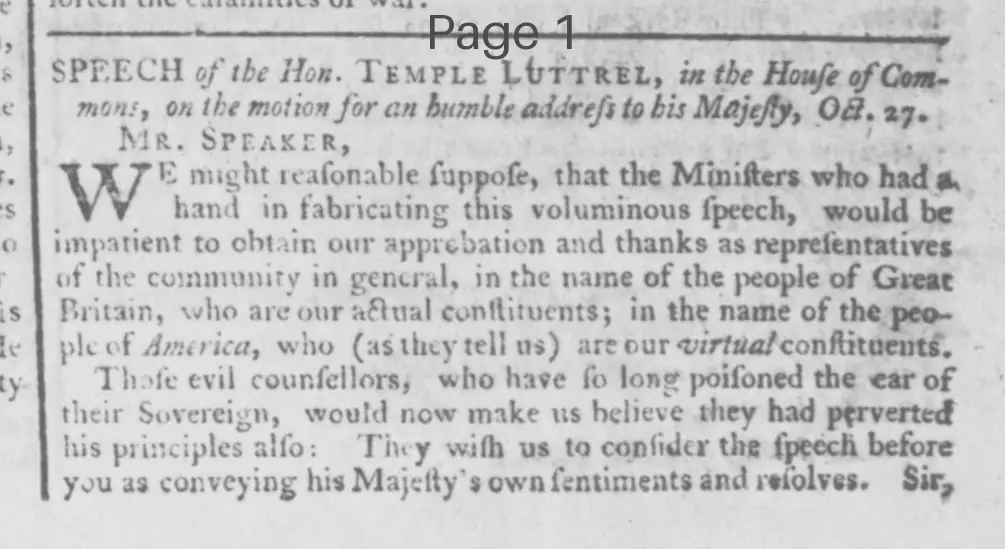
MR. SPEAKER,
hand in fabricating this voluminous speech, would be impatient to obtain our approbation and thanks as representatives of the community in general, in the name of the people of Great Britain, who are our actual constituents; in the name of the people of America, who (as they tell us) are our virtual constituents.
Those evil counsellors, who have so long poisoned the ear of their Sovereign, would now make us believe they had perverted his principles also: They wish us to consider the speech before you as conveying his Majesty's own sentiments and resolves. Sir,
We know that to be impossible. Our King is too humane, and besides, too well acquainted with the history of this country and its constitution, with the memoirs of the Stuart race, and of his own illustrious House, to imbibe the despotic doctrines here imputed to him. His Majesty knows, that when either of the three estates of this empire, or the whole in conspiracy together, shall arrogate power to which they are incompetent, such as infringing the original rights and liberties of the people in any part of the British dominions, it is the exertion of such power, not the resistance to it, which constitutes rebellion. If this be not the case, the glorious revolution was above all rebellions the most atrocious.
We, who are the deputies of the people, assembled together from different counties, cities, and boroughs of the kingdom, ought faithfully to impart to his Majesty the real wishes and dispositions of his subjects. As the first counsellors of the Crown, it is our peculiar province to advise and direct his Majesty on every national emergency like the present. But, Sir, in order to qualify us so to do, affection to our King, obligation to our country, and sober wisdom, all combine in requiring the closest and most deliberate discussions, and the deepest researches into the true bias of the times, previous to the offering up any address to the throne whatever. An address, at such a crisis as this, upon such important and decisive matters, cannot be considered as a mere point of etiquette, or personal compliment to our Sovereign; if it could, there is not a member of this House would be more forward in duty and obsequiousness than myself. Are we not totally ignorant of the real state of Great Britain and her colonies? Sir, the sense of the society at large is not to be ascertained by the signature of a score of provincial corporations, under corrupt ministerial influence; it is not to be ascertained by the voice of repletion and revelry, by a few mistaken individuals, brought together under the hospitable roof of a great Baron's castle. Sir, within those battlements Kings are not, now a days, made or unmade*; it is not to be ascertained by the cry of a few Tory justices, ductile magistrates, huddled together by their creator the Lord Lieutenant of the county, to approve of proscriptions and proclamations, devised in councils, where he himself takes the lead as President.t Sir, I will tell the noble Lord who spoke last I that if the people of Lancaster, Liverpool, and Manchester, were the oracles of British law and policy, the Electors of Hanover had never swayed the imperial sceptre of this realm. I admire, however, the pirited zeal and consistency of the addressing inhabitants of that part of England; I admire their firm reverence for the divine authority of Kings, their defence of Popery, of arbitrary government, and wooden law. The same political tenets which now fill the heads of these loyal addressers, filled also the heads of their townsmen in forty five and forty six. Those heads, which being impaled over Temple Bar in the last Whig reign, were soon after the commencement of the present, when a mighty northern Thane came into office, taken down with veneration and are now, it is said, enshrined in a certain interior cabinet where a Right Hon. Household officer in my eye, and others of the White Rose junto, frequently offer upon a bended knee their secret orisons and incense. Sir, the noble Lord who spoke last, and the Right Hon. member who delivered his sentiments earlier in the debate, have assured you, that the sense of this country is against the Americans, I am confident, as well from the intelligence I have been able to procure from a multitude of persons widely different in station and description, as by my own remarks in the progress of many a journey through the interior parts of this island, during the summer season, that the sense of the mass of the people is in favour of the Americans. They think that the provocation given by a rash and insufficient Ministry to the colony of Massachusetts Bay, in lawless and oppressive exactions, enforced by famine, devastation, and slaughter, at length constitutionally justified an appeal to arms. A very learned judge, who does now signal honour to the coif, assures us, in his excellent book of commentaries, that every freeman is warranted in the use of arms for defence of his rightful possessions and liberty; and that great luminary of his profession, Lord Chief Justice Holt, in pronouncing judgement on the memorable case of Tooley and Dekins, says, "When the liberty of the subject is invaded, it is a provocation to all the subjects of England." Where then will these grievances, this civil war and carnage terminate? I shall now borrow the words of Sir Charles Sedley, in the last age, to express my astonishment, that a nation, sick at heart as ours is, should wear so florid a countenance. But, Sir, is it not that hectic bloom which is frequently found to accompany a radical decay of the constitution, or rather some artificial beautifier spread over the surface of a cadaverous substance, for popular show and delusions? We have heretofore found it expedient, when this kingdom has been shaken to its foundation, from one extremity to the other, as it now actually is; when the original compact between the governing power and the subject has been differently construed, and in danger of being totally dissolved; I say, Sir, that the Commons in Parliament assembled, have found it expedient to inquire, in the first place, into the actual state and condition of the nation in general: For this we have a recent precedent, almost within the memory of man, not strictly speaking in the journals of a Parliament, but in the journals of a national and constitutional Assembly, which has done more good than all your Parliaments since the days of Henry the III. put together, which restored and established, on a firm basis, the Protestant religion, and civil liberties of the people, and which brought in the amiable families of Nassau and of Brunswick to maintain that religion, and to protect us in the enjoyment of those liberties: I mean, Sir, the convocation, or Congress, in the year 1688, whose acts and resolutions ought, like the leaves of the Sybils of old, to be sanctimoniously reverted to, at all times of state perplexity and peril. I therefore desire that the motion made on the opening of this Congress, commonly called the Convention Parliament, and which was the ground work of the glorious revolution, be now read.
The motion was then read, which stands upon the journals in the following words: "That the House do appoint a day to take into consideration the state and condition of the nation;" which motion passed, nemine contradicente, for the Monday following.
I now move you, Sir, that this House do appoint a day to take into consideration the present state and condition of Great Britain and her colonies, in order to ground thereupon an affectionate and dutiful address to the Crown, in answer to his Majesty's speech, this day delivered from the throne.
I am sorry not to see the honourable member, who proposed, and so ably supported this address, now in his seat; for I flatter myself he would acknowledge his motion premature, and admit of the necessity to take the preliminary step of ascertaining the temper and resources of Great Britain and her colonies, in order to address his Majesty with good effect; when we shall, I trust, open his eyes to the manifold impositions put upon his royal confidence, by some dark and dangerous parricides, ambushed too near the throne, and help him to restore that peace, good order, and happiness, throughout all his dominions, without which it is impossible that he can continue to reign over us with security; or that so pious and benevolent a Prince as he is, though he wears the most brilliant diadem in Christendom, can make it sit easy on his brow.
Alluding to the famous Earl of Warwick, who alternately deposed Henry VI. and Edward IV.
Earl of Gower, in the county of Stafford.
1 Lord Stanley.
1 Lord Stanley and Mr. Rice.
What sub-type of article is it?
What keywords are associated?
What entities or persons were involved?
Where did it happen?
Foreign News Details
Primary Location
Massachusetts Bay
Event Date
Oct. 27
Key Persons
Event Details
Hon. Temple Luttrell delivers a speech in the House of Commons opposing the motion for an address to the King, criticizing evil counsellors influencing the Sovereign, defending American resistance to oppressive exactions as justified rather than rebellion, referencing historical precedents like the Glorious Revolution, and moving to first consider the state of Great Britain and her colonies before addressing the throne.