Thank you for visiting SNEWPapers!
Sign up free
Story
October 23, 1834
Virginia Free Press
Charles Town, Jefferson County, West Virginia
What is this article about?
Reflective anniversary piece on the Virginia Constitutional Convention of 1829-30, recalling the opening scene with Madison nominating Monroe, key speeches by Upshur and Leigh, the assembly's talents, and the startling mortality rate among members, comparing to the 1788 convention.
Clipping
OCR Quality
95%
Excellent
Full Text
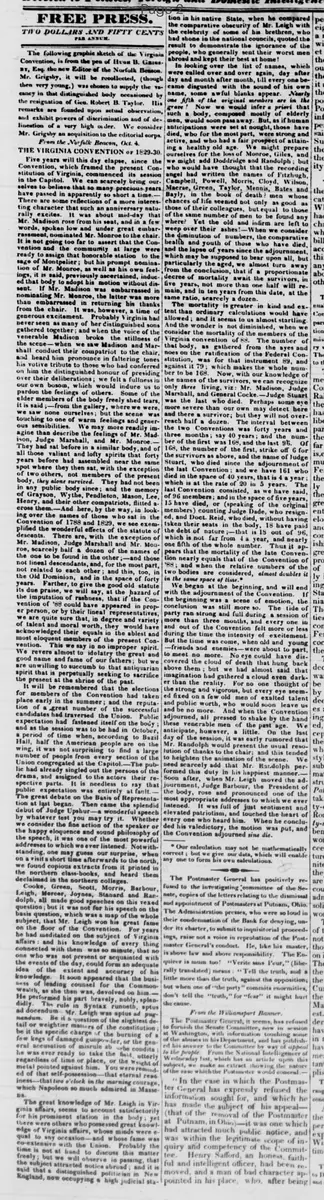
THE PRESS.
The following graphic sketch of the Virginia Convention, is from the pen of Hugh B. Grigsby, Esq. the new Editor of the Norfolk Beacon. Mr. Grigsby, it will be recollected, (though then very young.) was chosen to supply the vacancy in that distinguished body occasioned by the resignation of Gen. Robert B. Taylor. His remarks are founded upon actual observation, and exhibit powers of discrimination and of delineation of a very high order. We consider Mr. Grigsby an acquisition to the editorial corps.
From the Norfolk Beacon, Oct. 4.
THE VIRGINIA CONVENTION of 1829-30.
Five years will this day elapse, since the Convention, which framed the present Constitution of Virginia, commenced its session in the Capitol. We can scarcely bring ourselves to believe that so many precious years have passed in apparently so short a time.— There are some reflections of a more interesting character that such an anniversary naturally excites. It was about mid-day that Mr. Madison rose from his seat, and in a few words, spoken low and under great embarrassment, nominated Mr. Monroe to the chair. It is not going too far to assert that the Convention and the community at large were ready to assign that honorable station to the sage of Montpelier; but his prompt nomination of Mr. Monroe, as well as his own feelings, it is said, previously ascertained, induced that body to adopt his motion without dissent. If Mr. Madison was embarrassed in nominating Mr. Monroe, the latter was more than embarrassed in returning his thanks from the chair. It was, however, a time of generous excitement. Probably Virginia had never seen as many of her distinguished sons gathered together; and when the voice of the venerable Madison broke the stillness of the scene—when we saw Madison and Marshall conduct their compatriot to the chair, and heard him pronounce in faltering tones his votive tribute to those who had conferred on him the distinguished honour of presiding over their deliberations; we felt a fullness in our own bosom, which would induce us to pardon the feelings of others. Some of the elder members of the body freely shed tears, it is said;—from the gallery, where we were, we saw none ourselves; but the scene was touching to one of warm feelings and generous sensibilities. We may more readily imagine than describe the feelings of Mr. Madison, Judge Marshall, and Mr. Monroe.— They had sat before in a similar body, and of all those valiant and lofty spirits that forty years before had assembled near the same spot where they then sat, with the exception of two others, not members of the present body, they alone survived. They had not been in any public body since; and the memory of Grayson, Wythe, Pendleton, Mason, Lee, Henry, and their other compatriots, flitted across them.—And here, by the way, in looking over the names of those who sat in the Convention of 1788 and 1829, we see exemplified the wonderful effects of the statute of descents. There are, with the exception of Mr. Madison, Judge Marshall and Mr. Monroe, scarcely half a dozen of the names of the one to be found in the other;—and those not lineal descendants, and, for the most part, not related to each other; and this, too, in the Old Dominion, and in the space of forty years. Farther, to give the good old statute its due praise, we will say, at the hazard of the imputation of rashness, that if the Convention of '88 could have appeared in proper person, or by their lineal representatives, we are quite sure that, in degree and variety of talent and moral worth, they would have acknowledged their equals in the ablest and most eloquent members of the present Convention. This we say in no improper spirit. We revere almost to idolatry the great and good name and fame of our fathers; but we are unwilling to succumb to that antiquarian spirit that is perpetually seeking to sacrifice the present at the shrine of the past.
It will be remembered that the elections for members of the Convention had taken place early in the summer; and the reputation of a great number of the successful candidates had traversed the Union. Public expectation had fastened itself on the body; and as the session was to be held in October, a period of time when, according to Basil Hall, half the American people are on the wing, it was not surprising to find a large number of people from every section of the Union congregated at the Capitol.—The public had already singled out the persons of the drama, and assigned to the actors their respective parts. It is needless to say that public expectation was entirely at fault.— The great debate on the Basis of Representation at last began. Then came the splendid debut of Judge Upshur—a wonderful speech by whatever test you may try it. Whether we consider the fine action of the speaker or the happy eloquence and sound philosophy of the speech, it was one of the most powerful addresses to which we ever listened. Notwithstanding, one may guess our surprise, when on a visit a short time afterwards to the north, we found copious extracts from it printed in the northern class-books, and heard them declaimed in the northern colleges. Cooke, Green, Scott, Morris, Barbour, Leigh, Mercer, Joynes, Stanard and Randolph, all made good speeches on this vexed question; but it was not for his speech on the basis question, which was a map of the whole subject, that Mr. Leigh won his great fame on the floor of the Convention. For years he had meditated on the subject of Virginia affairs: and his knowledge of every thing connected with them was so minute, that no one who was not present or acquainted with the events of the day, could form an adequate idea of the extent and accuracy of his knowledge. It soon appeared that the business of leading counsel for the Commonwealth, as she then was, devolved on him.— He performed his part bravely, nobly, splendidly. The rule in Syntax runneth, situs ad docendum—Mr. Leigh was pius ad pugnandum. Be it a question of the slightest detail or weightier matters of the constitution; be it the specific charge of the burning of a few kegs of damaged gun-powder, or the general accusation of misrule ab urbe condita he was ever ready to take the lead, utterly regardless of time or place, or the weight of metal pointed against him. You were reminded of that self-possession—that eternal readiness—that two o'clock in the morning courage, which Napoleon so much admired in Massena.
The great knowledge of Mr. Leigh in Virginia affairs, seems to account satisfactorily for his prominent station in the body: yet there were others who possessed great knowledge of Virginia affairs, whose minds were equal to any occasion—and whose fame was co-extensive with the Union. Probably the time is not at hand to discuss this matter freely; but we will observe in passing, that the subject attracted notice abroad; and it is said that a distinguished politician in New England, now occupying a high judicial station in his native State, when he compared the comparative obscurity of Mr. Leigh with the celebrity of some of his brethren, who had shone in the national councils, quoted the result to demonstrate the ignorance of the people, who generally sent their worst men abroad and kept their best at home!
In looking over the list of names, which were called over and over again, day after day and month after month, till every one became disgusted with the sound of his own name, some awful blanks appear. Nearly one fifth of the original members are in the grave! Now we would infer a priori that such a body, composed mostly of elderly men, would soon pass away. But, as if human anticipations were set at nought, those have died, who for the most part, were strong and active, and who had a fair prospect of attaining a healthy old age. We might prepare ourselves for the loss of Monroe, Giles, and we might add Doddridge and Randolph; but who would have thought that the recording angel had written the names of Fitzhugh, Campbell, Powell, Morris, Cloyd, Wilson, Macrae, Green, Taylor, Mennis, Bates and Bayly, in the book of death? men whose chances of life seemed not only as good as those of their colleagues, but equal to those of the same number of men to be found anywhere? Yet the old and infirm are left to weep over their ashes!—When we consider the diminution of numbers, the comparative health and youth of those who have died, and the lapse of years since the adjournment, which may be supposed to bear upon all, but particularly the aged, we almost turn away from the conclusion, that if a proportionate decree of mortality await the survivors, in five years, not more than one half will remain, and in ten years from this date, at the same ratio, scarcely a dozen.
The mortality is greater in kind and extent than ordinary calculations would have allowed; and it seems to us almost startling. And the wonder is not diminished, when we consider the mortality of the members of the Virginia convention of '88. The number of that body, as gathered from the ayes and noes on the ratification of the Federal Constitution, was for that instrument 89, and against it 79; which makes the whole number to be 168. Now, with our knowledge of the names of the survivors, we can recognize only three living, viz: Mr. Madison, Judge Marshall, and General Cocke.—Judge Stuart was the last who died. Perhaps some eye more severe than our own may detect here and there a survivor; but they will not overreach half a dozen. The interval between the two Conventions was forty years and three months; say 40 years; and the number of the first was 168, and the last 96. Of 168, the number of the first, strike off 6 for the survivors as above, and the name of Judge Stuart, who died since the adjournment of the last Convention; and we have 161 who died in the space of 40 years, that is 4 a year; which is at the rate of 20 in 5 years. The last Convention consisted, as we have said, of 96 members; and in the space of five years, 15 have died, or (speaking of the original members) counting Judge Dade, who resigned, and Doct. Reid, who died, without having taken their seats in the body, 18 have paid the debt of nature—that is 18 out of 96, which is not far from 1/5 a year, and nearly one fifth of the whole number. Thus it appears that the mortality of the late Convention nearly equals that of the Convention of '88; and when the relative numbers of the two bodies are considered, almost doubles it in the same space of time.
We began at the beginning, and will end with the adjournment of the Convention. In the beginning was a scene of emotion, the conclusion was still more so. The tide of party ran strong and full during a session of more than three months, and every one in and out of the Convention felt more or less during the time the intensity of excitement. But the time was come, when old and young—friends and enemies—were about to part, to meet no more. No eye could have discovered the cloud of death that hung back above them: but we had almost said that imagination had gathered a cloud even darker than the reality. For no one thought of the strong and vigorous, but every eye seemed fixed on a few old men of exalted talent and public worth, who would soon leave us and be no more. And when the Convention adjourned, all pressed to shake by the hand these venerable men of the past age. We anticipate, however, a little. On the last day of the session, it was early rumored that Mr. Randolph would present the usual resolution of thanks to the chair: and this tended to heighten the animation of the scene. We need scarcely add that Mr. Randolph performed this duty in his happiest manner.— Soon after, when Mr. Leigh moved the adjournment, Judge Barbour, the President of the body, rose and pronounced one of the most appropriate addresses to which we ever listened. It was full of just sentiment and elevated patriotism, and touched the heart of every one who heard him. When he concluded his valedictory, the motion was put, and the Convention adjourned sine die.
Our calculation may not be mathematically correct; but we give our data, which will enable any one to form his own calculations.
The following graphic sketch of the Virginia Convention, is from the pen of Hugh B. Grigsby, Esq. the new Editor of the Norfolk Beacon. Mr. Grigsby, it will be recollected, (though then very young.) was chosen to supply the vacancy in that distinguished body occasioned by the resignation of Gen. Robert B. Taylor. His remarks are founded upon actual observation, and exhibit powers of discrimination and of delineation of a very high order. We consider Mr. Grigsby an acquisition to the editorial corps.
From the Norfolk Beacon, Oct. 4.
THE VIRGINIA CONVENTION of 1829-30.
Five years will this day elapse, since the Convention, which framed the present Constitution of Virginia, commenced its session in the Capitol. We can scarcely bring ourselves to believe that so many precious years have passed in apparently so short a time.— There are some reflections of a more interesting character that such an anniversary naturally excites. It was about mid-day that Mr. Madison rose from his seat, and in a few words, spoken low and under great embarrassment, nominated Mr. Monroe to the chair. It is not going too far to assert that the Convention and the community at large were ready to assign that honorable station to the sage of Montpelier; but his prompt nomination of Mr. Monroe, as well as his own feelings, it is said, previously ascertained, induced that body to adopt his motion without dissent. If Mr. Madison was embarrassed in nominating Mr. Monroe, the latter was more than embarrassed in returning his thanks from the chair. It was, however, a time of generous excitement. Probably Virginia had never seen as many of her distinguished sons gathered together; and when the voice of the venerable Madison broke the stillness of the scene—when we saw Madison and Marshall conduct their compatriot to the chair, and heard him pronounce in faltering tones his votive tribute to those who had conferred on him the distinguished honour of presiding over their deliberations; we felt a fullness in our own bosom, which would induce us to pardon the feelings of others. Some of the elder members of the body freely shed tears, it is said;—from the gallery, where we were, we saw none ourselves; but the scene was touching to one of warm feelings and generous sensibilities. We may more readily imagine than describe the feelings of Mr. Madison, Judge Marshall, and Mr. Monroe.— They had sat before in a similar body, and of all those valiant and lofty spirits that forty years before had assembled near the same spot where they then sat, with the exception of two others, not members of the present body, they alone survived. They had not been in any public body since; and the memory of Grayson, Wythe, Pendleton, Mason, Lee, Henry, and their other compatriots, flitted across them.—And here, by the way, in looking over the names of those who sat in the Convention of 1788 and 1829, we see exemplified the wonderful effects of the statute of descents. There are, with the exception of Mr. Madison, Judge Marshall and Mr. Monroe, scarcely half a dozen of the names of the one to be found in the other;—and those not lineal descendants, and, for the most part, not related to each other; and this, too, in the Old Dominion, and in the space of forty years. Farther, to give the good old statute its due praise, we will say, at the hazard of the imputation of rashness, that if the Convention of '88 could have appeared in proper person, or by their lineal representatives, we are quite sure that, in degree and variety of talent and moral worth, they would have acknowledged their equals in the ablest and most eloquent members of the present Convention. This we say in no improper spirit. We revere almost to idolatry the great and good name and fame of our fathers; but we are unwilling to succumb to that antiquarian spirit that is perpetually seeking to sacrifice the present at the shrine of the past.
It will be remembered that the elections for members of the Convention had taken place early in the summer; and the reputation of a great number of the successful candidates had traversed the Union. Public expectation had fastened itself on the body; and as the session was to be held in October, a period of time when, according to Basil Hall, half the American people are on the wing, it was not surprising to find a large number of people from every section of the Union congregated at the Capitol.—The public had already singled out the persons of the drama, and assigned to the actors their respective parts. It is needless to say that public expectation was entirely at fault.— The great debate on the Basis of Representation at last began. Then came the splendid debut of Judge Upshur—a wonderful speech by whatever test you may try it. Whether we consider the fine action of the speaker or the happy eloquence and sound philosophy of the speech, it was one of the most powerful addresses to which we ever listened. Notwithstanding, one may guess our surprise, when on a visit a short time afterwards to the north, we found copious extracts from it printed in the northern class-books, and heard them declaimed in the northern colleges. Cooke, Green, Scott, Morris, Barbour, Leigh, Mercer, Joynes, Stanard and Randolph, all made good speeches on this vexed question; but it was not for his speech on the basis question, which was a map of the whole subject, that Mr. Leigh won his great fame on the floor of the Convention. For years he had meditated on the subject of Virginia affairs: and his knowledge of every thing connected with them was so minute, that no one who was not present or acquainted with the events of the day, could form an adequate idea of the extent and accuracy of his knowledge. It soon appeared that the business of leading counsel for the Commonwealth, as she then was, devolved on him.— He performed his part bravely, nobly, splendidly. The rule in Syntax runneth, situs ad docendum—Mr. Leigh was pius ad pugnandum. Be it a question of the slightest detail or weightier matters of the constitution; be it the specific charge of the burning of a few kegs of damaged gun-powder, or the general accusation of misrule ab urbe condita he was ever ready to take the lead, utterly regardless of time or place, or the weight of metal pointed against him. You were reminded of that self-possession—that eternal readiness—that two o'clock in the morning courage, which Napoleon so much admired in Massena.
The great knowledge of Mr. Leigh in Virginia affairs, seems to account satisfactorily for his prominent station in the body: yet there were others who possessed great knowledge of Virginia affairs, whose minds were equal to any occasion—and whose fame was co-extensive with the Union. Probably the time is not at hand to discuss this matter freely; but we will observe in passing, that the subject attracted notice abroad; and it is said that a distinguished politician in New England, now occupying a high judicial station in his native State, when he compared the comparative obscurity of Mr. Leigh with the celebrity of some of his brethren, who had shone in the national councils, quoted the result to demonstrate the ignorance of the people, who generally sent their worst men abroad and kept their best at home!
In looking over the list of names, which were called over and over again, day after day and month after month, till every one became disgusted with the sound of his own name, some awful blanks appear. Nearly one fifth of the original members are in the grave! Now we would infer a priori that such a body, composed mostly of elderly men, would soon pass away. But, as if human anticipations were set at nought, those have died, who for the most part, were strong and active, and who had a fair prospect of attaining a healthy old age. We might prepare ourselves for the loss of Monroe, Giles, and we might add Doddridge and Randolph; but who would have thought that the recording angel had written the names of Fitzhugh, Campbell, Powell, Morris, Cloyd, Wilson, Macrae, Green, Taylor, Mennis, Bates and Bayly, in the book of death? men whose chances of life seemed not only as good as those of their colleagues, but equal to those of the same number of men to be found anywhere? Yet the old and infirm are left to weep over their ashes!—When we consider the diminution of numbers, the comparative health and youth of those who have died, and the lapse of years since the adjournment, which may be supposed to bear upon all, but particularly the aged, we almost turn away from the conclusion, that if a proportionate decree of mortality await the survivors, in five years, not more than one half will remain, and in ten years from this date, at the same ratio, scarcely a dozen.
The mortality is greater in kind and extent than ordinary calculations would have allowed; and it seems to us almost startling. And the wonder is not diminished, when we consider the mortality of the members of the Virginia convention of '88. The number of that body, as gathered from the ayes and noes on the ratification of the Federal Constitution, was for that instrument 89, and against it 79; which makes the whole number to be 168. Now, with our knowledge of the names of the survivors, we can recognize only three living, viz: Mr. Madison, Judge Marshall, and General Cocke.—Judge Stuart was the last who died. Perhaps some eye more severe than our own may detect here and there a survivor; but they will not overreach half a dozen. The interval between the two Conventions was forty years and three months; say 40 years; and the number of the first was 168, and the last 96. Of 168, the number of the first, strike off 6 for the survivors as above, and the name of Judge Stuart, who died since the adjournment of the last Convention; and we have 161 who died in the space of 40 years, that is 4 a year; which is at the rate of 20 in 5 years. The last Convention consisted, as we have said, of 96 members; and in the space of five years, 15 have died, or (speaking of the original members) counting Judge Dade, who resigned, and Doct. Reid, who died, without having taken their seats in the body, 18 have paid the debt of nature—that is 18 out of 96, which is not far from 1/5 a year, and nearly one fifth of the whole number. Thus it appears that the mortality of the late Convention nearly equals that of the Convention of '88; and when the relative numbers of the two bodies are considered, almost doubles it in the same space of time.
We began at the beginning, and will end with the adjournment of the Convention. In the beginning was a scene of emotion, the conclusion was still more so. The tide of party ran strong and full during a session of more than three months, and every one in and out of the Convention felt more or less during the time the intensity of excitement. But the time was come, when old and young—friends and enemies—were about to part, to meet no more. No eye could have discovered the cloud of death that hung back above them: but we had almost said that imagination had gathered a cloud even darker than the reality. For no one thought of the strong and vigorous, but every eye seemed fixed on a few old men of exalted talent and public worth, who would soon leave us and be no more. And when the Convention adjourned, all pressed to shake by the hand these venerable men of the past age. We anticipate, however, a little. On the last day of the session, it was early rumored that Mr. Randolph would present the usual resolution of thanks to the chair: and this tended to heighten the animation of the scene. We need scarcely add that Mr. Randolph performed this duty in his happiest manner.— Soon after, when Mr. Leigh moved the adjournment, Judge Barbour, the President of the body, rose and pronounced one of the most appropriate addresses to which we ever listened. It was full of just sentiment and elevated patriotism, and touched the heart of every one who heard him. When he concluded his valedictory, the motion was put, and the Convention adjourned sine die.
Our calculation may not be mathematically correct; but we give our data, which will enable any one to form his own calculations.
What sub-type of article is it?
Historical Event
Biography
Curiosity
What themes does it cover?
Fate Providence
Misfortune
Moral Virtue
What keywords are associated?
Virginia Convention
1829 30
James Madison
James Monroe
John Marshall
Mortality Rate
Historical Reflection
Constitutional Debate
What entities or persons were involved?
Hugh B. Grigsby
James Madison
James Monroe
John Marshall
Judge Upshur
Mr. Leigh
John Randolph
Judge Barbour
Where did it happen?
Capitol, Virginia
Story Details
Key Persons
Hugh B. Grigsby
James Madison
James Monroe
John Marshall
Judge Upshur
Mr. Leigh
John Randolph
Judge Barbour
Location
Capitol, Virginia
Event Date
1829 30
Story Details
Anniversary reflection on the Virginia Convention's opening with Madison nominating Monroe, emotional scenes, key debates and speeches by Upshur and Leigh, praise for members' talents equaling 1788 convention, high mortality among members, and emotional adjournment.