Thank you for visiting SNEWPapers!
Sign up free
Editorial
October 23, 1810
The Enquirer
Richmond, Henrico County, Virginia
What is this article about?
Editorial in The Enquirer discusses U.S. Minister Pinkney's correspondence with British Marquis Wellesley regarding France's revocation of the Berlin and Milan Decrees effective November 1, 1810, and Britain's conditional response to revoke its Orders in Council only if neutral commerce is fully restored. The piece expresses skepticism about British sincerity and historical precedents for blockades.
Clipping
OCR Quality
95%
Excellent
Full Text
The Enquirer.
RICHMOND, OCTOBER 23. 1810
MORE PROMISES!
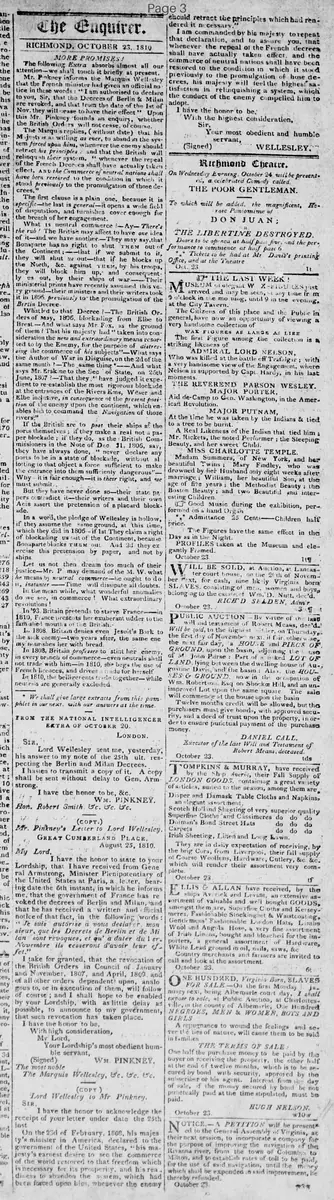
The following Extra absorbs almost all our attention-we shall touch it briefly at present. Mr. Pinkney informs the Marquis Wellesley that the French minister had given an official notice in these words : " I am authorised to declare to you, Sir, that the Decrees of Berlin & Milan are revoked, and that from the date of the 1st of Nov. they will cease to have their effect" Upon this Mr. Pinkney founds an enquiry, whether the British Orders will not cease, of course. The Marquis replies, (without date) that his Majesty is as willing as ever, to abandon the system forced upon him, whenever the enemy should restrict his principles : and that the British will relinquish their system, " whenever the repeal of the French Decrees shall have actually taken effect, And the Commerce of neutral nations shall have been restored to the condition in which it stood previously to the promulgation of those decrees." The first clause is a plain one, because it is specific-the last is general--it opens a wide field of disputation, and furnishes cover enough for the breach of her engagement. What is neutral commerce -Ay- There's the rub! The British may affect to have one idea of it-and we have another.-They may say, that Bonaparte has no right to shut them out of the Continent;-that if we submit to it, they will shut us out-that if he blocks up the North, &c. against Them, by his troops, they will block him up, and consequently us out, by their ships of war.- Their ministerial prints have recently assumed this very ground--their ministers and their writers took it in 1806. previously to the promulgation of the Berlin Decree. What led to that Decree?-The British Orders of may, 1806, blockading from Elbe to Brest -And what says Mr Fox, as the ground of them? That his majesty had " taken into consideration the new and extraordinary means resorted to by the Enemy, for the purpose of distressing the commerce of his subjects"—What says the Author of War in Disguise, on the 2d of the same month ?-The same thing -And what says Mr. Erskine to the Sec 'of State, on 26th June, 1807 ?-That they."have judged it expedient to re-establish the most rigorous blockade at the entrances of the Rivers Ems, Weser ;and Elbe inclusive, in consequence of the present position of the enemy upon the continent, which enables him to command the Navigation of those rivers." If the British are to post their ships at the ports themselves; if they make a real not a paper blockade: if they do, as the British Commissioners in the Note of Dec. 11, 1806, say, they have always done, " never declare any ports to be in a state of blockade, without allotting to that object a force sufficient to make the entrance into them sufficiently dangerous"- Why - it is fair enough-it is their right, and we must submit.. But they have never done so-their state papers contradict it--their writers and their own Acts assert the pretension of a placard blockade. In a word, the pledge of Wellesley is hollow, if they assume the same ground, at this time, which they did in 1806 - if 1st They claim a right of blockading us out of the Continent, because Bonaparte blocks Them out And 2d they exercise this pretension by paper, and not by ships. Let us not then dream too much of their justice--Mr. P may demand of the M. W. what he means by neutral commerce-he ought to do it, instanter -Time will dissipate all doubts. In the mean while, what wonderful anomalies do we see, in commerce! What extraordinary revolutions! In '93. Britain pretends to starve France-in 1810, France presents her exuberant udder to the famished mouths of the British. In 1808, Britain denies even Jesuit's Bark to the sick enemy-two years after, the same enemy nourishes her with bread. In 1803, Britain professes to stint her enemy, in every branch of commerce-even neutrals shall not trade with him-in 1810, she begs the use of French licences, and drives trade for herself In 1810, the belligerents trade together--while neutrals are generally excluded * We shall give large extracts from this pamphlet in our next. with our answers at the time.
FROM THE NATIONAL INTELLIGENCER EXTRA OF OCTOBER 20.
Lord Wellesley sent me, yesterday; his answer to my note of the 25th ult. respecting the Berlin and Milan Decrees. I hasten to transmit a copy of it. A copy shall be sent without delay to Gen. Armstrong I have the honor to be, &c. WM. PINKNEY. Hon. Robert Smith. &c. Gc. Fc.
(copy.)
Mr. Pinkney's Letter to Lord Wellesley.
Great Cumberland Place.
August 25, 1810.
My Lord,
I have the honor to state to your Lordship, that I have received from General Armstrong, Minister Plenipotentiary of the United States at Paris, a letter, bearing date the 6th instant, in which he informs me, that the government of France has revoked the decrees of Berlin and Milan, 'and that he has received a written and official notice of that fact, in the following words : " Je suis autorisé à vous déclarer, monsieur, que les Décrets de Berlin et de Milan sont révoqués, et qu' à dater du 1er Novembre ils cesseront d'avoir leur effet" I take for granted, that the revocation of the British Orders in Council of January and November, 1807, and April, 1809. and of all other orders dependent upon, analogous to, or in execution of them, will follow of course; and I shall hope to be enabled by your Lordship, with as little delay as possible, to announce to my government, that such revocation has taken place. I have the honor to be, With high consideration, My Lord, Your Lordship's most obedient humble servant, (Signed) WM. PINKNEY. The most noble The Marquis Wellesley, &c. c. &c.
(COPY)
Lord Wellesley to Mr Pinkney
SIR.
I have the honor to acknowledge the receipt of your letter under date the 25th inst On the 23d of February, 1808, his majesty's minister in America, declared to the government of the United States, " his majesty's earnest desire to see the commerce of the world restored to that freedom which is necessary for its prosperity, and his readiness to abandon the system, which had been forced upon him, whenever the enemy should retract the principles which had rendered it necessary. I am commanded by his majesty to repeat that declaration, and to assure you, that whenever the repeal of the French decrees shall have actually taken effect, and the commerce of neutral nations shall have been restored to the condition in which it stood previously to the promulgation of those decrees, his majesty will feel the highest satisfaction in relinquishing a system, which the conduct of the enemy compelled him to adopt. I have the honor to be. With the highest consideration, Sir, Your most obedient and humble servant, (Signed) WELLESLEY.
RICHMOND, OCTOBER 23. 1810
MORE PROMISES!
The following Extra absorbs almost all our attention-we shall touch it briefly at present. Mr. Pinkney informs the Marquis Wellesley that the French minister had given an official notice in these words : " I am authorised to declare to you, Sir, that the Decrees of Berlin & Milan are revoked, and that from the date of the 1st of Nov. they will cease to have their effect" Upon this Mr. Pinkney founds an enquiry, whether the British Orders will not cease, of course. The Marquis replies, (without date) that his Majesty is as willing as ever, to abandon the system forced upon him, whenever the enemy should restrict his principles : and that the British will relinquish their system, " whenever the repeal of the French Decrees shall have actually taken effect, And the Commerce of neutral nations shall have been restored to the condition in which it stood previously to the promulgation of those decrees." The first clause is a plain one, because it is specific-the last is general--it opens a wide field of disputation, and furnishes cover enough for the breach of her engagement. What is neutral commerce -Ay- There's the rub! The British may affect to have one idea of it-and we have another.-They may say, that Bonaparte has no right to shut them out of the Continent;-that if we submit to it, they will shut us out-that if he blocks up the North, &c. against Them, by his troops, they will block him up, and consequently us out, by their ships of war.- Their ministerial prints have recently assumed this very ground--their ministers and their writers took it in 1806. previously to the promulgation of the Berlin Decree. What led to that Decree?-The British Orders of may, 1806, blockading from Elbe to Brest -And what says Mr Fox, as the ground of them? That his majesty had " taken into consideration the new and extraordinary means resorted to by the Enemy, for the purpose of distressing the commerce of his subjects"—What says the Author of War in Disguise, on the 2d of the same month ?-The same thing -And what says Mr. Erskine to the Sec 'of State, on 26th June, 1807 ?-That they."have judged it expedient to re-establish the most rigorous blockade at the entrances of the Rivers Ems, Weser ;and Elbe inclusive, in consequence of the present position of the enemy upon the continent, which enables him to command the Navigation of those rivers." If the British are to post their ships at the ports themselves; if they make a real not a paper blockade: if they do, as the British Commissioners in the Note of Dec. 11, 1806, say, they have always done, " never declare any ports to be in a state of blockade, without allotting to that object a force sufficient to make the entrance into them sufficiently dangerous"- Why - it is fair enough-it is their right, and we must submit.. But they have never done so-their state papers contradict it--their writers and their own Acts assert the pretension of a placard blockade. In a word, the pledge of Wellesley is hollow, if they assume the same ground, at this time, which they did in 1806 - if 1st They claim a right of blockading us out of the Continent, because Bonaparte blocks Them out And 2d they exercise this pretension by paper, and not by ships. Let us not then dream too much of their justice--Mr. P may demand of the M. W. what he means by neutral commerce-he ought to do it, instanter -Time will dissipate all doubts. In the mean while, what wonderful anomalies do we see, in commerce! What extraordinary revolutions! In '93. Britain pretends to starve France-in 1810, France presents her exuberant udder to the famished mouths of the British. In 1808, Britain denies even Jesuit's Bark to the sick enemy-two years after, the same enemy nourishes her with bread. In 1803, Britain professes to stint her enemy, in every branch of commerce-even neutrals shall not trade with him-in 1810, she begs the use of French licences, and drives trade for herself In 1810, the belligerents trade together--while neutrals are generally excluded * We shall give large extracts from this pamphlet in our next. with our answers at the time.
FROM THE NATIONAL INTELLIGENCER EXTRA OF OCTOBER 20.
Lord Wellesley sent me, yesterday; his answer to my note of the 25th ult. respecting the Berlin and Milan Decrees. I hasten to transmit a copy of it. A copy shall be sent without delay to Gen. Armstrong I have the honor to be, &c. WM. PINKNEY. Hon. Robert Smith. &c. Gc. Fc.
(copy.)
Mr. Pinkney's Letter to Lord Wellesley.
Great Cumberland Place.
August 25, 1810.
My Lord,
I have the honor to state to your Lordship, that I have received from General Armstrong, Minister Plenipotentiary of the United States at Paris, a letter, bearing date the 6th instant, in which he informs me, that the government of France has revoked the decrees of Berlin and Milan, 'and that he has received a written and official notice of that fact, in the following words : " Je suis autorisé à vous déclarer, monsieur, que les Décrets de Berlin et de Milan sont révoqués, et qu' à dater du 1er Novembre ils cesseront d'avoir leur effet" I take for granted, that the revocation of the British Orders in Council of January and November, 1807, and April, 1809. and of all other orders dependent upon, analogous to, or in execution of them, will follow of course; and I shall hope to be enabled by your Lordship, with as little delay as possible, to announce to my government, that such revocation has taken place. I have the honor to be, With high consideration, My Lord, Your Lordship's most obedient humble servant, (Signed) WM. PINKNEY. The most noble The Marquis Wellesley, &c. c. &c.
(COPY)
Lord Wellesley to Mr Pinkney
SIR.
I have the honor to acknowledge the receipt of your letter under date the 25th inst On the 23d of February, 1808, his majesty's minister in America, declared to the government of the United States, " his majesty's earnest desire to see the commerce of the world restored to that freedom which is necessary for its prosperity, and his readiness to abandon the system, which had been forced upon him, whenever the enemy should retract the principles which had rendered it necessary. I am commanded by his majesty to repeat that declaration, and to assure you, that whenever the repeal of the French decrees shall have actually taken effect, and the commerce of neutral nations shall have been restored to the condition in which it stood previously to the promulgation of those decrees, his majesty will feel the highest satisfaction in relinquishing a system, which the conduct of the enemy compelled him to adopt. I have the honor to be. With the highest consideration, Sir, Your most obedient and humble servant, (Signed) WELLESLEY.
What sub-type of article is it?
Foreign Affairs
Trade Or Commerce
War Or Peace
What keywords are associated?
Berlin Decree
Milan Decree
British Orders
Neutral Commerce
Blockades
Napoleonic Wars
Diplomatic Correspondence
What entities or persons were involved?
Mr. Pinkney
Marquis Wellesley
Bonaparte
Mr. Fox
Mr. Erskine
General Armstrong
British Orders In Council
French Decrees Of Berlin And Milan
Editorial Details
Primary Topic
Skepticism Toward British Response To French Revocation Of Berlin And Milan Decrees
Stance / Tone
Skeptical And Critical Of British Intentions
Key Figures
Mr. Pinkney
Marquis Wellesley
Bonaparte
Mr. Fox
Mr. Erskine
General Armstrong
British Orders In Council
French Decrees Of Berlin And Milan
Key Arguments
French Decrees Revoked Effective November 1, 1810
British Conditional Revocation Depends On Actual Effect And Restoration Of Neutral Commerce
Ambiguity In 'Neutral Commerce' Allows British Evasion
Historical British Blockades Justify Their Actions But Not Paper Blockades
British Pledge Is Hollow If Based On 1806 Precedents
Anomalies In Wartime Commerce Between Belligerents Excluding Neutrals