Thank you for visiting SNEWPapers!
Sign up free
Daily Globe
Saint Paul, Ramsey County, Minnesota
What is this article about?
In post-revolution Texas, tension arises over moving state archives from Austin. Deaf Smith, Houston's deaf scout, delivers a demand and duels Col. Morton, killing him at 100 yards. Houston then successfully removes the archives. (187 characters)
Clipping
OCR Quality
Full Text
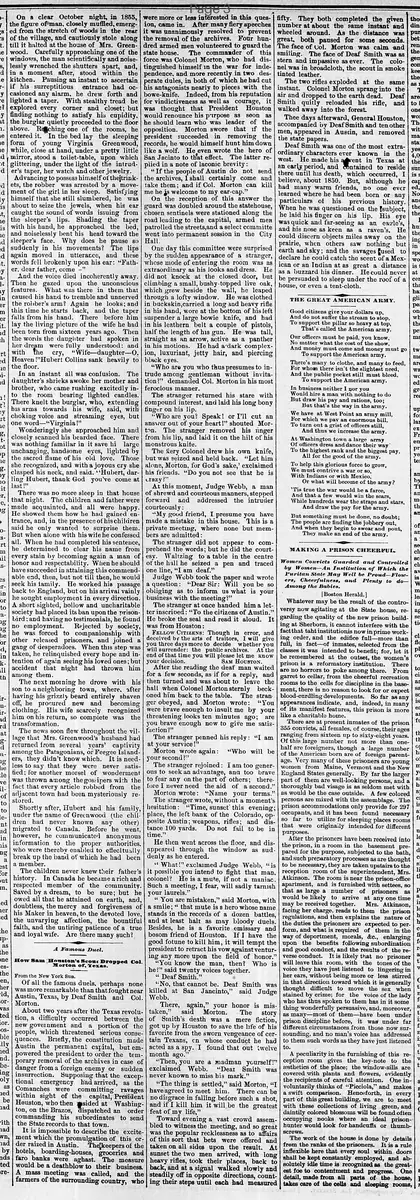
How Sam Houston's Scout Dropped Col. Morton of Texas.
[From the New York Sun.]
Of all the famous duels, perhaps none was more remarkable than that fought near Austin, Texas, by Deaf Smith and Col. Morton.
About two years after the Texas revolution, a difficulty occurred between the new government and a portion of the people, which threatened serious consequences. Briefly, the constitution made Austin the permanent capital, but empowered the president to order the temporary removal of the archives in case of danger from a foreign enemy or sudden insurrection. Supposing that the exceptional emergency had arrived, as the Comanches were committing ravages within sight of the capital, President Houston, who then resided at Washington, on the Brazos, dispatched an order commanding his subordinates to send the State records to that town.
It is impossible to describe the excitement which the promulgation of this order raised in Austin. The keepers of the hotels, boarding-houses, groceries and faro banks were aghast. The measure would be a deathblow to their business. A mass meeting was called, and the farmers of the surrounding country, who were more or less interested in this question, came in. After many fiery speeches it was unanimously resolved to prevent the removal of the archives. Four hundred armed men volunteered to guard the state house. The commander of this force was Colonel Morton, who had distinguished himself in the war for independence, and more recently in two desperate duels, in both of which he had cut his antagonists nearly to pieces with the bowie-knife. Indeed, from his reputation for vindictiveness as well as courage, it was thought that President Houston would renounce his purpose as soon as he should learn who was leader of the opposition. Morton swore that if the president succeeded in removing the records, he would himself hunt him down like a wolf. He even wrote the hero of San Jacinto to that effect. The latter replied in a note of laconic brevity:
"If the people of Austin do not send the archives, I shall certainly come and take them; and if Col. Morton can kill me he is welcome to my ear-cap."
On the reception of this answer the guard was doubled around the statehouse, chosen sentinels were stationed along the road leading to the capital, armed men patrolled the streets, and a select committee went into permanent session in the City Hall.
One day this committee were surprised by the sudden appearance of a stranger, whose mode of entering the room was as extraordinary as his looks and dress. He did not knock at the closed door, but climbing a small, bushy-topped live oak, which grew beside the wall, he leaped through a lofty window. He was clothed in buckskin, carried a long and heavy rifle in his hand, wore at the bottom of his left suspender a large bowie knife, and had in his leathern belt a couple of pistols half the length of his gun. He was tall, straight as an arrow, active as a panther in his motions. He had a dark complexion, luxuriant, jetty hair, and piercing black eyes.
"Who are you who thus presumes to intrude among gentlemen without invitation?" demanded Col. Morton in his most ferocious manner.
The stranger returned his stare with compound interest, and laid his long bony finger on his lip.
"Who are you? Speak! or I'll cut an answer out of your heart!" shouted Morton. The stranger removed his finger from his lip, and laid it on the hilt of his monstrous knife.
The fiery Colonel drew his own knife, but was seized and held back. "Let him alone, Morton, for God's sake," exclaimed his friends. "Do you not see that he is crazy?"
At this moment, Judge Webb, a man of shrewd and courteous manners, stepped forward and addressed the intruder courteously:
"My good friend, I presume you have made a mistake in this house. This is a private meeting, where none but members are admitted."
The stranger did not appear to comprehend the words; but he did the courtesy. Waltzing to a table in the centre of the hall he seized a pen and traced one line, "I am deaf."
Judge Webb took the paper and wrote a question: "Dear Sir: Will you be so obliging as to inform us what is your business with the meeting?"
The stranger at once handed him a letter inscribed: "To the citizens of Austin." He broke the seal and read it aloud. It was from Houston:
Fellow Citizens: Though in error, and deceived by the arts of traitors, I will give you three days more to decide whether you will surrender the public archives. At the end of that time you will please let me know your decision.
SAM HOUSTON.
After the reading the deaf man waited for a few seconds, as if for a reply, and then turned and was about to leave the hall when Colonel Morton sternly beckoned him back to the table. The stranger obeyed, and Morton wrote: "You were brave enough to insult me by your threatening looks ten minutes ago; are you brave enough now to give me satisfaction?"
The stranger penned his reply: "I am at your service!"
Morton wrote again: "Who will be your second?"
The stranger rejoined: I am too generous to seek an advantage, and too brave to fear any on the part of others; therefore I never need the aid of a second.
Morton wrote: "Name your terms."
The stranger wrote, without a moment's hesitation: "Time, sunset this evening; place, the left bank of the Colorado, opposite Austin; weapons, rifles; and distance 100 yards. Do not fail to be in time."
He then went across the floor, and disappeared through the window as suddenly as he entered.
"What!" exclaimed Judge Webb, "is it possible you intend to fight that man, colonel? He is a mute, if not a maniac. Such a meeting, I fear, will sadly tarnish your laurels."
"You are mistaken," said Morton, with a smile; "that mute is a hero whose name stands in the records of a dozen battles, and at least half as many bloody duels. Besides, he is a favorite emissary and bosom friend of Houston. If I have the good fortune to kill him, it will tempt the president to retract his vow against venturing any more upon the field of honor."
"You know the man, then? Who is he?" said twenty voices together.
"Deaf Smith."
"No, that cannot be. Deaf Smith was killed at San Jacinto," said Webb.
"There, again, your honor is mistaken," said Morton. "The story of Smith's death was a mere fiction, got up by Houston to save the life of his favorite from the sworn vengeance of certain Texans, on whose conduct he had acted as a spy. I found that out twelve months ago."
"Then, you are a madman yourself!" exclaimed Webb. "Dear Smith was never known to miss his mark."
"The thing is settled," said Morton, "I have agreed to meet him. There can be no disgrace in falling before such a shot, and if I kill him it will be the greatest feat of my life."
Toward evening a vast crowd assembled to witness the meeting, and so great was the popular recklessness as to affairs of this sort that bets were offered and taken on all sides upon the result. At sunset the two men arrived, with long heavy rifles, took their places, back to back, and at a signal walked slowly and steadily off in opposite directions, counting their steps until each had measured fifty. They both completed the given number at about the same instant and wheeled around. As the distance was great, both paused for some seconds. The face of Col. Morton was calm and smiling. The face of Deaf Smith was as stern and impassive as ever. The colonel was in broadcloth, the scout in smoke tinted leather.
The two rifles exploded at the same instant. Colonel Morton sprang into the air and dropped to the earth dead. Deaf Smith quietly reloaded his rifle, and walked away into the forest.
Three days afterward, General Houston, accompanied by Deaf Smith and ten other men, appeared in Austin, and removed the state papers.
Deaf Smith was one of the most extraordinary characters ever known in the west. He made his advent in Texas at an early period, and continued to reside there until his death, which occurred, I believe, about 1850. But, although he had many warm friends, no one ever learned where he had been born or any particulars of his previous history. When he was questioned on the subject, he laid his finger on his lip. His eye was quick and far-seeing as an eagle's, and his nose as keen as a raven's. He could discern objects miles away on the prairie, when others saw nothing but earth and sky; and the savages used to declare he could catch the scent of a Mexican or an Indian at as great a distance as a buzzard his dinner. He could never be persuaded to sleep under the roof of a house, or even a tent-cloth.
What sub-type of article is it?
What themes does it cover?
What keywords are associated?
What entities or persons were involved?
Where did it happen?
Story Details
Key Persons
Location
Near Austin, Texas; Left Bank Of The Colorado, Opposite Austin
Event Date
About Two Years After The Texas Revolution
Story Details
Deaf Smith, a scout for President Houston, interrupts a meeting in Austin to deliver a letter demanding the surrender of state archives. He challenges Col. Morton to a duel after tension arises. At sunset, they duel with rifles at 100 yards; Deaf Smith kills Morton instantly. Three days later, Houston removes the archives successfully.