Thank you for visiting SNEWPapers!
Sign up free
The Enquirer
Richmond, Henrico County, Virginia
What is this article about?
On March 8, the Committee of Commerce and Manufactures reports to the House of Representatives on a Baltimore memorial complaining that sick or disabled U.S. seamen are denied infirmary benefits post-arrival before reshipment, despite prior payments. It critiques the 1802 fund generalization, reviews prior laws, and proposes adding 5 cents/month to hospital money and repealing the act for permanent relief.
Clipping
OCR Quality
Full Text
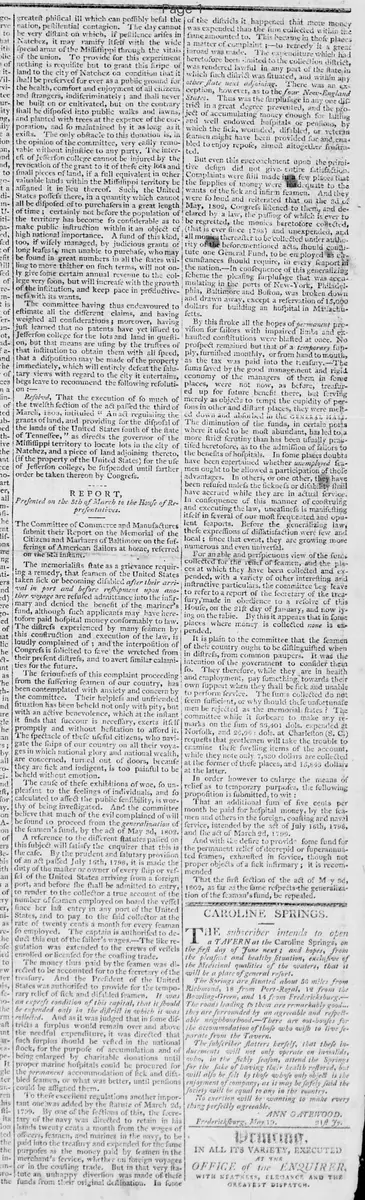
Presented on the 8th of March to the House of Representatives.
The Committee of Commerce and Manufactures submit their Report on the Memorial of the Citizens and Mariners of Baltimore on the sufferings of American Sailors at home, referred on the 8th instant.
The memorialists state as a grievance requiring a remedy, that seamen of the United States taken sick or becoming disabled after their arrival in port and before reshipment upon another voyage are refused admittance into the infirmary and denied the benefit of the mariner's fund, although such applicants may have heretofore paid hospital money conformably to law.
The distress experienced by many seamen by this construction and execution of the law, is loudly complained of : and the interposition of Congress is solicited to save the wretched from their present distress, and to avert similar calamities for the future.
The seriousness of this complaint proceeding from the suffering seamen of our country, has been contemplated with anxiety and concern by the committee. Their helpless and unfriended situation has been beheld not only with pity, but with an active benevolence, which at the instant it finds that succour is necessary, exerts itself promptly and without hesitation to afford it. The spectacle of these useful citizens, who navigate the ships of our country on all their voyages in which national glory and national wealth, are concerned, turned out of doors, because they are sick and indigent, is too painful to be beheld without emotion.
The cause of these exhibitions of woe, so unpleasant to the feelings of individuals, and so calculated to affect the public sensibility, is worthy of being investigated. And the committee believe that much of the evil complained of will be found to proceed from the generalization of these seamen's fund, by the act of May 3d, 1802.
A reference to the different statutes passed on this subject will satisfy the enquirer that this is the case. By the prudent and salutary provision of an act passed July 16th, 1798, it is made the duty of the master or owner of every ship or vessel of the United States arriving from a foreign port, and before she shall be admitted to entry, to render to the collector a true account of the number of seamen employed on board the vessel since her last entry in any port of the United States, and to pay to the said collector at the rate of twenty cents a month for every seaman so employed. The captain is authorised to deduct this out of the sailor's wages. - The like regulation was extended to the crews of vessels enrolled or licensed for the coasting trade.
The money thus paid by the seamen was directed to be accounted for to the secretary of the treasury. And the President of the United States was authorised to provide for the temporary relief of sick and disabled seamen. It was an express condition of this capital, that it should be expended only in the district in which it was collected. And as it was judged that in some districts a surplus would remain over and above the needful expenditure, it was directed that such surplus should be vested in the national stock, for the purpose of accumulation and of being enlarged by charitable donations until proper marine hospitals could be procured for the permanent accommodation of sick and disabled seamen, or what was better, until pensions could be assigned them.
To these excellent regulations another important one was added by the statute of March 2d, 1799. By one of the sections of this, the secretary of the navy was directed to retain in his hands twenty cents a month from the wages of officers, seamen, and marines in the navy, to be paid into the treasury and expended for the same purposes as the money paid by seamen in the merchant's service, whether on foreign voyages or in the coasting trade. But in that very statute an unhappy diversion was made of these funds from their original destination. In some of the districts it happened that more money was expended than the sum collected within the same amounted to. This became in those places a matter of complaint ;-to remedy it a great inroad was made. The expenditure which had heretofore been limited to the collection district, was rendered lawful in any part of the state in which such district was situated, and within any other state next adjoining. There was an exception, however, as to the four New-England States. Thus was the surplusage in any one district in a great degree prevented, and the project of accumulating money enough for lasting and well endowed hospitals or pensions, by which the sick, wounded, disabled, or veteran seamen might have been provided for and enabled to enjoy repose, almost altogether frustrated.
But even this encroachment upon the primitive design did not give entire satisfaction. Complaints were still made in a few places that the supplies of money were inadequate to the wants of the sick and infirm seamen. And they were so loud and reiterated that on the 3d of May, 1802, Congress listened to them, and declared by a law, the passing of which is ever to be regretted, the monies heretofore collected, (that is ever since 1798) and unexpended, and all monies thereafter to be collected under authority of the beforementioned acts, should constitute one General Fund, to be employed as circumstances should require, in every seaport in the nation.--In consequence of this generalizing scheme the pleasing surplusage that was accumulating in the ports of New-York, Philadelphia, Baltimore and Boston, was broken down and drawn away, except a reservation of 15,000 dollars for building an hospital in Massachusetts.
By this stroke all the hopes of permanent provision for sailors with impaired limbs and exhausted constitutions were blasted at once. No prospect remained but that of a temporary supply, furnished monthly, or from hand to mouth, as the tax was paid into the treasury.--The sums saved by the good management and rigid economy of the managers of them in some places, were not now, as before, treasured up for future benefit there, but serving merely as objects to tempt the cupidity of persons in other and distant places, they were melted down and absorbed in the General Mass. The diminution of the funds, in certain ports where it used to be most abundant, has led to a more strict scrutiny than has been usually practiced heretofore, as to the admission of sailors to the benefits of hospitals. In some places doubts have been entertained whether unemployed seamen ought to be allowed a participation of those advantages. In others, or one other, they have been refused unless the sickness or disability shall have accrued while they are in actual service. In consequence of this manner of construing and executing the law, uneasiness is manifesting itself in several of our most frequented and opulent seaports. Before the generalizing law, these expressions of dissatisfaction were few and local; since that event, they are growing more numerous and even universal.
For an able and perpicuous view of the sums collected for the relief of seamen, and the places at which they have been collected and expended, with a variety of other interesting and instructive particulars, the committee beg leave to refer to a report of the secretary of the treasury, made in obedience to a resolve of this House, on the 21st day of January, and now lying on the table. By this it appears that in some places where money is collected none is expended.
It is plain to the committee that the seamen of their country ought to be distinguished when in distress, from common paupers. It was the intention of the government to consider them so. They therefore, while they are in health and employment, pay something towards their own support when they shall be sick and unable to perform service. The sums collected do not seem sufficient, or why should these unfortunate men be rejected as the memorial states ? The committee while it forbears to make any remarks on the sum of 33,401 dols. expended at Norfolk, and 26,967 dols. at Charleston (S. C.) requests that gentlemen will take the trouble to examine these swelling items of the account, while they note only 7,890 dollars are collected at the former of these places, and 15,845 dollars at the latter.
In order however to enlarge the means of relief as to temporary purposes, the following proposition is submitted, to wit :
That an additional sum of five cents per month be paid for hospital money, by the seamen and others in the foreign, coasting and naval service, intended by the act of July 16th, 1798, and the act of March 2d. 1799.
And with the desire to provide some fund for the permanent relief of decrepid or superannuated seamen, exhausted in service, though not proper objects of a sick infirmary; it is recommended
That the first section of the act of May 3d, 1802, as far as the same respects-the generalization of the seaman's fund, be repealed.
What sub-type of article is it?
What keywords are associated?
What entities or persons were involved?
Where did it happen?
Domestic News Details
Primary Location
Baltimore
Event Date
8th Of March
Key Persons
Outcome
proposes additional five cents per month for hospital money and repeal of the first section of the act of may 3d, 1802, regarding generalization of the seaman's fund.
Event Details
The Committee of Commerce and Manufactures submits a report on the memorial from Baltimore citizens and mariners complaining that U.S. seamen sick or disabled after port arrival but before reshipment are denied infirmary and mariner's fund benefits despite prior payments. The report reviews laws from 1798, 1799, and 1802, criticizes the generalization of funds leading to stricter admissions and diminished surpluses, and solicits congressional interposition for relief.