Thank you for visiting SNEWPapers!
Sign up free
Alexandria Gazette
Alexandria, Alexandria County, District Of Columbia
What is this article about?
Account of missionary Mr. Kay's experiences in Caffraria, describing the Caffres' debased condition, customs, diet, dwellings, social structure, witchcraft, punishments, and travel methods in Southern Africa.
Clipping
OCR Quality
Full Text
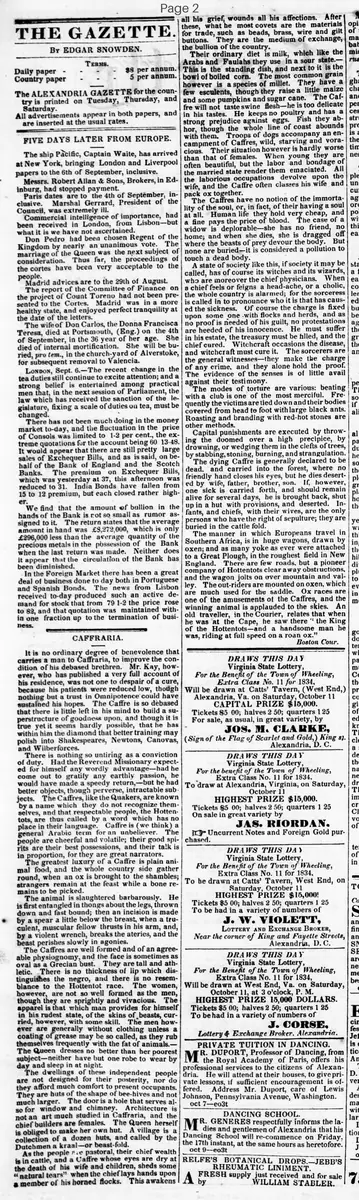
It is no ordinary degree of benevolence that carries a man to Caffraria, to improve the condition of his debased brethren. Mr. Kay, however, who has published a very full account of his residence, was not one to despair of a cure, because his patients were reduced low, though nothing but a trust in Omnipotence could have sustained his hopes. The Caffre is so debased that there is little left in his mind to build a superstructure of goodness upon, and though it is true yet it seems hardly possible, that he has within him the diamond that better training may polish into Shakespeares, Newtons, Canovas, and Wilberforces.
There is nothing so untiring as a conviction of duty. Had the Reverend Missionary expected for himself any worldly advantage—had he come out to gratify any earthly passion, he would have made a speedy return,—but he had better objects, though perverse, intractable subjects. The Caffres, like the Quakers, are known by a name which they do not recognize themselves, and that respectable people, the Hottentots, are thus called by a word which has no place in their language. Caffre is (we think) a general Arabic term for an unbeliever. The people are cheerful and volatile; their good spirits are their best possessions, and their talk is in proportion, for they are great narrators.
The greatest luxury of a Caffre is plain animal food, and the whole country side gather round, when an ox is brought to the shambles; strangers remain at the feast while a bone remains to be picked.
The animal is slaughtered barbarously. He is first entangled in thongs about the legs, thrown down and fast bound; then an incision is made by a spear a little below the breast. when a truculent, muscular fellow thrusts in his arm, and by a violent wrench, breaks the arteries, and the beast perishes slowly in agonies.
The Caffres are well formed and of an agreeable physiognomy, and the face is sometimes as oval as a Grecian bust. They are tall and athletic. There is no thickness of lip which distinguishes the negro, and there is no resemblance to the Hottentot race. The women, however, are not so well formed as the men, though they are sprightly and vivacious. The apparel is that which man provides for himself in his rudest state, of the skins of beasts, carried, however, with some skill. The men however are generally without clothing unless a coating of grease may be so called, as they rub themselves frequently with the fat of animals.—
The Queen dresses no better than her poorest subject—neither have but one robe to wear by day and sleep in at night.
The dwellings of these independent people are not designed for their posterity, nor do they afford much comfort to present occupants. They are huts of the shape of bee-hives and not much larger. The door is a hole that serves also for window and chimney. Architecture is not an art much studied in Caffraria, and the chief builders are females. The Queen herself is obliged to make her own hut. A village is a collection of a dozen huts. and called by the Dutchmen a kraal—or beast-fold.
As the people are pastoral, their chief wealth is in cattle, and a Caffre whose eyes are dry at the death of his wife and children, sheds some "natural tears" when the chief lays hands upon a member of his horned flocks. This awakens all his grief, wounds all his affections. After these, what he most covets are the materials for trade, such as beads, brass, wire and gilt buttons. They are the medium of exchange, the bullion of the country.
Their ordinary diet is milk, which like the Arabs and Faulahs they use in a sour state.— This is the standing dish, and next to it is the bowl of boiled corn." The most common grain however is a species of millet. They have a few esculents, though they raise a little maize and some pumpkins and sugar cane. The Caffre will not taste swine flesh—he is too delicate in his tastes. He keeps no poultry and has a strong prejudice against eggs. Fish they abhor, though the whole line of coast abounds with them. Troops of dogs accompany an encampment of Caffres, wild, starving and voracious. Their situation however is hardly worse than that of females. When young they are often beautiful, but the labor and bondage of the married state render them emaciated. All the laborious occupations devolve upon the wife, and the Caffre often classes his wife and pack ox together.
The Caffres have no notion of the immortality of the soul, or, in fact, of their having a soul at all. Human life they hold very cheap, and a fine pays the price of blood. The case of a widow is deplorable—she has no friend, no home; and when she dies, she is dragged off where the beasts of prey devour the body. But none are buried—it is considered a pollution to touch a dead body.
A state of society like this, if society it may be called, has of course its witches and its wizards, who are moreover the chief physicians. When a chief feels or feigns a head-ache, or a cholic, the whole country is alarmed; for the sorceress is called in to pronounce who it is that has caused the sickness. Of course the charge is fixed upon some one —with flocks and herds, and as no proof is needed of his guilt, no protestations are heeded of his innocence. He must suffer in his estate, the treasury must be filled, and the chief cured. Witchcraft occasions the disease, and witchcraft must cure it. The sorcerers are the general witnesses—they make the charge of any crime, and they alone hold the proof. The evidence of the senses is of little avail against their testimony.
The modes of torture are various: beating with a club is one of the most merciful. Frequently the victims are tied down and their bodies covered from head to foot with large black ants. Roasting and branding with red-hot stones are other methods.
Capital punishments are executed by throwing the doomed over a high precipice, by drowning, or wedging them in the clefts of trees, by stabbing, stoning, burning, and strangulation.
The dying Caffre is generally declared to be dead. and carried into the forest, where no friendly hand closes his eyes, but he dies deserted by wife, father, brother, son. If, however, one sick is carried forth, and should remain alive for several days, he is brought back, shut up in a hut with provisions, and deserted.
Infants, and chiefs, with their wives, are the only persons who have the right of sepulture; they are buried in the cattle fold.
The manner in which Europeans travel in Southern Africa, is in huge wagons, drawn by oxen; and as many yoke as ever were attached to a Great Plough, in the roughest field in New England. There are few roads. but a pioneer company of Hottentots clear a way obstructions, and the wagon jolts on over mountain and valley. The out-riders are mounted on oxen, which are much used for the saddle. Ox races are one of the amusements of the Caffres, and the winning animal is applauded to the skies.
An old traveller, in the Courier, relates that when he was at the Cape, he saw there "the King of the Hottentots—and a handsome man he was, riding at full speed on a roan ox."
What sub-type of article is it?
What keywords are associated?
What entities or persons were involved?
Where did it happen?
Foreign News Details
Primary Location
Caffraria
Key Persons
Event Details
Mr. Kay, a Reverend Missionary, resided in Caffraria to improve the condition of the debased Caffres through benevolence and trust in Omnipotence. The text describes Caffre society: their name origin, cheerful nature, barbarous animal slaughter, physical appearance, minimal apparel, beehive huts built by females, pastoral wealth in cattle, trade items, sour milk and millet diet, prejudices against certain foods, treatment of women and dogs, lack of belief in soul immortality, cheap human life, witchcraft and sorcery as medicine and justice, various tortures and capital punishments, treatment of the dying and burial practices limited to infants and chiefs, and European travel by ox-drawn wagons in Southern Africa.